Why Did Hadrian Give Back Trajan's Conquests? The Decision That Ended Roman Expansion
October 31, 2026 · 7 min read
Every map of the Roman Empire at its greatest extent shows the same year, 117, and the same shape: a bulge in the east where Armenia, Mesopotamia and a province the Romans called Assyria reach down the Tigris and Euphrates toward the Persian Gulf. The map is accurate for a few months. Trajan had spent the years from 114 conquering that territory, had sailed down to the Gulf and reportedly wished aloud that he were young enough to go on to India, and then had watched the whole conquest revolt behind him. He died on the coast of Cilicia in August 117 on his way home. His successor, named in a letter from the deathbed that the successor's enemies said was forged, gave all of it back within weeks.
That decision is the reason there is a map at all. The year 117 marks the greatest extent because Hadrian decided it would be, and no emperor who followed him seriously reversed the choice for three hundred years. It was the first time in Roman history that the state had said, deliberately and as policy, that it was big enough. It was also the decision that made the Senate hate him for the rest of his life, and it is worth asking why both of those things were true at once.
What Trajan had actually won
The eastern war had been Trajan's own project, undertaken late in a reign that had already produced the conquest of Dacia and the greatest building programme Rome had seen. The pretext was Armenia, where the Parthian king had installed a candidate without asking Rome's leave. Trajan annexed Armenia outright in 114, pushed down into northern Mesopotamia in 115, and took the Parthian capital at Ctesiphon in 116, reaching the head of the Gulf. Three new provinces were declared. Coins were struck with the legend announcing that Armenia and Mesopotamia had been brought under the power of the Roman people.
Then, in 116, almost everything behind him rose. The cities of Mesopotamia expelled or killed their garrisons; the Jewish communities of Cyrene, Egypt and Cyprus were already in open revolt; the Parthians regrouped. Trajan's generals spent the next year retaking what had been taken, and Trajan himself, suffering a stroke, set up a Parthian prince as a client king at Ctesiphon and turned for home. The conquests existed as a declaration and a coinage. On the ground they were a set of besieged garrisons in a country that had not accepted them.
Hadrian was governor of Syria when the news of Trajan's death reached him at Antioch. He had the army of the East, the frontier, and the mess. He also had the view of a man who had spent his career on the Danube and in the East rather than in Rome, and who had watched the eastern war from close enough to see what it was costing.
The case for giving it back
The realist case was strong, and Hadrian's defenders have made it ever since. Mesopotamia was indefensible against Parthia without a permanent commitment of several legions that the empire did not have to spare. The new provinces generated no revenue to speak of and had already shown that they would need reconquering every few years. Holding them meant a standing war with Parthia on the Parthians' own ground, where Roman armies had come to grief before, and the Jewish revolts of 115 to 117 had shown how thin the garrison of the eastern provinces already was. The Danube frontier, which Hadrian knew well, was not quiet either. An emperor who tried to hold Trajan's conquests and the rest of the empire at once would be fighting on two fronts for a decade.
So Hadrian withdrew. Armenia reverted to a client kingdom under Parthian influence, Mesopotamia and Assyria were abandoned, and the Euphrates became the frontier again. He considered giving up Dacia too, according to the single late source for his life, and was talked out of it by friends who pointed out how many Roman settlers were already there. The parallel is instructive: Dacia had gold, a decade of colonisation and a defensible line, and so Dacia stayed. The eastern provinces had none of those things. The decision was not a general retreat. It was a judgement about which conquests could be made to pay and which could not.
He then made the judgement permanent. In 121 he left Rome and spent most of the next twelve years touring the frontiers, and what he built on them tells the story: a timber palisade along the German border, a stone wall eighty Roman miles long across Britain, forts and roads and a frontier ditch in Africa. In 123 a new Parthian war threatened, and Hadrian defused it not with a campaign but by meeting the Parthian king at the Euphrates and talking. The army was not neglected. It was drilled harder than it had been in a generation, and the surviving text of a speech Hadrian gave to a legion on a parade ground in Numidia in 128 shows him criticising their cavalry manoeuvres in detail. But it was drilled for readiness, not conquest. The Roman army was being turned from an instrument for acquiring territory into a garrison for holding it.
Why the Senate could not forgive it
None of this looked like prudence from the Senate House. It looked like surrender, and it looked like something worse.
The immediate cost fell on Trajan's generals. In 118, while Hadrian was still travelling to Rome from the East, four former consuls who had all held high command under Trajan were killed on the Senate's order for an alleged conspiracy. Hadrian swore he had not ordered their deaths, dismissed the praetorian prefect who had, and promised never again to execute a senator without the Senate's judgement. Nobody believed the oath, and the senators spent the next twenty years assuming that the man who had given away Trajan's conquests had also disposed of Trajan's men. Whether that was true is argued in detail in the book; what matters here is that it was believed.
The deeper cost was to the Senate's reason for existing. For six centuries the Roman governing class had defined itself by expansion. Provinces were governed by senators, armies were commanded by senators, triumphs were voted to senators, and the wealth that sustained a senatorial house came, in the end, from the loot and the administration of newly conquered territory. An emperor who said the empire was big enough was telling the Roman aristocracy that its work was done. There would be no more Dacias to govern and no more Mesopotamias to plunder. There would be rescripts, inspections, and a civil service of equestrian secretaries who answered to the emperor alone, and the emperor himself would be in Athens, or on the Nile, or at a villa eighteen miles outside Rome, consulting jurists and Greek professors instead of them.
The Senate's hatred, in other words, was the sound of a governing class being told that history had moved past it. When Hadrian died in 138 the senators tried to annul his acts and refuse him the deification that had become routine for an emperor who died in power. His heir Antoninus had to plead for it in person, and one ancient explanation for Antoninus's title Pius is that he had been dutiful to a dead man the Senate wanted erased.
Was he right?
The verdict of the next three centuries is unambiguous. The emperors who followed Hadrian held the lines he drew, with small adjustments in Scotland and Germany, until the frontiers themselves began to fail in the third century. The two emperors who tried in earnest to do what Trajan had done both proved his point. Septimius Severus retook northern Mesopotamia at the end of the second century and created a province that drained the treasury and provoked a hundred years of war with Persia. Julian marched down the Euphrates in 363 and came back dead. Nobody after Hadrian made the old assumption, that there would always be more, into policy again. Several wanted to. None could.
What the verdict does not do is make Hadrian easier to like. The same mind that could see, alone among its contemporaries, that an empire had limits never found any limit to its own authority over the people around it. The emperor who handed back three provinces also ordered his ninety-year-old brother-in-law to die so that a grandson could not inherit. The far-sightedness and the cruelty were not in tension. They were the same temperament, applied to a map and to a dinner table, and the Romans who knew him had to live with both.
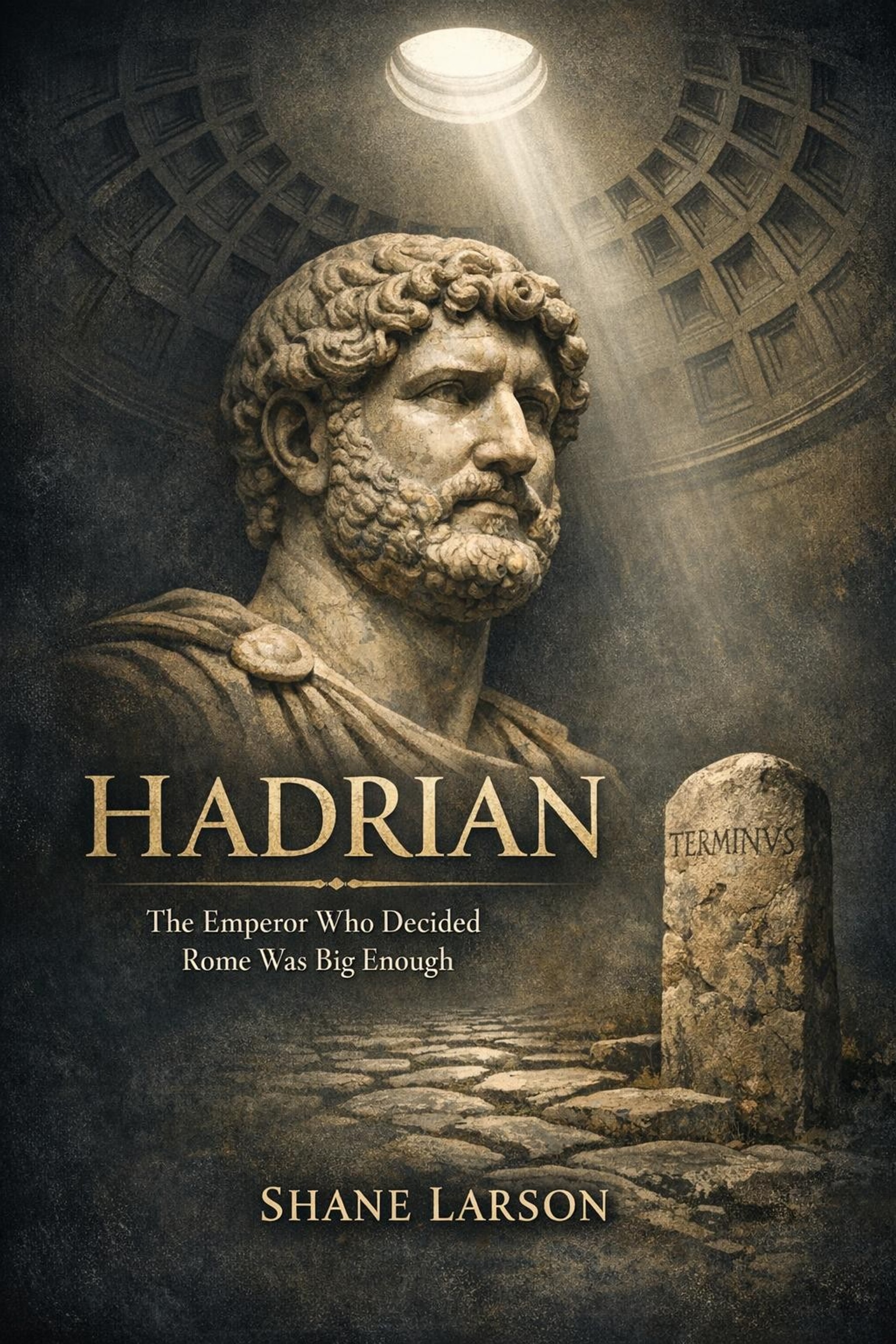
*Hadrian: The Emperor Who Decided Rome Was Big Enough* is a life of the man rather than a history of the reign: the orphan from Spain who became Trajan's ward, the Greek-mad officer, the emperor who spent twelve years inspecting his own empire, the builder of the Pantheon, and the dying man at Baiae who chose Marcus Aurelius two generations ahead. The reign itself is told as policy, in its place in the sequence from Nerva to Commodus, in *The Height of Empire*; the empire on the far side of the Euphrates in *The Parthians*; and the boy Hadrian chose in *Marcus Aurelius*.
New posts and releases, straight to your inbox. No spam, unsubscribe anytime.