The Great Wall Wasn't a Wall — and It Wasn't Built to Keep People Out
October 2, 2026 · 7 min read
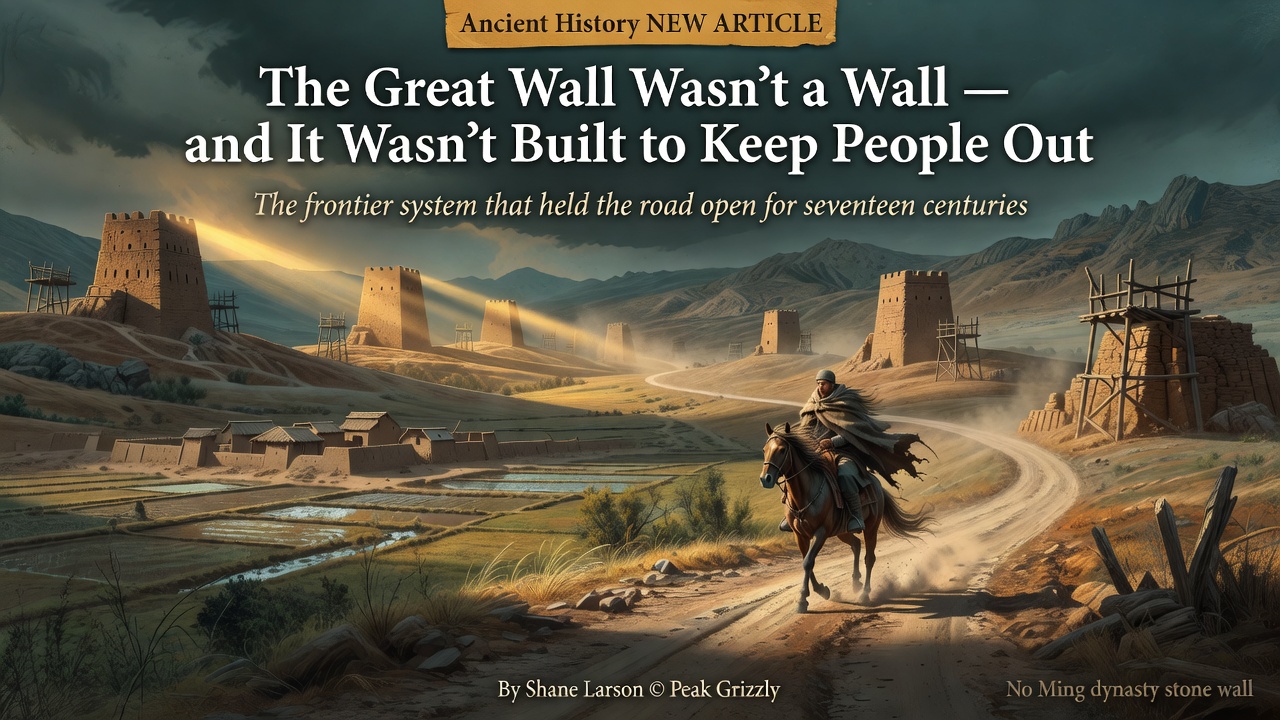
Picture the Great Wall of China and you are almost certainly picturing the wrong wall. The crenellated grey stone snaking over green ridges in every photograph is mostly Ming dynasty work from the sixteenth century AD — a late, lavish renovation of an idea that was already seventeen hundred years old. The original is something stranger and, once you see it clearly, far more interesting: not a barrier at all, but the visible ridge of an integrated frontier machine — beacon towers, garrisons, military farms, postal relays and roads — much of it built of pounded earth, and much of it aimed not at keeping anyone out but at holding a corridor open.
We know this in unusual detail, because the men who ran the system left their paperwork in the desert.
Walls before the empire
The northern walls are older than the Chinese empire itself. In the fourth and third centuries BC, the northern kingdoms of the Warring States period — Zhao, Yan and Qin — each fought mounted raiders along their own frontiers, and each answered with rammed earth: soil pounded between board frames into layered walls that, in the dry north, can outlast stone masonry. King Wuling of Zhao went further. Around 307 BC he ordered his soldiers into trousers and onto horseback in the nomad style, and had to argue his own scandalised court into the change. The kingdoms also built walls against each other, which is worth pausing on: a wall, in this world, was not a border fence. It was a normal instrument of statecraft, something a government did to organise space, control movement and mark administration — closer to infrastructure than to fortification.
When the First Emperor unified China in 221 BC, he inherited all of these walls at once. Around 215 BC he sent his general Meng Tian north with an enormous army — the historian Sima Qian, writing a century later, gives a figure of three hundred thousand men, which modern historians treat as a ceiling rather than a count — to drive the nomads out of the Ordos, the grassland loop inside the great bend of the Yellow River. Meng Tian took the land, and then connected and extended the old kingdom walls into a single system, garrisoned by soldiers and built out by conscripts and convicts. It was less a construction project than a colonisation: walls, roads, forts and forced settlement arriving together.
Then the Qin dynasty collapsed, barely a decade later, and the frontier evaporated. The garrisons marched off into the civil wars, the settlers went home, and the steppe confederacy that had just formed on the far side — the Xiongnu, under their founding ruler Modu — simply rode back into the Ordos. Nothing about that episode makes sense if the wall was a barrier. A wall does not fail because it falls down; this one stood exactly where Meng Tian's men had pounded it. It failed because the state behind it went away. The wall was never the defence. It was the skeleton of a defence, and the flesh was people.
What the wall actually was
The Han dynasty, which won those civil wars, spent sixty years paying the Xiongnu an annual subsidy of silk and grain rather than fighting them. When Emperor Wu reversed that policy in 133 BC and went to war, the wall came back — and the Han version is the one that shows us, in writing, what such a system was actually for.
The best window is a stretch of frontier along the Ejin River, at a place the Han called Juyan. The garrisons there kept their records on strips of wood, and the desert kept the wood. Excavated by the thousand, the Juyan slips are the daily paperwork of a working frontier: duty rosters naming which soldier stood which watch; ration ledgers issuing measured grain to men and horses; equipment inspections counting crossbows and arrows tower by tower; sick lists; leave requests; a soldier's letter home about money. None of it reads like the garrison of a fortress waiting for a siege. It reads like the staff of a sensor network.
The Xiongnu
Because that is what the system was. The wall itself — pounded earth, in the far west sometimes layered with reeds and gravel where there was no good soil — connected a chain of watchtowers running far beyond the wall's own end. Each tower kept signalling equipment, and the signals were coded: fire by night, smoke by day, with the number and arrangement of signals indicating the size and direction of an incursion. A raid seen at one tower could, in principle, be reported down the line faster than the raiders themselves could ride. Behind the towers sat the garrisons; behind the garrisons, state farms — the tuntian, military-agricultural colonies of soldiers and settled convicts who were supposed to make the frontier feed itself instead of consuming grain carted a thousand kilometres from the interior; and threading through all of it, roads and postal relay stations moving orders, reports and official travellers.
An earth wall a few metres high was never going to stop an army, and the Han knew it. What the rammed-earth line actually did was humbler and smarter. It stopped a raiding party from crossing quickly, quietly and anywhere — horses had to be led over or funnelled toward gates, which cost raiders their two real weapons, speed and surprise. It made the return journey, with driven livestock and loot, slower still. And every hour it bought was an hour for the beacon line to summon cavalry to the crossing point. The wall did not keep raiders out. It made raiding unprofitable, which is a different and better thing.
The tell: a wall through empty desert
The clearest proof that the wall was policy rather than barrier is where the Han chose to build it next. After the young general Huo Qubing took the Hexi corridor — the chain of oases running northwest through modern Gansu province — from the Xiongnu in 121 BC, the Han extended the wall system out along it, past Dunhuang, to the Jade Gate and beyond, pushing watchtowers deep into country where almost nobody lived.
As a fence, walling a desert is absurd; there was no farmland behind it to protect and no population to shield. As strategy, it was precise. The corridor was the one practicable route between the steppe to the north and two things the Xiongnu needed: their Qiang allies in the highlands to the south, and the oasis states of the Tarim basin to the west, which paid them tribute. The wall down the Hexi corridor was a blade laid across those connections — a fortified line built to separate allies, not to exclude invaders — and simultaneously a protected road for Han armies, envoys and supply columns heading west. It followed the water, because the road followed the water. It existed to hold the road.
And the road outlived the war. The garrisons, wells and relay stations built as military logistics became the physical spine along which embassies, and then merchants, and then silk in commercial quantities moved west within a generation. When historians say the Silk Road opened in the late second century BC, this is what physically opened: a military corridor with watered stations a day's travel apart, patrolled and provisioned at state expense. The most famous trade route in history began as the supply line of a war — which is why the fortifications and the caravans appear in the record together, and why neither makes sense without the other.
So the familiar question — did the Great Wall work? — is the wrong question, because it imagines a fence. Judged as a fence, the wall failed constantly for two thousand years. Judged as what its builders actually made — an instrument for slowing raiders, moving information, projecting supply and cutting an enemy's alliances apart — it was one of the most effective pieces of infrastructure the ancient world produced. A wall is a thing. This was a system, and the earthwork was just the part of it you can photograph.
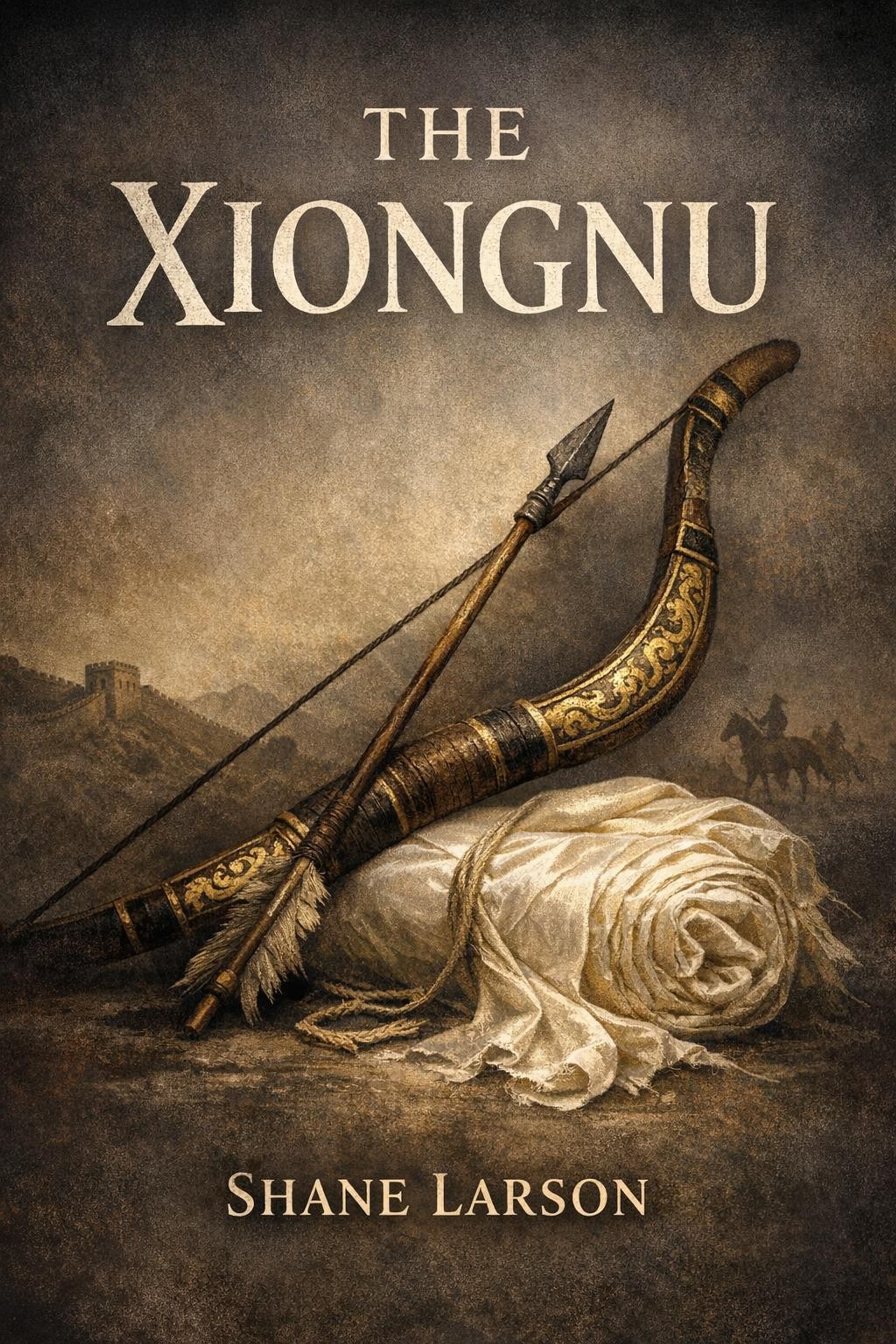
The enemy all of this was aimed at — the steppe confederacy that forced the frontier system into being, took China's subsidies for sixty years, and lost the war that opened the Silk Road — is the subject of my book, The Xiongnu: The Nomad Confederacy That Forced China to Build the Wall. It tells the story from both sides of the line: the first steppe empire in history, reconstructed from its enemy's records and its own excavated graves.
The Xiongnu
New posts and releases, straight to your inbox. No spam, unsubscribe anytime.