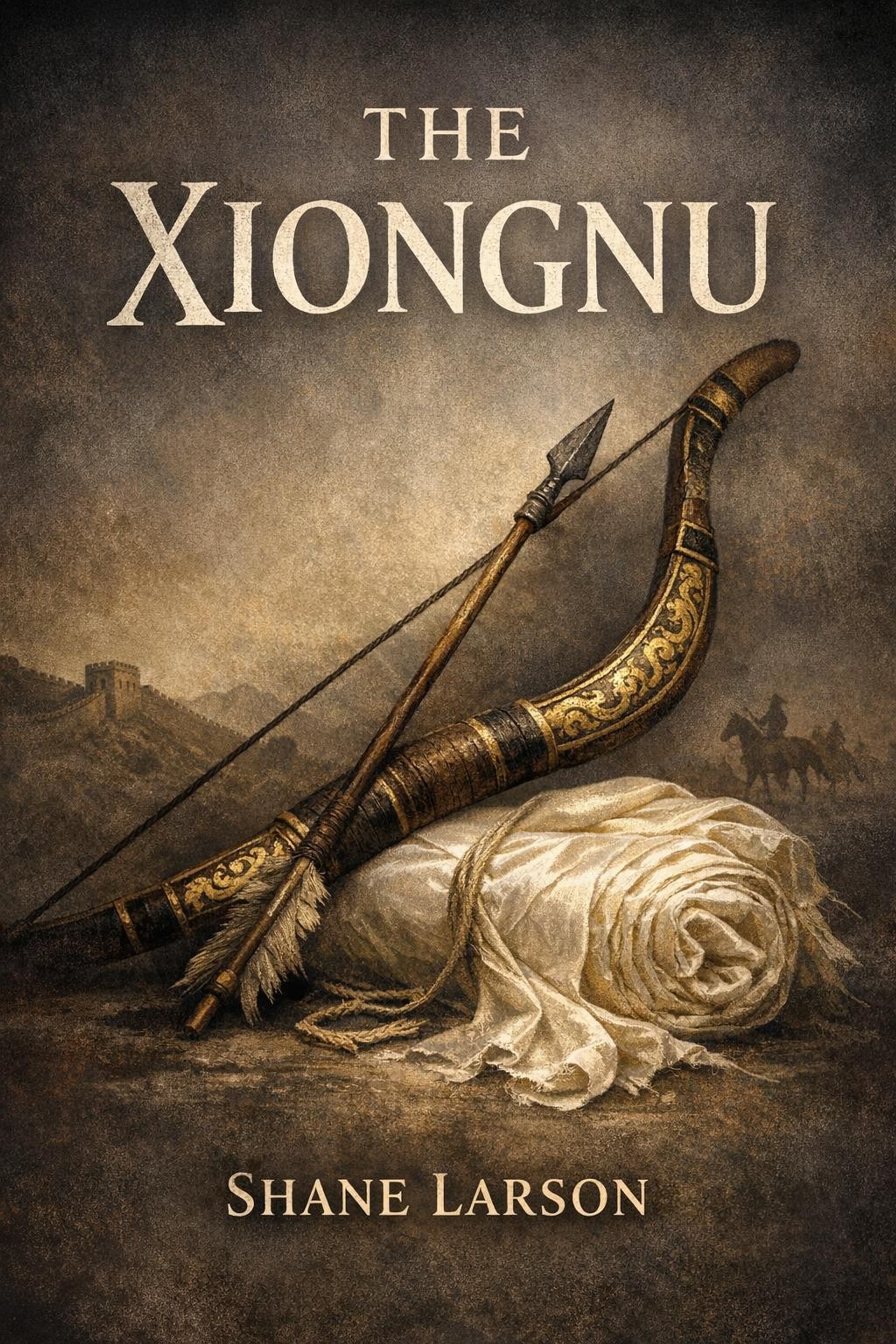
The Xiongnu
The Nomad Confederacy That Forced China to Build the Wall
By Shane Larson
About This Book
In 126 BC a ragged man presented himself at the gates of Chang'an and asked to see the emperor. He had left thirteen years earlier at the head of a hundred-man embassy, sent to find a people called the Yuezhi and propose an alliance. One other man came back with him. He had spent ten of those years as a prisoner of the enemy he had been sent to outflank, had married among his captors, had escaped — and then, instead of running home, had finished the mission.
His name was Zhang Qian, and by the only measure his instructions recognised, he had failed. The Yuezhi, comfortably resettled in Bactria, wanted no part of a revenge war. The report he delivered mattered more than any alliance would have. He described Ferghana, Bactria, Sogdiana and Parthia — cities, coined money, and markets where Chinese cloth was already being sold along routes no official in Chang'an knew existed. The corridor his report opened would carry garrisons, then embassies, then silk: the route we call the Silk Road. It exists because China went looking for allies against one enemy.
That enemy is the subject of this book.
The Xiongnu were the first steppe empire in history. Around 209 BC a leader the Chinese sources call Modu — a hostage prince who trained his bodyguard with signal arrows to shoot at whatever he shot at, and then shot at his father — welded the tribes of the Mongolian steppe into something they had never had: a state, with a decimal army, a ranked nobility and a designated succession. Nine years later that state surrounded the founding emperor of the Han dynasty on a frozen hilltop at Baideng, held him there for seven days, and released him on terms that committed the richest empire on earth to sixty years of annual payments in silk, grain, wine and imperial brides.
That relationship is the spine of this book. A steppe confederacy cannot tax pasture the way an empire taxes farmland; the goods that held Modu's commanders loyal had to come from China, by raid or by treaty. The payments the Han called gifts between kinsmen were, in working terms, the Xiongnu state's operating budget. When Emperor Wu stopped paying and started fighting, in 133 BC, he began a war that lasted most of a century, emptied a famously full treasury, and drove Chinese walls, garrisons and farm colonies west across the Gansu desert to cut the nomads off from their allies.
The Xiongnu left no literature; nearly every narrative fact about them comes from two Chinese historians, Sima Qian and Ban Gu — officials of the empire the Xiongnu raided, writing about an enemy. This book names that problem, gives Sima Qian a chapter of his own, and checks the Chinese account against the one witness that owed the Han court nothing: the excavated tombs and settlements of Mongolia. The "pure nomads" of the chronicles turn out to have kept granaries, smelted iron, and been buried with Han lacquer, Greek-influenced textiles and jade from three thousand kilometres away.
Why I Wrote This
I came to the Xiongnu backwards, through their enemy. Writing The First Emperor, I spent a long chapter on the walls Meng Tian connected across the north, and I kept noticing that I was describing an enormous construction project aimed at people I couldn't name. The wall had a builder, a budget, a labour force, a chapter of its own. The people it faced were "the nomads." That imbalance is baked into the sources — the Xiongnu wrote nothing, and everything we know about them comes from Chinese officials — but it isn't baked into the history. They had a founder, a court, a revenue system, and an ending nobody expects. Once I understood that the Silk Road itself began as a manoeuvre in their war, the book stopped being optional. The wall gets photographed. I wanted the people it was aimed at to get a book.
Frequently Asked Questions
Who was the Great Wall of China actually built to keep out?
The walls the First Emperor connected in the 210s BC, and the much longer Han extensions after them, were aimed at the Xiongnu and their steppe predecessors. But "keep out" is the wrong verb: the wall was the visible ridge of a frontier system — beacon lines, garrisons, military farms and relay roads — built to cut the Xiongnu off from their allies and hold a corridor open. The stone-faced wall in most photographs is largely Ming construction, over a thousand years later, on the strategic template this enemy forced into being.
Did the Xiongnu become the Huns who attacked Rome?
Nobody knows, and this book says so plainly. The names may be connected, a Sogdian letter of about AD 313 uses a Hun-like word for people from the Chinese frontier, and some material and genetic threads do run west — but there is a three-century, four-thousand-kilometre gap in the evidence, and steppe confederacies were coalitions rather than peoples, which makes "are they the same people" a badly formed question. Appendix C lays out the full case for and against.
How did the Silk Road actually start?
As a by-product of this war. Emperor Wu sent Zhang Qian west in about 138 BC to find allies against the Xiongnu, and the garrisons, wells and postal stations the Han built to fight along the line his report opened became the route's physical spine.
Do I need to read The First Emperor or The Scythians before this one?
No — it stands alone. Readers of The First Emperor will finally meet the enemy the wall faced; readers of The Scythians will recognise the steppe pattern the Xiongnu turned into a state.
What language did the Xiongnu speak?
We don't know. No text in their language survives, the few words Chinese sources transcribe have been claimed for Turkic, Mongolic, Iranian and Yeniseian alike, and the confederacy was almost certainly multilingual anyway. Even "Xiongnu" is a Chinese name; their own name for themselves is lost.
If You Liked This, You Might Like
- The First Emperor — the other side of the same frontier — the man who connected the walls, and the empire whose collapse handed the Ordos back to the steppe.
- Attila — the western end of the Hun question: the confederacy that broke against Rome five centuries after the northern Xiongnu rode out of Chinese records.
- The Mongol Storm — the empire that ran the Xiongnu playbook — confederacy, extraction, succession crisis — at continental scale.
The Xiongnu forced the largest state on earth to pay for peace, provoked the wall into its final shape, and started the Silk Road by accident. The Xiongnu: The Nomad Confederacy That Forced China to Build the Wall tells the first steppe empire's story as an empire — from the enemy's records, and against them.
What You'll Learn
- **Modu's founding decade** — how a hostage prince manufactured obedience with a whistling arrow, killed his father, and turned a dozen rival tribes into an empire.
- **Seven days at Baideng** — the encirclement of 200 BC that taught the Han they could not conquer the steppe, and the escape so humiliating the court kept its details secret.
- **The real economics of *heqin*** — what the "peace through kinship" payments cost, who profited, and the defector Zhonghang Yue, who taught the chanyu that dependence on Han silk was the trap.
- **Sima Qian, the hostile witness** — the historian who accepted castration rather than leave his book unfinished, and how to read an enemy's careful account of a people who wrote nothing.
- **The war that emptied a full treasury** — Wei Qing, Huo Qubing, the deep cavalry strikes of the 120s BC, and a scorecard tallied in dead horses and debased currency.
- **The heavenly horses of Ferghana** — the campaign that marched a Han army four thousand kilometres to besiege a city for its breeding stock, building the physical Silk Road as it went.
- **The frontier on paper** — the wooden duty rosters, ration ledgers and soldiers' letters from Juyan that show how the wall system actually ran.
- **Two endings** — a northern half that rode out of recorded history, and a southern half that moved inside the wall and, centuries later, took the empire's capital and its dynastic name.
New Ancient History releases and free chapters — no spam, unsubscribe anytime.