The Two Removals of 1942: How Japan and the United States Both Emptied the Aleutian Islands
November 18, 2026 · 8 min read
In the middle of June 1942, the people of St. Paul Island were told to be on the beach with one suitcase each. The ship waiting offshore was an Army transport, the Delarof, and nobody aboard it could tell them where it was going, because nobody had decided. Some three hundred and fifty miles to the southwest, in the same days, the people of Atka watched the U.S. Navy set fire to their village, church included, so that it would be of no use to the Japanese. The Japanese never came to Atka.
Five hundred miles farther west, at the end of the chain, the Japanese had already come. On June 7 an army battalion had landed at Attu and found a village of about forty-two Unangan people, the Native people the records call Aleuts, plus a white schoolteacher and her husband, who ran the radio. The husband was dead within a day. The teacher was taken to Japan. The village would follow in September.
In a single summer in 1942, two governments emptied every Unangan village in the Pribilofs and along the chain west of Unimak Pass. One was the enemy. The other was their own. The two removals are almost never told together, and when you put them side by side the second one becomes much harder to look at.
The village the enemy took
Attu is the last island in the chain, closer to Kamchatka than to Anchorage. Its one village sat at Chichagof Harbor: about forty-two people, a small Russian Orthodox church, a schoolhouse, and the government radio and weather station run by Charles Foster Jones. His wife, Etta Jones, taught the school.
When Major Matsutoshi Hozumi's battalion came ashore on June 7, there was no fight to speak of. Jones was killed; the accounts of how differ, and it is not settled. Etta Jones was separated from the village and eventually held in Japan with Australian nurses captured at Rabaul. The Attuans stayed on the island under guard through the summer, and in September the Japanese put them on a ship for Hokkaido.
They were held at Otaru, a port city on the island's west coast, in a single building, and put to work digging clay. When Japan's own food supply began to fail, theirs failed first. Beriberi and tuberculosis moved through the house. The count of the dead depends on who is counting and whether the babies born in captivity who did not survive are included, but the sources range from sixteen to twenty-two people, out of a village of about forty-two. Nearly half.
Some twenty-two to twenty-five survivors were liberated in September 1945. Then the United States made a decision that is easy to miss: it did not let them go back to Attu. The island was judged too remote and the community too small to be worth resettling. The survivors were resettled at Atka, several hundred miles east, among people who had their own ruined village to rebuild. Attu has not been lived in since.
The villages their own government took
Now the other removal, which began in the same weeks and involved about twenty times as many people.
After Dutch Harbor was bombed on June 3 and 4, and Attu and Kiska were occupied, the Navy decided that the Native villages of the chain and the Pribilofs had to be cleared. The government's word for what followed was evacuation. The people who lived through it called the places they were sent camps, and the details explain why.
About 881 Unangan were removed from nine communities: St. Paul and St. George in the Pribilofs, and Atka, Nikolski, Akutan, Biorka, Kashega, Makushin, and Unalaska along the chain. The Pribilovians went first, aboard the Delarof, in mid-June; Atka's people were taken off as their village burned; the remaining villages were cleared in July.
Who went was decided by blood. A person with one-eighth or more Aleut ancestry was removed. A white resident of the same village was not required to go. No single written order matches what was actually done; the federal commission that investigated the removal forty years later looked for one and could not find it. The decisions were made in pieces by the Navy, the Fish and Wildlife Service, which ran the Pribilofs as a fur-seal operation, and the Office of Indian Affairs.
No destination had been prepared. The ships sailed first and the question of where to put the people was answered afterward, in Southeast Alaska, with whatever empty buildings could be found. St. Paul's people went into a closed salmon cannery at Funter Bay, on Admiralty Island. St. George's went into an abandoned gold-mine camp across the bay. Atka's went to a derelict herring plant at Killisnoo. The people of Akutan, Biorka, Kashega, Makushin, and Nikolski were held first at the Wrangell Institute boarding school and then moved to a disused Civilian Conservation Corps camp at Ward Lake, near Ketchikan. Unalaska's people went to a cannery at Burnett Inlet.
The Fog War
None of these places had been built for families in winter. The buildings leaked and were not insulated, the water was contaminated by latrines that in some camps emptied onto the beach, and there was little heat, inadequate food, and almost no medical care. Pneumonia, tuberculosis, influenza, and measles went through the camps in succession, and the old and the very young died first. Over the two to three years the people were held, the usual count of the dead runs from 74 to 80. That is roughly one in ten of everyone removed, in conditions that, by most later accounts, were materially worse than those in the camps holding Japanese Americans.
Territorial health officials saw the conditions and reported them. How much Washington knew, and when, is still argued, but the warnings are in the files and were written while people were dying.
One detail says more about the removal than any other. In the summer of 1943, with the camps in their second year, the Fish and Wildlife Service brought the Pribilof men back to St. Paul and St. George to take the annual fur seal harvest. The harvest was federal revenue. When it was done, the men were returned to Funter Bay. The islands were safe enough to work on. They were not, apparently, safe enough to live on. Whatever the removal had been about by then, it was not safety.
What they came home to
The people were allowed to return in 1944 and 1945. Their houses had been looted. American servicemen stationed in the islands had taken furniture, boats, and personal belongings, and had stripped the churches of their icons and vestments. Three villages, Biorka, Kashega, and Makushin, were never reoccupied; their people were resettled at Unalaska or Akutan. Add Attu, and four of the ten Unangan communities that existed in May 1942 did not exist by 1946.
Then nothing was said for close to forty years.
Why it took so long is partly a story about who the Unangan were: few, remote, poor, and without political weight. It is partly that the records sat scattered across three federal agencies with no interest in assembling them. And it is partly that the vehicle for redress did not exist yet. When Congress created the Commission on Wartime Relocation and Internment of Civilians in 1980 to examine the incarceration of Japanese Americans, the Unangan removal was added to its charge. The commission held hearings in Unalaska and Anchorage in 1981, and its report found that the removal had been carried out without adequate planning, that the camps had been unfit to live in, and that officials had known it at the time.
The Aleutian and Pribilof Islands Restitution Act was passed as Title II of the Civil Liberties Act of 1988, the same law that apologized to Japanese Americans. It paid $12,000 to each surviving evacuee, set up a community trust fund, and provided money to restore the stripped churches. Japanese American survivors received $20,000 under Title I, and the difference was noticed at the time. By 1988, forty-six years after the Delarof sailed, many of the people who had boarded her were gone.
Why the two belong together
Histories of the Aleutian campaign usually give the Unangan a paragraph, and histories of the removal give the campaign one. But the Attuans were taken by Japan and the rest of the Unangan were removed by the United States in the same summer, for a reason that came down, in both cases, to Japanese soldiers being on the islands. The battle the Americans fought on Attu in May 1943 was fought over the ruins of the village the Japanese had emptied, and the soldiers who looted the Unangan's houses were the men fighting the fog and the garrison.
Put side by side, the two removals also measure each other. The Attuans' captivity in Otaru is what you expect from a wartime enemy with a failing food supply. The Unangan's years at Funter Bay and Killisnoo are what you do not expect from a government toward its own citizens, and the comparison is the point. A people who had been wards of the federal government since 1867, managed as part of a fur-seal operation and told where to live and when they could leave, could be moved to a cannery with no destination prepared because for seventy years nobody had needed to ask them anything.
The fog that gives the campaign its character hid the Japanese carriers, the American airfields, and a garrison slipping away from Kiska. It also covered this.
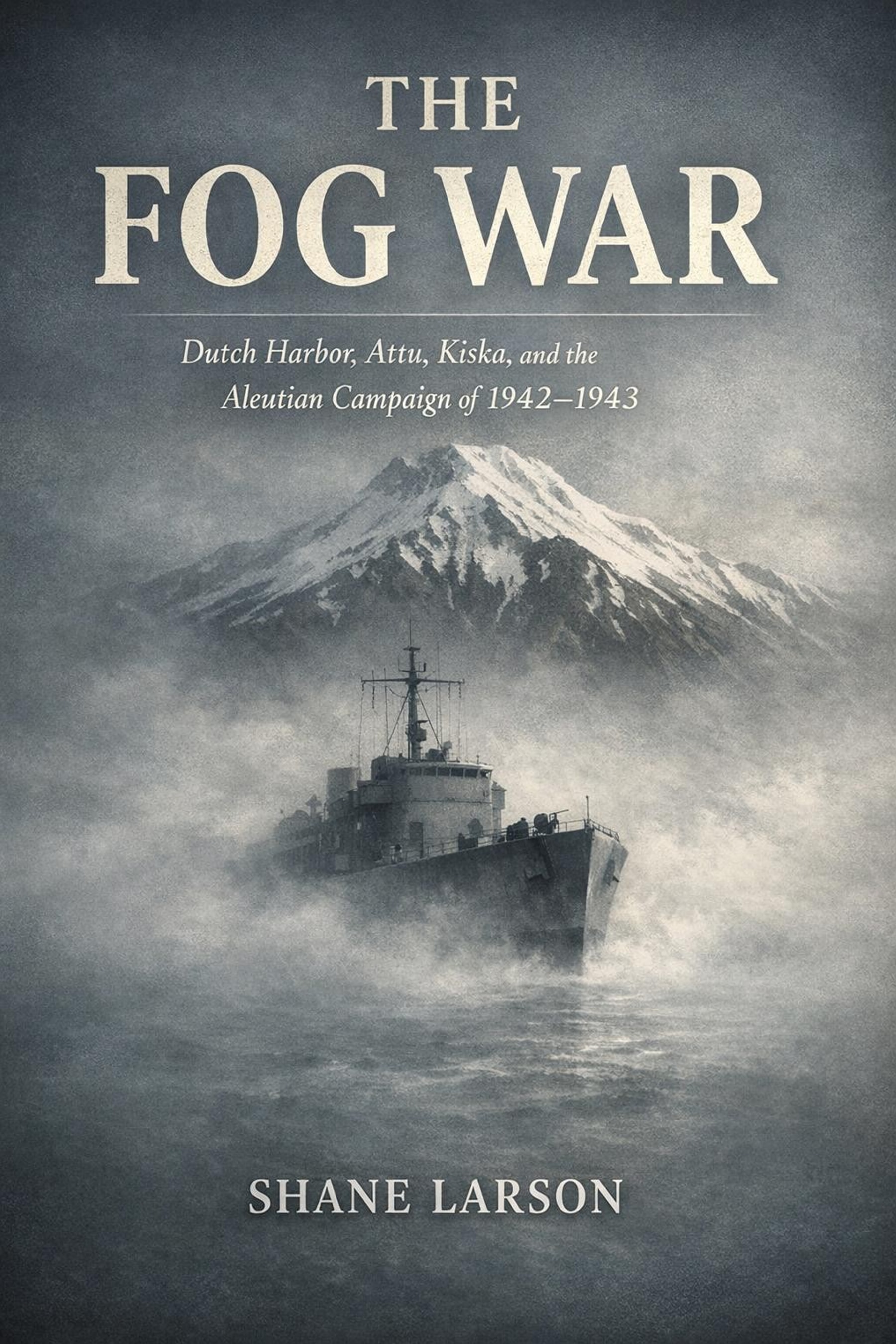
The Fog War: Dutch Harbor, Attu, Kiska, and the Aleutian Campaign of 1942–1943 is available now in ebook and paperback.
The Fog War
New posts and releases, straight to your inbox. No spam, unsubscribe anytime.