Forty Thousand Romans, One Afternoon: How Horse Archers Beat the Legion at Carrhae
October 1, 2026 · 6 min read
In the early summer of 53 BC, seven Roman legions marched into the open plain of northern Mesopotamia and met an army a quarter their size that contained no infantry at all. By nightfall the Roman force had effectively ceased to exist — roughly twenty thousand dead, ten thousand captured, the sacred eagle standards taken, the commander soon to be killed at a parley. Carrhae stands with Cannae and the Teutoburg Forest among the worst defeats Rome ever suffered, and it is the only one of the three that Rome went on to repeat, in milder forms, for the next two and a half centuries.
The usual explanations reach for personality. Crassus was old, greedy, unlucky, misled by a treacherous guide. All of that is in the ancient accounts, and some of it is even true. But personalities do not explain why the same thing kept happening to better generals. Carrhae went the way it did because one army had been engineered, over generations, to beat exactly the other one — and the mechanics of that engineering are worth taking apart.
Two Machines Built for Different Arguments
The Roman legion of the late Republic was the finest close-combat instrument in the ancient world. Everything about it — the big shield, the short sword, the throwing javelins, the rotation of fresh ranks into the fighting line — assumed one thing: that the enemy would accept contact. Every answer the legion had began with the other side coming within about thirty yards.
The army the Parthian commander Surena brought to Carrhae refused, as a matter of doctrine, to ever do that. He fielded roughly nine thousand horse archers and about a thousand cataphracts — armoured riders on armoured horses, carrying a two-handed lance. No spearmen, no swordsmen, no line to charge. The horse archers were not skirmishers who softened an enemy up for the real fight. They were the real fight.
The Bow
The weapon that made this possible was the composite recurve bow, and it deserves more respect than it usually gets. A self bow — a single stave of wood — is limited by the properties of wood. The steppe bow laminated three materials into one spring: a wooden core, horn on the belly to resist compression, and layers of animal sinew on the back to store energy in tension. Building one took months of gluing and seasoning; building a good one took years. The result was a weapon short enough to use from horseback that delivered the power of a much larger bow, with an effective reach well beyond anything a legionary could throw back.
Against unarmoured flesh the arrows were lethal at long range. Against mail and shield they did something arguably worse: they wounded. The Roman accounts of Carrhae dwell on hands pinned to shields and feet nailed to the ground — details chosen for horror, but reflecting something tactically real. An army being wounded faster than it can reply, hour after hour, does not need to be annihilated. It needs only to be kept in the sun and bled.
Behind each bow stood a lifetime of training. A legionary could be drilled to competence in months. A mounted archer who could hit while galloping — including the backward shot over the horse's tail that Romans made proverbial as the "Parthian shot" — had been practising since childhood. That is why no Roman general could answer the horse archer by simply raising his own: the weapon system was not the bow but the man, and the man took twenty years to make.
The Answer the Legion Didn't Have
Face this with heavy infantry and every option is bad. Charge, and the archers trot away, shooting as they go — the Parthian shot was not a stunt but the standard method of punishing pursuit. Stand in open order, and the arrows fall among unshielded flanks. Lock shields into the testudo, and you have protected the ranks by immobilising them — at which point the cataphracts, held in reserve precisely for this moment, have a stationary target that cannot present a fighting line while huddled under its shields. Every defensive posture invited the lance; every aggressive posture invited the arrow. The legion was not out-fought at Carrhae. It was out-designed.
The Parthians
Crassus tried the remaining option: cavalry. His son Publius led about thirteen hundred horsemen, with archers and cohorts in support, to drive the skirmishers off. The horse archers gave way — fluidly, deliberately — until Publius's force was far from the main body, then turned, surrounded it, and destroyed it. The cataphracts finished the survivors on a hillock. Publius's head came back to the Roman line on a spear. The lure-and-envelop was as much a part of the doctrine as the bow itself: an enemy who chases a horse archer is not attacking him, he is accepting an invitation.
The Camel Train
None of this works, though, without the least glamorous element on the field. The standard consolation for infantry facing archers was patience: quivers empty in minutes, and a horse archer with an empty quiver is just a man on a tired horse. Roman officers at Carrhae told their men exactly that — hold formation, the arrows will run out.
They did not run out. Surena had brought them up on a train of a thousand camels, and rotated his squadrons back to refill quivers throughout the day. It sounds like a detail; it decided the battle. Ammunition resupply on the battlefield converted the horse archer from a nuisance with a time limit into a perpetual-motion killing machine. The moment the Romans understood the volleys were not going to stop, the tactical problem became insoluble, and everyone in the square knew it. Logistics, not marksmanship, is the answer to the exam question "why did Carrhae go the way it did."
Why Rome Kept Losing the Same Argument
Rome was not incapable of beating Parthians. A few years later Ventidius Bassus defeated three Parthian armies in succession — by fighting in hill country, holding high ground, and using massed slingers, whose lead bullets outranged the bow and did not care about armour. On terrain that constrained cavalry, with the right missile counter, the trick was repeatable.
The deeper problem was that Rome could not make Parthia fight on that terrain, and could not make victories mean anything. Parthia declined to defend a centre: its kings could lose Mesopotamia, even lose the capital, and simply withdraw toward the Iranian plateau while the invader's supply lines lengthened over ground stripped of fodder, and mounted armies gathered on his flanks. Trajan took Ctesiphon in 116 and lost every gain within eighteen months. The generals of Lucius Verus sacked it in 165 and carried home a plague. Septimius Severus sacked it in 197 and then failed twice before the walls of little Hatra. Five major invasions over four centuries produced, in the end, one modest border province. The horse archer won the battles; distance, water, and the refusal to stand still won the wars. Rome never solved the horse archer because the horse archer was only the visible edge of a state that had organised itself, top to bottom, around not being catchable.
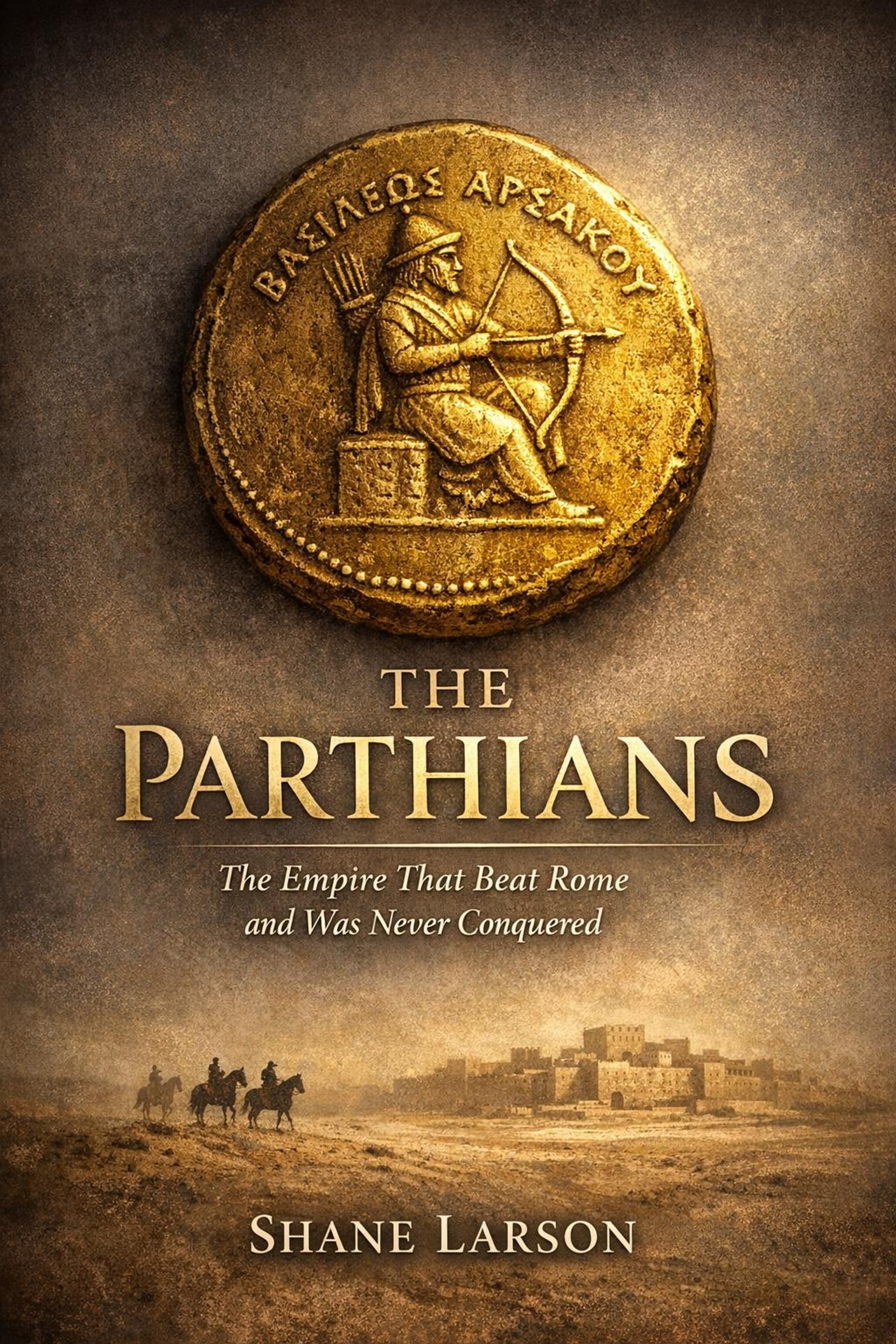
The fall, when it came in AD 224, came from inside — a rebellious vassal, not a legion. Rome's most persistent enemy was never conquered; it is merely almost never written about, because it left no history of its own and its enemies wrote the only surviving version. I spent a book trying to correct that. If you want the whole story — the empire behind the bow, the noble houses that fielded these armies, and all four centuries of the standoff told from the eastern side of the river — it's called The Parthians: The Empire That Beat Rome and Was Never Conquered.
The Parthians
New posts and releases, straight to your inbox. No spam, unsubscribe anytime.