For Four Hundred Years, Buddhist Art Refused to Show the Buddha. Then He Got a Body — Twice
October 3, 2026 · 7 min read
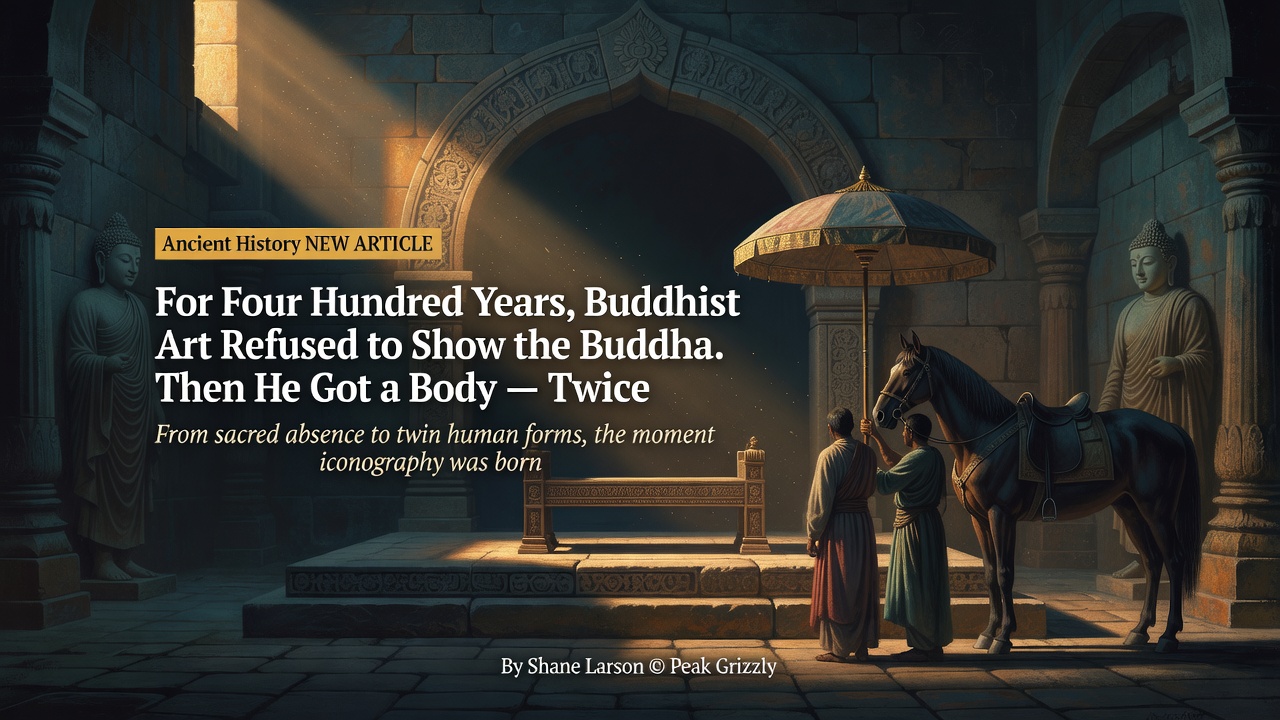
On a carved stone gateway at Sanchi, in central India, a horse leaves a palace at night. Attendant spirits bear up its hooves so they make no sound on the pavement. A groom holds a royal parasol at exactly the height where a rider's head should be. The scene shows one of the most famous episodes in Indian tradition — the night the prince Siddhartha abandoned his father's palace to begin the search that would make him the Buddha — and the sculptors, working around the first century BC, left him out. Not carelessly, and not for lack of skill. They left him out of every scene on the monument.
This was the rule, not an oddity. For roughly four hundred years after the Buddha's death, the art of the communities that revered him represented him by deliberate absence. On the railings of Bharhut and the gateways of Sanchi — the earliest Buddhist narrative sculpture that survives, from the second and first centuries BC — you find an empty throne beneath a tree, attended by kneeling figures; a pair of footprints marked with wheels; a parasol shading nobody; a riderless horse. The crowds in these scenes bow, gesture, and rejoice, and all of it is aimed at a carefully framed piece of empty space.
An absence that worked
The convention was fluent, not primitive. Sculptors who could fill a panel with elephants, musicians, city walls, and individually characterized faces were perfectly capable of carving one more human figure; they chose not to, and their audiences plainly read the empty throne at sight. Why the figure was withheld is a question we cannot actually answer. No surviving early text forbids images. One explanation is doctrinal — that someone who has passed entirely beyond the world cannot honestly be depicted in it. Another, argued seriously in recent decades, is that many of these scenes were never "portraits with a hole" at all, but pictures of worship at the great pilgrimage sites, where the throne, the tree, and the footprints were themselves the objects a visitor came to see. What is certain is that the convention was deliberate, stable, and spread across the subcontinent — and that it held for four centuries.
Then it stopped.
Then a body — twice
The empire under which it stopped is one most readers have never heard of. The Kushans descended from the Yuezhi, nomads driven off the Chinese frontier in the second century BC by the steppe empire of the Xiongnu. The survivors moved some two thousand miles west, took Bactria — the Greek colonial world Alexander's settlers had planted in what is now northern Afghanistan — and then crossed the Hindu Kush into India. By the early second century AD their empire ran from the Oxus River to the Ganges plain, taxing every road worth taxing between Rome's east and Han China's west. They left no chronicle; their second king's very name was unknown until a stone inscription surfaced in 1993. What they did leave was money, sculpture, and a religion transformed.
Under Kushan rule, and in significant part under Kushan patronage, the Buddha acquired a human body — and he acquired it in two places at nearly the same time, in two idioms so different you can tell them apart across a museum gallery.
In Gandhara, the region around the Peshawar basin in the empire's northwest, workshops carved him in grey-green schist: standing and seated figures wrapped in heavy robes with deep, naturalistic folds that behave like a Roman toga, wavy hair gathered into a topknot, faces modeled on a frankly Greco-Roman armature. Set a Gandharan Buddha beside an Apollo and the family resemblance is unmistakable — which is exactly what made this art famous, because a Greek sculptural tradition had been rooted in Bactria for centuries, and something of it plainly survived into these workshops.
Far to the southeast, at Mathura on the Yamuna — the Kushans' Indian capital — workshops produced a completely different Buddha in mottled red sandstone: broad-shouldered, open-eyed, energetic, the robe a thin cloth clinging to the body and leaving one shoulder bare, the whole figure descended from older Indian images of yakshas, the powerful male nature spirits who had guarded Indian gateways for centuries. Nothing about the Mathura Buddha needs Greece to explain it.
The Kushan Empire
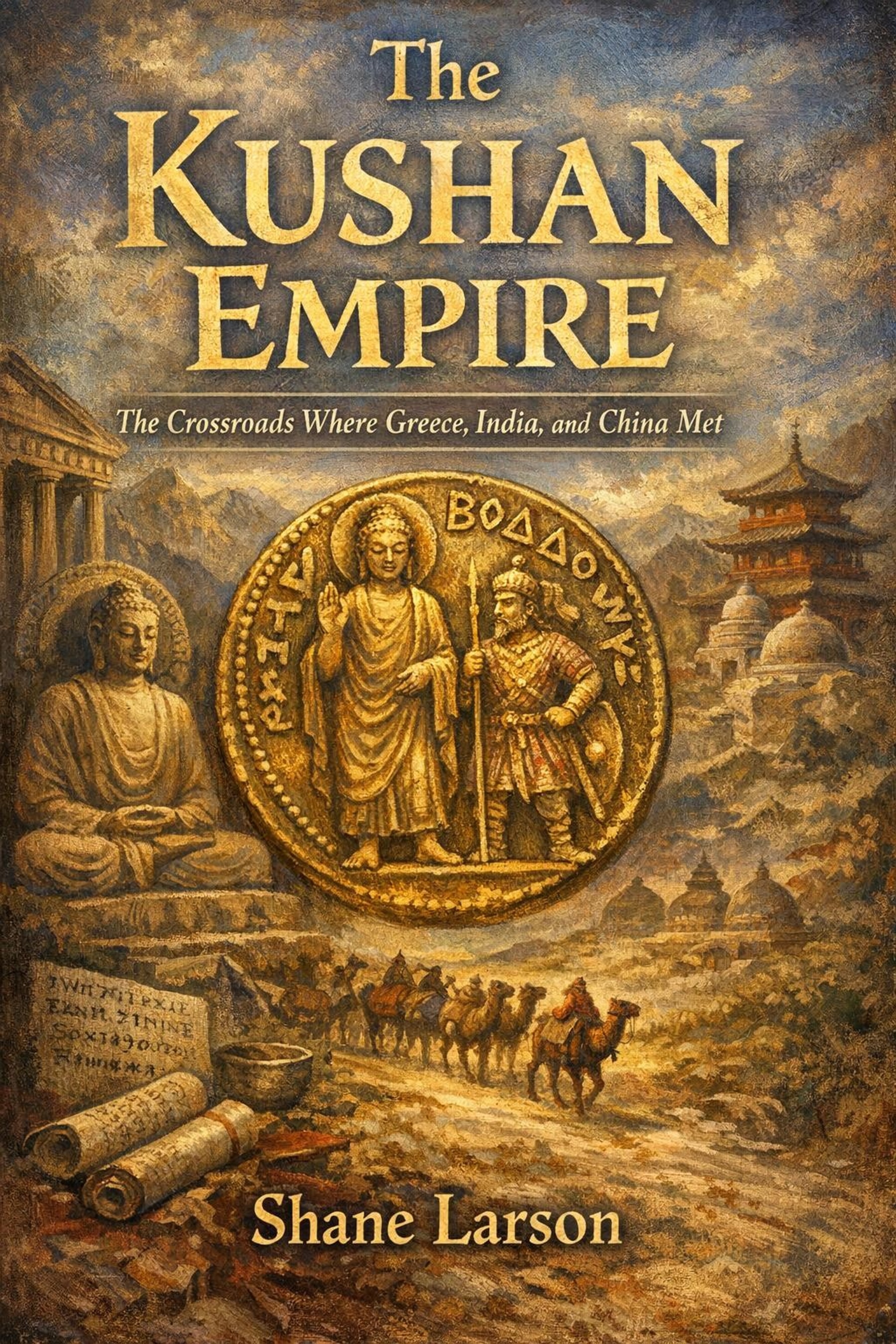
And on the coinage of Kanishka, the empire's greatest king, who came to the throne around AD 127, the new image appears with a patron and an approximate date attached: a standing robed figure, halo behind the head, right hand raised, and beside him in Greek letters a word no Greek ever needed — BODDO. It is among the earliest surviving images of the Buddha that can be tied to a named ruler and a workable year.
A hundred-year argument, with a thumb on the scale
Which workshop did it first? That question has been argued for over a century, and for much of that century the argument was not clean. The French scholar Alfred Foucher made the case in the early 1900s that the Buddha image was born in Gandhara, out of the Greek inheritance — and in the colonial world that published him, the conclusion carried an unmistakable subtext: even India's most famous face was really Europe's gift. In 1927 Ananda Coomaraswamy answered that the Mathura image needed no Greek ancestry at all, and that the Indian line of descent was complete on its own. Both men were doing serious scholarship. Both conclusions also happened to flatter the politics of the people drawing them.
Strip the ideology out and the evidence is genuinely, stubbornly ambiguous. Mathura's advantage is inscriptions: some of its early images carry the regnal years of Kushan kings. But those years are counted in an era whose starting point was itself disputed for a century, so a carved date does not translate cleanly into a calendar date. Gandhara's problem is the opposite: an enormous mass of sculpture, almost none of it usefully dated, ordered mostly by style — and a stylistic sequence can be run in more than one direction. A handful of early objects, like a small gold reliquary from Bimaran with a robed Buddha worked into its side, would settle the matter if their own dates were secure. They are not.
So the honest current position is this: two centers, two idioms, both producing Buddha images at close to the same time, inside one empire whose kings, merchants, and guilds were paying for sacred building on an unprecedented scale — and no way, on present evidence, to say which came first. That is not a dodge. It is a finding, and a more interesting one than either tidy answer. The image of the Buddha was not one invention with one inventor. It emerged, more or less at once, at both ends of a state that had made itself the junction of the Greek, Iranian, Indian, and Chinese worlds — which suggests the decisive ingredient was not any single artistic bloodline but the patronage environment that connected them all.
The face that traveled
What the two workshops fixed between them became one of the most copied templates in human history. The cranial mound (the ushnisha) beneath the topknot; the dot between the brows (the urna); the elongated earlobes, stretched by the heavy jewelry of a prince who had renounced it; the monastic robe; the halo; the small vocabulary of hand gestures — reassurance, meditation, teaching, touching the earth. Learn those conventions in front of a Kushan-era sculpture and you can recognize every one of them in a Chinese cave temple, a Korean bronze, a Japanese hall, a Javanese terrace. Every Buddha image from Kyoto to Borobudur descends, through long chains of copying carried along the trade roads the Kushans taxed, from prototypes made in their territory.
The empire itself had no such afterlife. No narrative history of it survives in any language; no later dynasty claimed its legacy; modern scholars spent a hundred years unable to agree on when Kanishka was crowned. The state vanished almost without record. The face it paid for became the most recognizable image in Asia.
The Kushans are the subject of my book, The Kushan Empire: The Crossroads Where Greece, India, and China Met — the story of the nomad dynasty that held the middle of the Silk Road, reconstructed from its coins, its inscriptions, and its sculpture, because it left no history of its own. The Buddha image is one chapter of that story; the empire that could produce such a thing without apparently finding it strange is the rest.
The Kushan Empire
New posts and releases, straight to your inbox. No spam, unsubscribe anytime.