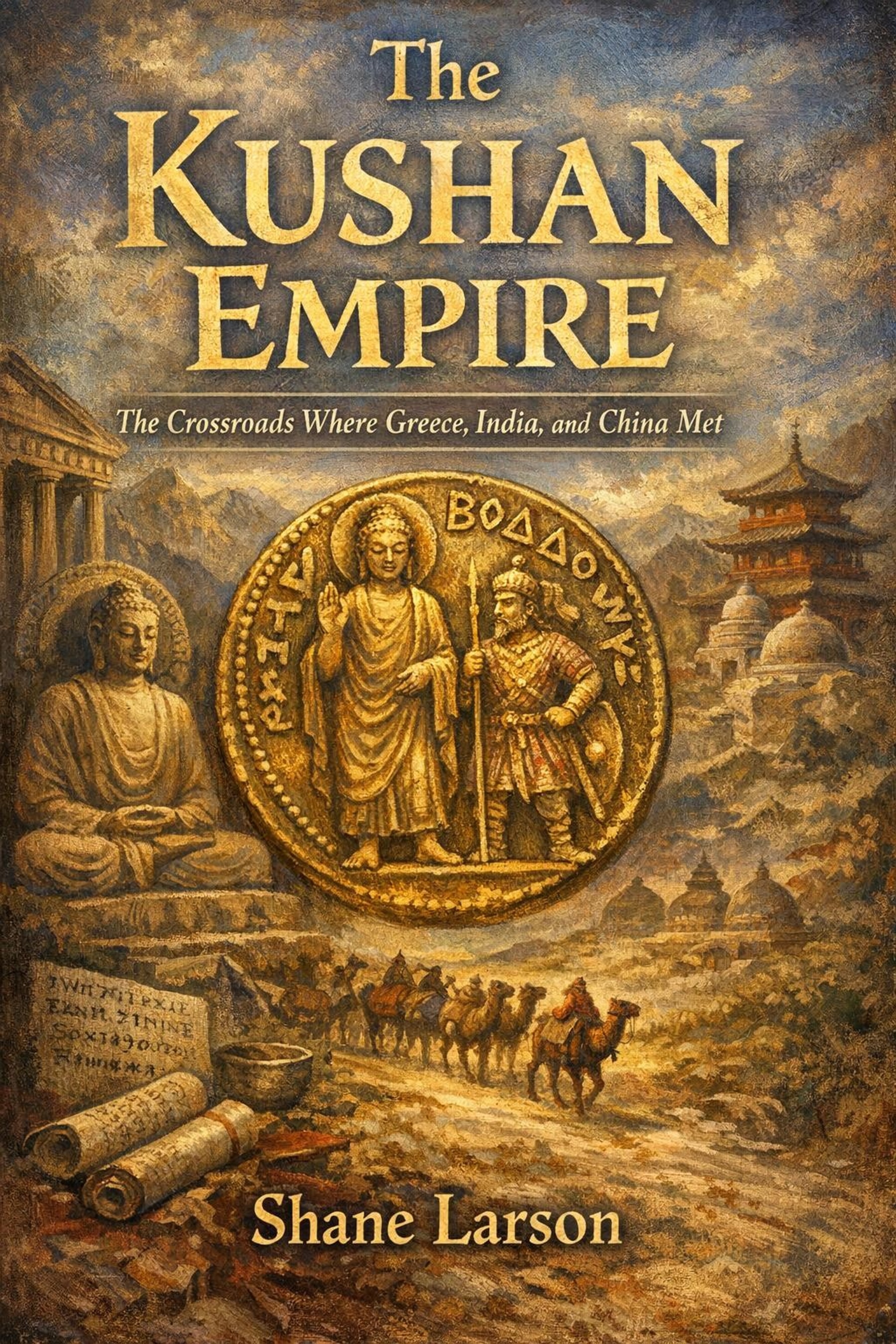
The Kushan Empire
The Crossroads Where Greece, India, and China Met
By Shane Larson
About This Book
In 1993, workmen digging in northern Afghanistan turned up a stone carrying twenty-three lines of text in an Iranian language spelled out in Greek letters — a combination that exists almost nowhere else on earth. Read from photographs, it proved to be a proclamation by an emperor named Kanishka: the cities his authority reached, the gods his sanctuary honored, and the names of his father, grandfather, and great-grandfather. One of those names closed a file that had been open for nineteen centuries. Kanishka's grandfather had struck coins by the hundred thousand, every one carrying a grand Greek title — Soter Megas, Great Savior — and no personal name at all. To modern scholarship he was simply the Nameless King. A single stone in a farmer's field gave him back his name: Vima Takto.
That is what it takes to learn anything at all about the Kushan Empire. No chronicle of it survives in any language. As far as anyone can tell, none was ever written — or none was copied, because no later dynasty had a reason to remember these kings. Everything known about them has been recovered the hard way, from the things they made: coins, inscriptions, sculpture, and the ruins of their cities.
Yet the state behind that silence was among the most consequential of the ancient world. At its height it ran from the deserts beyond the Oxus, at the edge of the Aral Sea's world, down to the Ganges plain in the heart of India — and it held every mountain pass and river crossing worth taxing between Rome's eastern provinces and Han China's western frontier.
The founders were refugees. The Yuezhi had been a prosperous nomad confederacy on the Chinese borderlands until the Xiongnu broke them and drove them west, a migration of two thousand miles that knocked over every people in its path. The land they finally took was Bactria — still a functioning Greek country more than two centuries after Alexander, with a theater, a gymnasium, and Delphic maxims carved in stone beside the Oxus. What the newcomers did next is the heart of the story: they kept nearly everything. The Greek alphabet stayed in the chancellery, the mints kept striking, the local gods kept their altars, and when the borrowed script could not spell the local language, the kings added a letter rather than throw it away.
The empire this produced was cosmopolitan in a way no ancient rival matched — not many peoples ranked beneath a conqueror's culture, but four inheritances held in genuine balance: Greek, Iranian, Indian, and the steppe. Under Kushan patronage, Buddhism changed from a regional monastic discipline into a devotional, image-making religion capable of crossing a continent — and, after roughly four centuries in which Buddhist art had marked the Buddha's presence only by an empty throne or a pair of footprints, workshops at two ends of Kushan territory gave him a human face. Every Buddha image from Kyoto to Java descends from prototypes made on Kushan ground.
Why I Wrote This
Three facts would not leave me alone. For some four hundred years, Buddhist art refused to show the Buddha — and then, under a dynasty of former nomads, he suddenly had a face, and nobody can say which of two cities gave it to him. An emperor's grandfather spent nineteen hundred years known only as the Nameless King, until a stone surfaced in 1993 and identified him. And every Silk Road book I had read told the story from its two ends, Rome and Chang'an, because the ends left libraries — while the empire that held the entire middle, and made the road work as a road, got a paragraph. I wanted the book that stands in the middle and looks both ways. Writing it meant learning to read coins the way numismatists do, and that method turned out to be the best story of all.
Frequently Asked Questions
Did Greek art create the first image of the Buddha?
The honest answer is that nobody knows, and this book does not pretend otherwise. Anthropomorphic Buddha images appear at Gandhara and at Mathura close together in time, the dating evidence for each has real problems, and the old confidence that the Greek-influenced answer must be right rested partly on colonial-era assumptions that have since been dismantled. The book lays out the evidence for both centers and leaves the priority question where the evidence leaves it: open.
When did the Kushan Empire exist, and where was it?
Roughly the first century AD through the third, with a reduced kingdom surviving in India about a century longer after the Sasanians took the western territories. At its height it stretched from the Oxus region of Central Asia across the Hindu Kush to Gandhara, the Punjab, and Mathura on the Ganges plain — the corridor connecting the Iranian, Indian, and Chinese worlds.
Why do different books give different dates for Kanishka?
Because his accession was seriously disputed for over a century, with proposals ranging from AD 78 to AD 278. The book uses the current consensus of about AD 127, resting on an astronomical argument published in 2001, and walks through the whole dispute rather than hiding it.
Is this an academic book, or can a general reader follow it?
It is narrative history written for a general reader, and it assumes no prior knowledge of Central Asia, numismatics, or Buddhism. The scholarly machinery — die studies, hoard evidence, inscription dating — is taught in plain language, because watching the reconstruction happen is half the point.
Does the book cover how Buddhism spread to China?
Yes. A full chapter follows the monasteries along the oasis towns of the Tarim Basin, the merchant economics that funded them, and the first translators in the Han capital — and explains why Buddhism traveled when other Indian religions stayed home.
If You Liked This, You Might Like
- The Mauryan Empire — Ashoka's Buddhist imperial patronage is the precedent the Kushan kings inherited; the first time an empire and Buddhism transformed each other.
- Alexander's Generals — the wars of the successors explain how Bactria became a Greek country in the first place, and why there was a gymnasium on the Oxus for the Yuezhi to find.
- The First Emperor — the making of Qin China is the eastern end of the road the Kushans taxed, and the origin of the frontier pressures that set the Yuezhi moving.
- The Persian Empire — the Achaemenid world supplied the royal title, the fire altars, and most of the gods on Kushan money; this is where that inheritance comes from.
The two ends of the Silk Road left libraries; the middle left objects. This is the history recovered from the objects — an empire read back into existence one coin, one stone, and one storeroom at a time.
What You'll Learn
- A migration that remade Asia. How a defeated confederacy's flight from the Chinese frontier set off a chain reaction — Sakas displaced, Indo-Greek kingdoms broken — that ended in empire.
- The Greek world east of Persia. Ai Khanoum on the Oxus, the Indo-Greek kings, and Menander, whose coins blanket northern India and who appears in Buddhist literature debating a monk on the nature of the self.
- History built from money. What a die study is, what a coin hoard can date, why a weight standard is a diplomatic statement, and how a king-list was assembled for a dynasty that left none.
- The Rabatak stone and the chronology wars. Why scholars placed Kanishka's accession anywhere across two centuries, and how the dispute was finally resolved.
- Thirty gods on the coinage. Iranian, Greek, and Indian deities sharing one empire's money — and what it means that the Buddha appears in gold, and appears so rarely.
- Two workshops, one revolution. Gandhara's Buddhas in Mediterranean drapery and Mathura's in red sandstone, made close in time, and the century-old fight over which came first.
- The road Buddhism took to China. Monasteries strung along the oasis chain, merchant money funding merit, and Lokaksema in Luoyang producing the first Chinese translations of Mahayana texts.
- The sealed storerooms at Begram. Roman glass, Chinese lacquer, and carved Indian ivories found packed together in two rooms — a junction economy caught in a single archaeological moment.
New Ancient History releases and free chapters — no spam, unsubscribe anytime.
More in This Genre
View all →