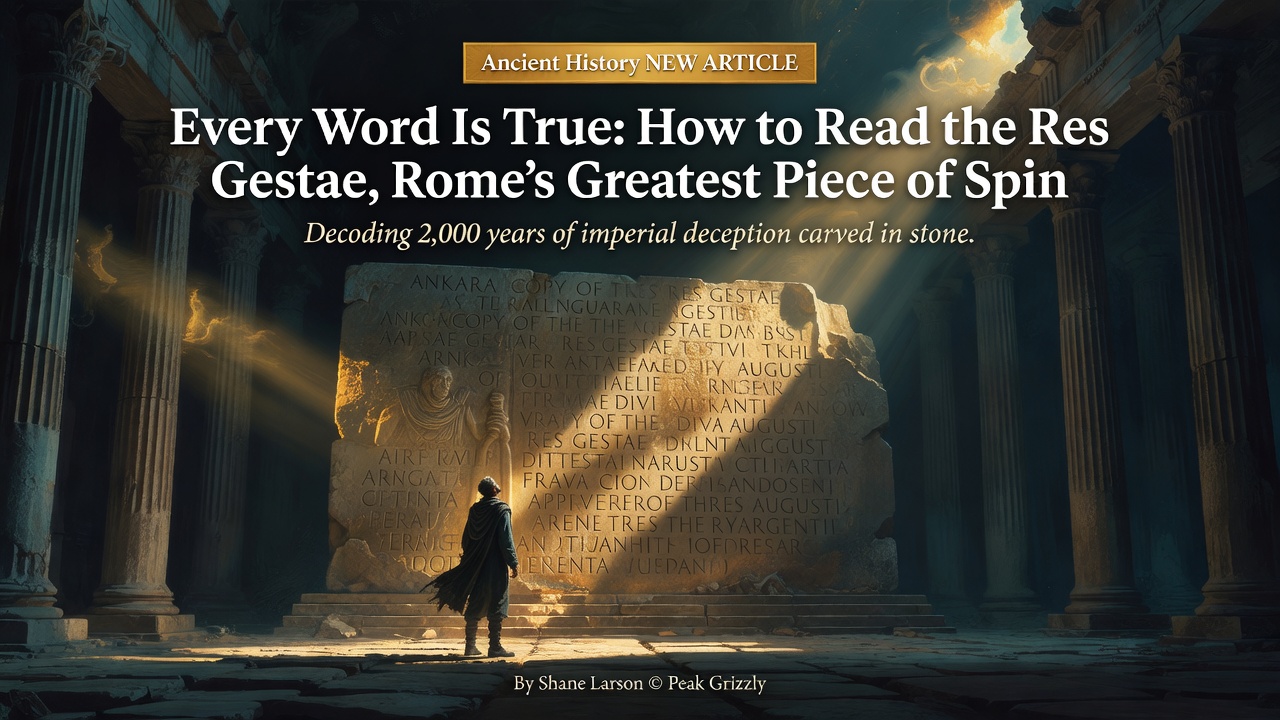
Every Word Is True: How to Read the Res Gestae, Rome's Greatest Piece of Spin
August 13, 2026 · 7 min read
On a temple wall in Ankara, Turkey, there is a first-person account of the career of Augustus, the first Roman emperor, carved in Latin on one wall and Greek on another. He wrote it himself, near the end of his life, for display on bronze pillars outside his tomb in Rome. The bronze was melted down centuries ago; the provincial copies in stone survived, and the Ankara copy — the Monumentum Ancyranum — is nearly complete. Scholars call the text the Res Gestae Divi Augusti, the deeds of the deified Augustus.
Here is the remarkable thing about it. In two thousand years of increasingly suspicious scholarship, nobody has caught the Res Gestae inventing a sum, an office, or a date. The temple restorations it counts are visible in the fabric of Rome. The cash handouts it itemizes are stated in figures precise enough to audit. The offices check against the inscribed consular lists, year by year.
And it is one of the most misleading documents ever written.
That combination — verifiably accurate and systematically deceptive — makes the Res Gestae the best training text the ancient world offers for a skill that has not gone out of date: reading a powerful person's account of themselves. The method is simple to state. Take each claim and put it in one of three bins: true, true and misleading, or absent. The document is short; you can sort the whole thing in an evening. Here is the method applied to four of its most famous claims.
Claim one: "I transferred the state"
In section 34, Augustus describes the moment in 27 BC that later ages would call the restoration of the Republic: rem publicam ex mea potestate in senatus populique Romani arbitrium transtuli — he moved the state out of his own power and into the free judgment of the Senate and people of Rome.
What is true: the handover happened, formally and publicly, in a full Senate. Afterward, the Republic's machinery genuinely ran again. Elections were held annually, and were contested enough to be expensive and occasionally violent — a good sign they were real. The courts sat. The Senate governed provinces and minted coinage. A gold coin of 28 BC shows the program was already being advertised a year earlier: Octavian in civilian dress, seated as a magistrate, with a legend announcing that he had restored laws and rights to the Roman people.
What is implied: that he gave up control.
What is missing: the second half of the transaction. Within days, the Senate handed him a ten-year command over Spain, Gaul, and Syria — the provinces that happened to contain nearly every legion Rome possessed. The "senatorial" provinces that returned to proconsuls chosen by lot were, with an exception or two, unarmed. Every element had a Republican precedent; only the combination was new. The sentence about transferring the state is true. It describes half of an exchange.
Claim two: "No more power than my colleagues"
The next sentence is the most carefully drafted in the document. After that time, Augustus writes, he exceeded everyone in auctoritas — standing, weight, the quality of being deferred to — but held no more potestas, formal legal power, than the colleagues who shared each magistracy with him: potestatis autem nihilo amplius habui quam ceteri qui mihi quoque in magistratu conlegae fuerunt.
What is true: as consul, his legal powers were identical to his fellow consul's, and the consular lists prove the fellow consuls existed.
What is implied: that the constitution was unchanged, and he was simply the most respected man in a functioning republic.
What is missing: everything that ran the empire. Notice the fence built into the Latin: in magistratu — "in each magistracy." After 23 BC, Augustus governed through two instruments that were deliberately not magistracies: the power of a tribune, held for life without the office, and a provincial command legally superior to every governor's. Neither is covered by the sentence, because the sentence was drawn to exclude them. The first claim, about auctoritas, cannot be checked at all — informal influence is unfalsifiable by design. A modern lawyer would admire the craftsmanship. That is not a compliment.
Augustus
Claim three: "I compelled the Parthians"
In 53 BC, Crassus lost seven legionary eagles — the sacred standards that embodied a legion's identity — to Parthia at the disaster of Carrhae. More were lost in 40 and 36 BC. Recovering them was the one military demand the Roman public genuinely, repeatedly made. The Res Gestae reports the outcome: Parthos trium exercituum Romanorum spolia et signa reddere mihi supplicesque amicitiam populi Romani petere coegi — he compelled the Parthians to return the spoils and standards of three Roman armies and to seek Rome's friendship as suppliants.
What is true: three armies' standards, genuinely returned, in 20 BC. The Parthian king did cultivate Roman friendship afterward, and eventually sent four of his own sons to be raised in Rome.
What is implied: a defeated enemy on its knees, returning the loot of a lost war. Supplices literally means those who kneel — and on the coins struck to mark the event, a Parthian kneels forever, holding out a standard. The mint's legend, SIGNIS RECEPTIS, "the standards recovered," was chosen with equal care: recovered, not captured. Defensible to the letter.
What is missing: the fact that no battle was fought. The standards came back through negotiation — a diplomatic deal backed by a show of force in Armenia, with a pretender to the Parthian throne held on Roman soil as leverage. It was excellent statecraft, and it cost zero casualties. The commemoration — a triumphal arch, a temple to Mars the Avenger, coin issues in the millions — presented it as the feat of arms of the age. The one indispensable fact is not denied anywhere. It is simply not there.
Claim four: "All Italy swore, of its own free will"
The civil war against Antony and Cleopatra appears in the document as a national crusade: iuravit in mea verba tota Italia sponte sua — all Italy swore an oath of loyalty to him, of its own accord, and demanded him as leader for the war he won at Actium.
What is true: the oath was real; it became the model for the loyalty oaths that provinces would swear to emperors for centuries.
What is implied: spontaneity. Sponte sua — of its own free will — is the load-bearing phrase.
What is missing: the administration behind the spontaneity. Suetonius preserves a detail Augustus did not: the town of Bononia was formally excused from the oath because of its old ties to Antony's family. An oath with an exemption process is an organized oath. And note who is absent from the war itself: Antony is never named — here or anywhere in the document — which converts a civil war between Romans into a foreign war against an enemy too alien to mention. Neither is Cleopatra.
The deepest bin
Which brings us to the third category, the one that does the heaviest work. The proscriptions of 43 BC — several hundred Roman senators and equestrians posted for death with a price on each head, the act that funded and secured the young Octavian's rise — are not in the Res Gestae. The office that carried them out appears, described as a lawful commission held for ten years; not one of its acts is mentioned. His exiled daughter Julia is not there. The three legions annihilated in Germany in AD 9 are not there, though the document happily counts standards recovered from enemies. It does not count eagles lost.
An absence, unlike a lie, cannot be cross-examined. It never contradicts an inscription or a coin, because it leaves no surface to check. That is why the Res Gestae prefers silence to falsehood at every important juncture: silence holds.
Do it yourself
The Res Gestae takes less than an hour to read, and translations are freely available. Read it once cold, and notice the impression it builds: everything counted, everything lawful, nothing hidden. Then read it again with a timeline of the civil wars open beside it, and sort the claims into the three bins. You will not find a false statement. You will find something better made than falsehood — an arrangement of true statements engineered so that the truths point away from what is missing.
It is a skill worth having. Documents built on this exact pattern — accurate, auditable, and curated into deception — did not go out of production in AD 14.
If you want the full audit — the whole reign read against the evidence, claim by claim — my book Augustus: The Man Who Ended the Republic and Called It Peace (Book Seven of the Rome: From Village to Empire series) spends four hundred pages doing exactly that, from the death lists he omitted to the wall in Ankara where his version still stands.
Augustus
New posts and releases, straight to your inbox. No spam, unsubscribe anytime.