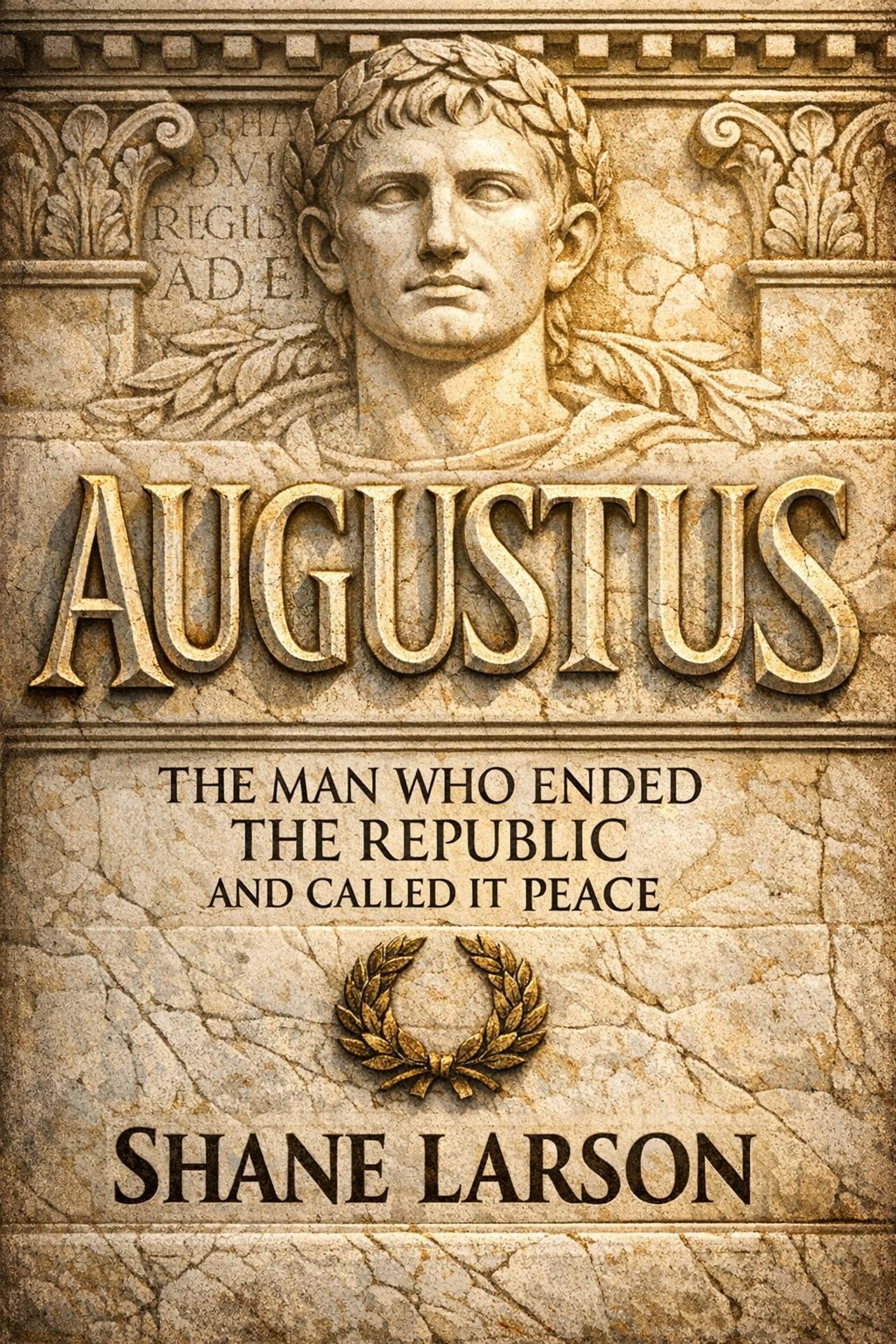
Augustus
The Man Who Ended the Republic and Called It Peace
By Shane Larson · Rome: From Village to Empire (Book 7)
About This Book
After his death in the summer of AD 14, two bronze pillars were set up at the entrance to his tomb, as his will instructed. On them, in the first person, was the account of a life: the army raised at nineteen, the offices held and refused, the 82 temples restored in one year, the money paid to the Roman people, counted down to the sesterce. The man in the tomb had written every word of it himself.
The bronze is long gone, melted down in some later century nobody bothered to record. The text survives because the provinces copied it in stone; the fullest copy is still legible on a temple wall in Ankara, Latin on one side, Greek on the other. Scholars call it the Res Gestae Divi Augusti, and in two thousand years of hostile scholarship nobody has caught it inventing a sum, an office, or a date.
Here is what it does not contain. In November 43 BC, lists went up in the Roman Forum naming several hundred senators and equestrians for death, with cash rewards for killers and death for anyone who gave shelter. Cicero was hunted down on the coast road, his head and hands nailed to the speaker's platform. The edict carried three signatures, and one belonged to a twenty-year-old who would rule the Roman world for over forty years. His account covers those years in full. Of the lists it says nothing at all.
The Argument
This book makes one argument. Augustus's achievement was not military. He was ill or missing at Philippi, nearly drowned twice against Sextus Pompey, and present at Actium in a role nobody has ever defined; his wars were won by Marcus Agrippa.
What he built was rarer than a victory: a monarchy that never had to admit it was one. In January 27 BC he stood in the Senate and formally handed everything back — provinces, armies, powers — and the Senate returned it as a bundle no Roman could object to: a ten-year command whose expiry date never once operated, a tribune's lifelong power without the office, a new name that was a religious adjective, not a title. Every piece was traditional. Only the combination was new, and the combination was everything. Underneath ran the plumbing: Egypt held as personal property, and a new military treasury paying every discharged soldier's pension, converting the army's loyalty from its generals to the man who guaranteed the money.
And the counterweight, stated in the same breath: he reached that settlement across the proscription lists — several hundred Roman citizens posted for death at a price per head, their property confiscated to pay the armies. He was twenty years old, and he signed. Then he wrote the record by which posterity would judge him, and left the lists out.
What's Inside
- An eighteen-year-old student learns that Caesar's will has made him son and heir, and accepts against the advice of everyone who loves him — the one great gamble of a career built on never gambling again.
- The proscriptions treated as what they were: not a conspiracy but a legislated office with posted prices — and, before anything else, a revenue instrument.
- Antony and Cleopatra reconstructed against the winner's propaganda: a capable soldier, and the educated ruler of the richest state in the Mediterranean — not the drunk and the seductress.
- A full chapter on Agrippa — the harbours, the fleets, the battles — and the strangest fact: he never once made a move for himself.
- The settlements of 27 and 23 BC, including the gold coin that forced historians to redate the "restoration of the Republic."
- The Parthian standards: a negotiated handover, no battle fought, commemorated with an arch, a temple, and millions of coins showing a Parthian on his knees — the reign's method in a single case study.
- The marriage laws and the daughter exiled under them; the succession plan that kept dying; three legions lost in a German forest; the quiet end at Nola.
- Three appendices: the Res Gestae section by section, the constitutional machinery, and an honest guide to which parts rest on rock and which on inference.
Why I Wrote This
Every other subject in this series has to be reconstructed from fragments written centuries later, mostly by people with an axe to grind. Augustus is the opposite problem, and it hooked me completely: we have this man's own account of his own life — complete, in his own words, still standing on a wall in Ankara. And it is not a pack of lies; that would be less interesting. The sums check out. The dates hold. The offices are real. What made me write this book is what the document leaves out. No proscriptions. No Antony, no Cleopatra — not even their names. No Julia, his only child. He decided what two thousand years would remember, and mostly we have remembered it. A man's silences, once you can prove they were deliberate, tell you more than his claims. Nobody left better-documented silences.
Frequently Asked Questions
Was Augustus a good emperor?
He was never officially an emperor at all — that is the point of him. He refused the dictatorship and never held an office that sounded like a monarch's. The peace was real: for a century after Actium no legion fought another, and the archaeology shows a world getting measurably richer. The price was real too — the death lists, the confiscated towns — and this book refuses to let either half of the ledger erase the other.
What is the Res Gestae?
Augustus's first-person account of his own career, thirty-five short paragraphs written for bronze pillars outside his tomb and copied in stone across the provinces; the best-preserved copy survives in Ankara. Nearly every claim can be verified, and nearly every verification succeeds. Its power lies in what it omits.
Did Augustus really restore the Republic in 27 BC?
Two statements are both true: the machinery of the Republic genuinely ran again — real elections, sitting courts, a functioning Senate — and the Republic was genuinely over, because nearly every legion sat in provinces one man controlled. Historians have argued about that morning for two thousand years, and the book's position is that the argument itself is the evidence. The ambiguity was not a flaw; it was the product.
Did Augustus win his own battles?
No. Agrippa won the naval war against Sextus Pompey, won Actium, and built the harbours and fleets that made both possible, while Augustus's own record runs from undistinguished to nearly fatal. His genius was knowing what people needed to be told, and spending forty years telling them.
How willing a participant was Augustus in the proscriptions?
Honestly: we don't know. The friendly tradition says he resisted his colleagues and was overruled; the hostile tradition says he resisted longest but then pursued the killing most relentlessly; both versions come pre-shaped by what their authors needed him to be. What no source disputes is that the edicts went out over three names, and his was one of them.
Do I need to read the earlier books in the series first?
No. This volume stands alone — everything it assumes about the dying Republic is covered in the introduction. If you've read Julius Caesar, this book begins on the day that one ends; the only fact you need walking in is that Caesar was murdered on the Ides of March.
If You Liked This, You Might Like
- Julius Caesar — This book opens on his murder; that one explains how he earned it. The direct predecessor.
- Nero — The last ruler of the dynasty Augustus founded, and what happened to the disguised monarchy once an heir stopped bothering with the disguise.
- Spartacus — A generation earlier, the war that exposed what the Republic's armies had become — and the slave society underneath everything Rome built.
- The Fall of Rome — The far end of the story: how the empire assembled in these pages came apart, and what "decline" actually looked like.
He wrote the first draft of his own history and made it stick for two thousand years. This book is the second draft.
Augustus: The Man Who Ended the Republic and Called It Peace is Book Seven of Rome: From Village to Empire.
What You'll Learn
- How an eighteen-year-old student accepted Caesar's inheritance against everyone's advice — the one great gamble of a career built on never gambling again
- What the proscriptions actually were: not a conspiracy but a legislated office with posted prices, and before anything else a revenue instrument
- Antony and Cleopatra reconstructed against the winner's propaganda — a capable soldier and the educated ruler of the richest state in the Mediterranean
- Why Agrippa won the wars Augustus is remembered for, and never once made a move for himself
- How the settlements of 27 and 23 BC built a monarchy that never had to admit it was one
- The Parthian standards: a negotiated handover, no battle fought, sold as a conquest on millions of coins
- What the Res Gestae leaves out — the death lists, Antony, Cleopatra, his only child — and why the silences prove the method
Included with Kindle Unlimited — read it free if you're a member.
New Ancient History releases and free chapters — no spam, unsubscribe anytime.
More in Rome: From Village to Empire
View series →