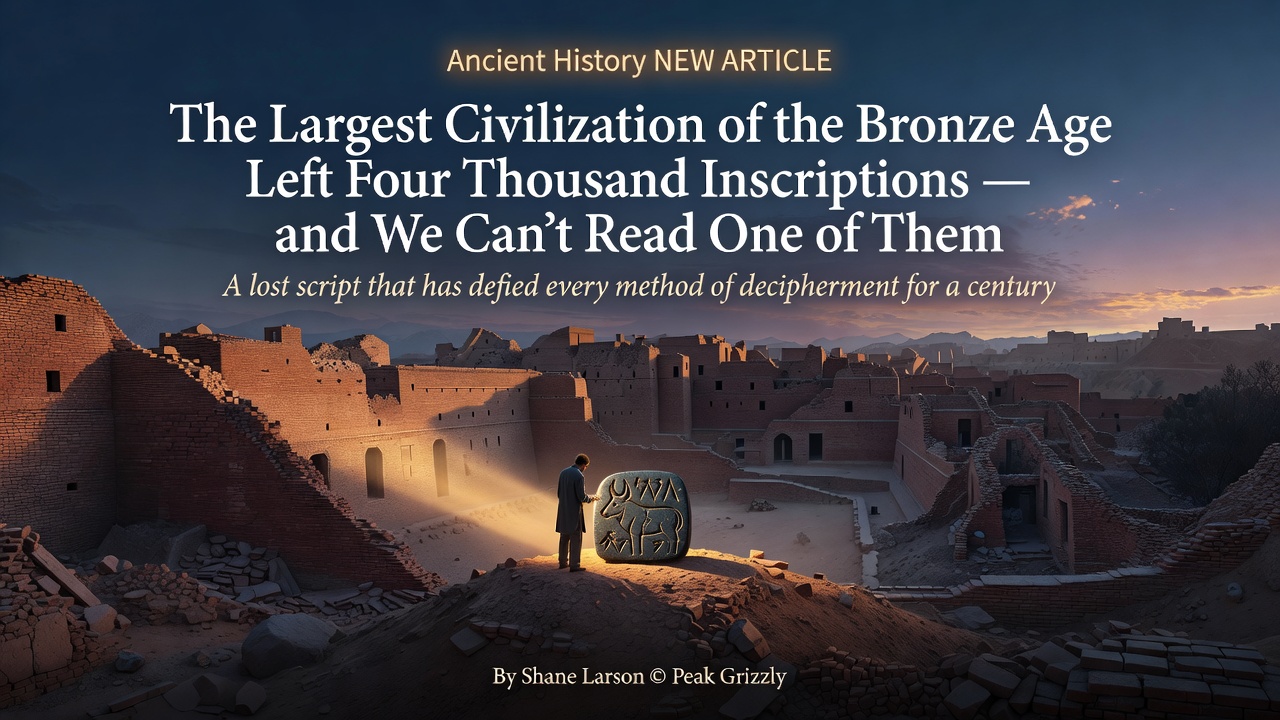
The Largest Civilization of the Bronze Age Left Four Thousand Inscriptions — and We Can't Read One of Them
August 19, 2026 · 7 min read
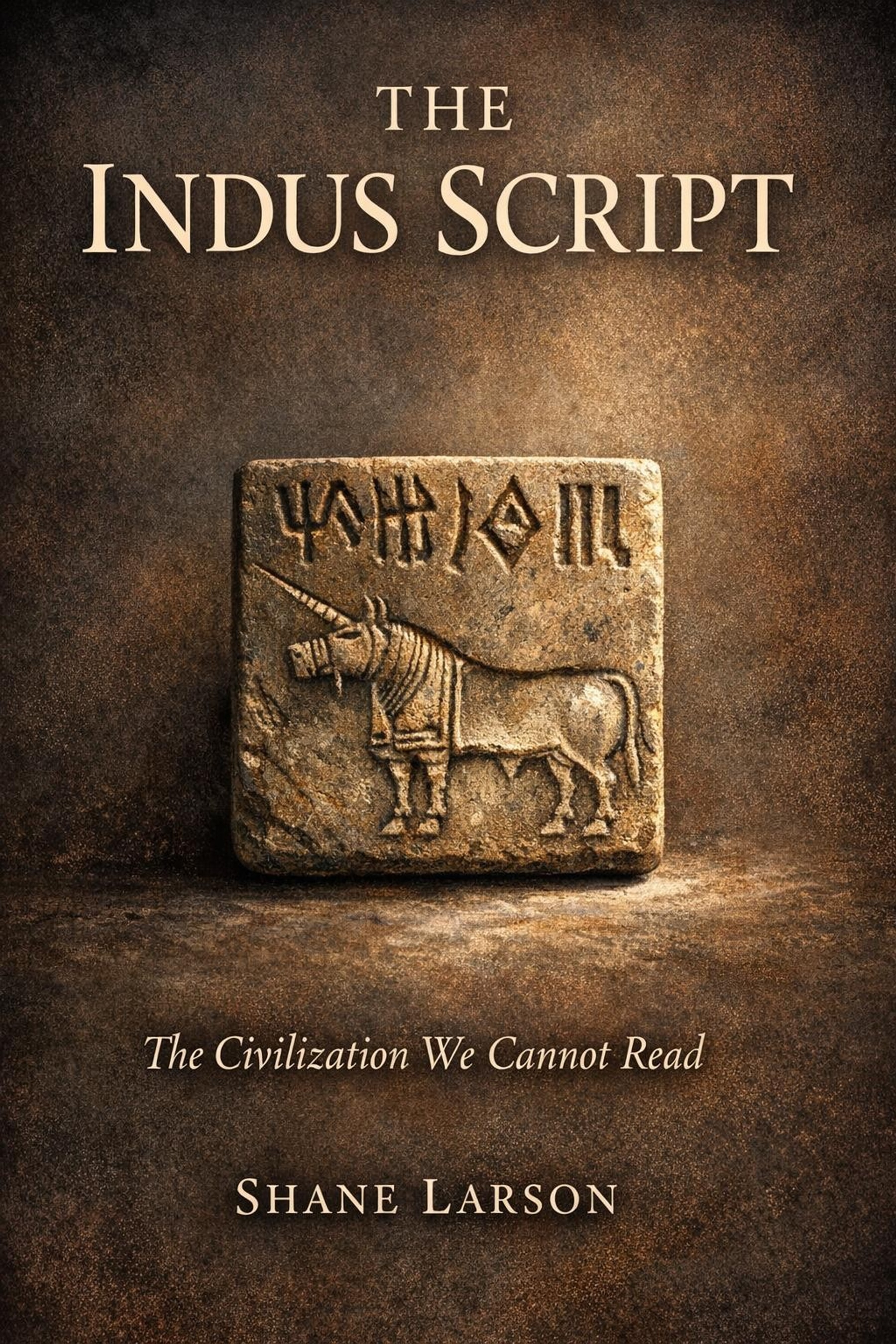
Pick up one of the objects at the center of this problem and it fits on your thumb: a square seal of steatite about the size of a postage stamp, an animal carved in profile — most often a one-horned bull that archaeologists call the "unicorn" — and above it, four or five signs cut with real precision by someone who clearly knew exactly what they meant. Roughly four thousand inscribed objects like this survive from the Indus civilization: seals, sealings, copper tablets, marked pottery, and one signboard from the city of Dholavira with signs large enough to mount over a gateway.
Not one of them has been read. Not partially, not tentatively, not in a way that any second scholar independently accepts. A hundred years of professional effort — epigraphers, linguists, Soviet and Finnish computational teams, cryptographers, and lately machine-learning researchers — has produced dozens of claimed decipherments and zero that survived contact with anyone outside the group that proposed it.
That failure would be interesting for any ancient script. For this one, it is astonishing, because of what the script belongs to. At its height around 2000 BC, the Indus civilization — also called the Harappan civilization — was the largest on earth, covering about a million square kilometers of what is now Pakistan and northwestern India. Its cities were laid out on grids, with baked brick in a standard ratio, covered drains under the streets, hundreds of wells, and a system of weights accurate to a fraction of a gram at sites hundreds of miles apart. Mesopotamian records mention trade with a distant land called Meluhha, which most scholars identify as the Indus region, and Indus seals have turned up in Mesopotamian cities. This was not a marginal culture. It was a peer of Egypt and Sumer that organized more territory than either — and it is the only one of the three whose own voice we cannot hear at all.
What a decipherment actually requires
Decipherments look like magic from the outside, but they run on a short list of practical requirements. Historically there have been three ways in.
The first is a bilingual text. The Rosetta Stone carried the same decree in Egyptian hieroglyphs and in Greek, which everyone could already read; Champollion used the Greek, plus royal names conveniently ringed in cartouches, to pry the hieroglyphs open.
The second is a known — or correctly guessed — underlying language. Maya glyphs yielded because the Mayan languages are still spoken, so the sound values could eventually be checked against living speech.
The third way is the hard one: pure internal analysis, which is how Linear B fell in 1952. There was no bilingual. But there were thousands of clay tablets, many of them long administrative documents, and that volume made pattern analysis possible. Alice Kober built grids of word endings that revealed the language was inflected. Michael Ventris extended the grids, guessed the language was an early form of Greek, and then came the part that matters: the reading was confirmed when a newly excavated tablet from Pylos produced sensible Greek words for objects — tripods, jars — that were actually drawn on the same tablet. A decipherment is proven when it predicts correctly on material it was not built from. That is the standard.
Now line the Indus script up against it. Bilingual text: none, despite centuries of documented contact with the fully literate cuneiform world. Mesopotamian scribes mentioned Meluhha and its goods; one record even refers to an official who interpreted the Meluhhan language — which means the language was distinct enough to need interpreting, and that nobody bothered to write any of it down in a script we can read. Known language: none. The Mature Harappan cities were abandoned around 1900 BC, the script died without descendants, and there is no continuous tradition connecting it to any later writing in South Asia. Long texts for internal analysis: this is where the case collapses entirely.
A corpus the size of a newspaper article
The four thousand inscribed objects sound like a lot until you look at what is on them. The average inscription is around five signs. The great majority are under ten. The longest inscription on a single surface runs to seventeen signs, with a handful of slightly longer texts spread across the faces of a three-sided object. The direction of writing — right to left, established from where signs get cramped at the ends of lines — is one of the few things everyone agrees on.
The Indus Script
Add it all up and the entire surviving output of the largest Bronze Age civilization amounts to something on the order of a short newspaper article, chopped into four thousand separate scraps. Kober and Ventris had long tablets full of repeated words in varying grammatical forms; that repetition-with-variation is what made their grids possible. Five-sign texts cannot show inflection. They barely show anything.
Even the basic inventory is contested. Iravatham Mahadevan's 1977 concordance lists 417 distinct signs; other catalogues count differently, from roughly 400 to well over 600, because deciding whether two similar marks are one sign written twice or two different signs is a judgment call, and a long tail of signs appears only once in the whole corpus. When specialists cannot agree on how many signs exist, sound values are a distant dream.
This is why the failed attempts have failed. The most serious program, pursued for half a century by the Finnish scholar Asko Parpola, reads the script as an early Dravidian language using the rebus principle — a sign depicting a fish read as the Dravidian word for fish, which happens also to mean "star," yielding plausible star and planet names. It is careful, learned work, and it may even be right. But in a corpus this short, it cannot be tested. No Dravidian reading — and no competing Sanskrit or Indo-Aryan reading, a claim that carries heavy political freight in modern India — has ever produced a Ventris-style confirmation, a prediction verified on texts the method was not built from. Without that, a reading is a hypothesis that can never graduate.
The possibility nobody wants: it may not be writing
There is a sharper problem underneath, raised in earnest in 2004 by Steve Farmer, Richard Sproat, and Michael Witzel: the possibility that the Indus signs do not encode language at all. Their argument is not hand-waving. The texts are extremely short. An unusually large fraction of signs occur only once. No site has produced the long administrative documents that every other early literate society generated in bulk. There is no evidence of scribal training or corrected errors. And the system vanished without descendants, which genuine writing traditions rarely do. On this view, the signs are something like heraldry or merchants' marks — emblems of clans, deities, offices, or commodities — meaningful, but not spelling out speech.
The rebuttals are serious too. The signs follow consistent positional rules — certain signs overwhelmingly favor the ends of sequences, certain pairs recur far above chance — and that ordering holds across a million square kilometers and seven centuries, a discipline emblem systems rarely maintain. A 2009 statistical study led by Rajesh Rao found that the script's conditional entropy — roughly, how predictable the next sign is given the current one — sits in the same band as natural languages. Critics answered that the band is wide and that structure is not the same thing as meaning, which is true. And the brevity may prove nothing: a stamp seal physically permits only a few signs, and any longer texts written on palm leaf, cotton, or bark in that climate would have rotted three thousand years ago. The absence of long texts might be an accident of preservation, not a fact about the society.
The dispute is unresolved, and here is the uncomfortable summary of the whole field: after a century, we do not know what the Indus script says, we do not know what language it records, and we do not know for certain that it records a language at all.
What would settle it is easy to name and hard to find: a genuine bilingual, most plausibly an object carrying both Indus signs and cuneiform from some Gulf or Mesopotamian trading context, possibly sitting unrecognized in a museum storeroom right now; or a long text on a durable medium from the enormous unexcavated portions of the major sites. Until then, the largest civilization of the Bronze Age remains the strangest kind of historical presence — a society we can measure, weigh, and map in extraordinary detail, and cannot hear.
Shane Larson's new book, The Indus Script: The Civilization We Cannot Read, tells the full story — the cities and their missing kings, the Meluhha trade, every major decipherment attempt and why each one failed, and the live argument over whether the signs are writing at all. It is a companion to his earlier The Indus Valley Civilization for readers who want the whole case laid out honestly, with no solution oversold.
The Indus Script
New posts and releases, straight to your inbox. No spam, unsubscribe anytime.