Jesse James Wasn't Robin Hood. A Newspaper Editor Made Him One.
July 4, 2026 · 6 min read
Ask most people what they know about Jesse James and you'll get some version of the same story: a daring outlaw who robbed greedy banks and railroads, shared the loot with poor Missouri farmers, and was finally gunned down by a treacherous coward. It's a good story. It's also, in almost every particular that matters, a lie—and we can name the man who wrote it.
The real Jesse James is harder to love and far more interesting. He was not a Robin Hood. He was a Confederate guerrilla who carried the savagery of the Civil War's border conflict into a decade of robbery, and the "stole from the rich, gave to the poor" part of his legend has almost no basis in the documentary record. What he actually became was something new in American life: the first outlaw to be a celebrity, his name sold in dime novels while he was still alive to rob the next train. Understanding how that happened tells you more about America than any tale of buried gold ever could.
The War Made the Outlaw
You cannot understand the bank robber without the guerrilla. Jesse James was born in 1847 in Clay County, Missouri, into a slaveholding farm family on the most violent fault line in the country. The Missouri-Kansas border had been bleeding since the 1850s, and when the Civil War came it turned that borderland into a no-quarter guerrilla war of ambush and reprisal.
James's older brother Frank rode with William Quantrill's raiders, who carried out the 1863 Lawrence massacre in Kansas. By 1864, sixteen-year-old Jesse was riding under "Bloody Bill" Anderson, one of the most feared bushwhacker leaders of the war. That September, Anderson's men stopped a train at Centralia, Missouri, pulled unarmed Union soldiers off it, and killed them—then ambushed and destroyed the militia that pursued them. This was the school that trained Jesse James: ambush, no surrender, total hatred. When the Confederacy collapsed, men like him did not come home to peace. They came home to occupied, embittered Reconstruction Missouri with the only skills they had.
The robberies that followed were the war continued by other means. The same tactics. The same targets—the institutions of the victorious North. The same comrades, now a loose gang of ex-guerrillas including the Younger brothers. The first strike, the Clay County Savings Association robbery in Liberty in 1866, is often called the first daylight peacetime bank robbery in American history. A bystander was killed. Wartime methods, civilian targets. That was the pattern, and it never really changed.
The Editor Who Built a Hero
Here is the part the movies leave out, and it's the most important part. Jesse James did not become a folk hero by accident or by charity. He became one because a talented, motivated newspaperman decided to make him one.
His name was John Newman Edwards. He had been a Confederate cavalry officer, and after the war he became an editor in Kansas City, founding and writing for papers including the Kansas City Times. Edwards was a true believer in the Lost Cause—the postwar movement to recast the Confederacy's defeat as a noble tragedy—and he found in the James gang the perfect vehicle for it. He printed letters supposedly from Jesse himself. He wrote soaring editorials portraying the robbers not as criminals but as gallant Southern knights, driven to outlawry by vindictive Yankee banks, Yankee railroads, and a Reconstruction government that had disenfranchised honorable Confederate men.
This was political theater, manufactured in real time, while the subject was still alive and still committing crimes. It worked because the audience wanted it to work. Defeated, occupied, resentful, much of western Missouri was ready to see a Confederate avenger in a man who was, in plain fact, robbing for money. Edwards gave them one. He is, as much as any gunfight, the reason you know the name Jesse James.
Jesse James
The Villains the Myth Needed
A hero needs a villain, and the Gilded Age supplied perfect ones. Banks, railroads, and the Pinkerton National Detective Agency were among the most hated institutions in America. When James robbed a railroad—the gang turned to trains starting with the Adair, Iowa, robbery in 1873—he was robbing the single most resented corporation of the age. That made the outlaw sympathetic in a way that robbing an individual farmer never could.
Then the pursuers handed Edwards a gift he could not have invented. The express companies hired the Pinkertons, and the manhunt turned vengeful. On the night of January 26, 1875, agents threw an incendiary device into the James family farmhouse near Kearney. It exploded. Jesse's young half-brother Archie was killed. His mother, Zerelda, was so badly maimed that her arm had to be amputated. The public recoiled. Overnight, the manhunt had manufactured the very martyr it meant to destroy. The lesson reaches well past the 19th century: how you pursue someone can do more for their reputation than anything they ever do for themselves.
Northfield, and the Slow Unraveling
The myth could survive Missouri, where the gang had safe houses and silent neighbors. It could not survive Minnesota. On September 7, 1876, the gang rode into Northfield to rob the First National Bank and met a town that fought back. Citizens grabbed shotguns and rifles. The bank's clerk, Joseph Lee Heywood, was murdered for refusing to open the safe. Within minutes two gang members lay dead in the street, and a two-week manhunt ran down and captured the surviving Youngers. Jesse and Frank escaped, but the gang was finished.
What followed was a slow, paranoid unraveling: years in hiding under false names, a doomed attempt at a normal life, and finally a new gang of untested, untrustworthy recruits. One of them was Robert Ford. With an extraordinary reward on James's head and a secret deal with the governor of Missouri for a pardon, Ford made his choice. On April 3, 1882, in a rented house in St. Joseph, Jesse took off his gun belt and climbed onto a chair to straighten a picture. Ford shot him in the back of the head.
The Fords were charged, convicted, sentenced to hang—and pardoned by the governor within hours. The public delivered its own verdict in a ballad about "the dirty little coward that shot Mr. Howard." The bullet made Jesse immortal and Ford infamous. The legend devoured them both.
What the Record Actually Says
For more than a century the myth outran the man. Dime novels and stage shows were running before Jesse was even buried; his mother charged tourists to visit the farm and sold pebbles off the grave; impostors surfaced for decades claiming to be the "real" Jesse James who had supposedly faked his death. Modern scholarship, most notably T.J. Stiles's reframing of James as a political terrorist rather than a Robin Hood, finally pulled the documented man back into view. And in 1995, an exhumation and DNA test confirmed that the body in the Missouri grave was, in fact, Jesse James—closing the most persistent of the legends.
The robberies were never the remarkable thing. Plenty of men robbed banks. The remarkable thing was the machine that turned a fugitive into a saint, and the willing audience that needed him to be one. That—not the loot, not the gunfights—is the real story of America's first celebrity outlaw.
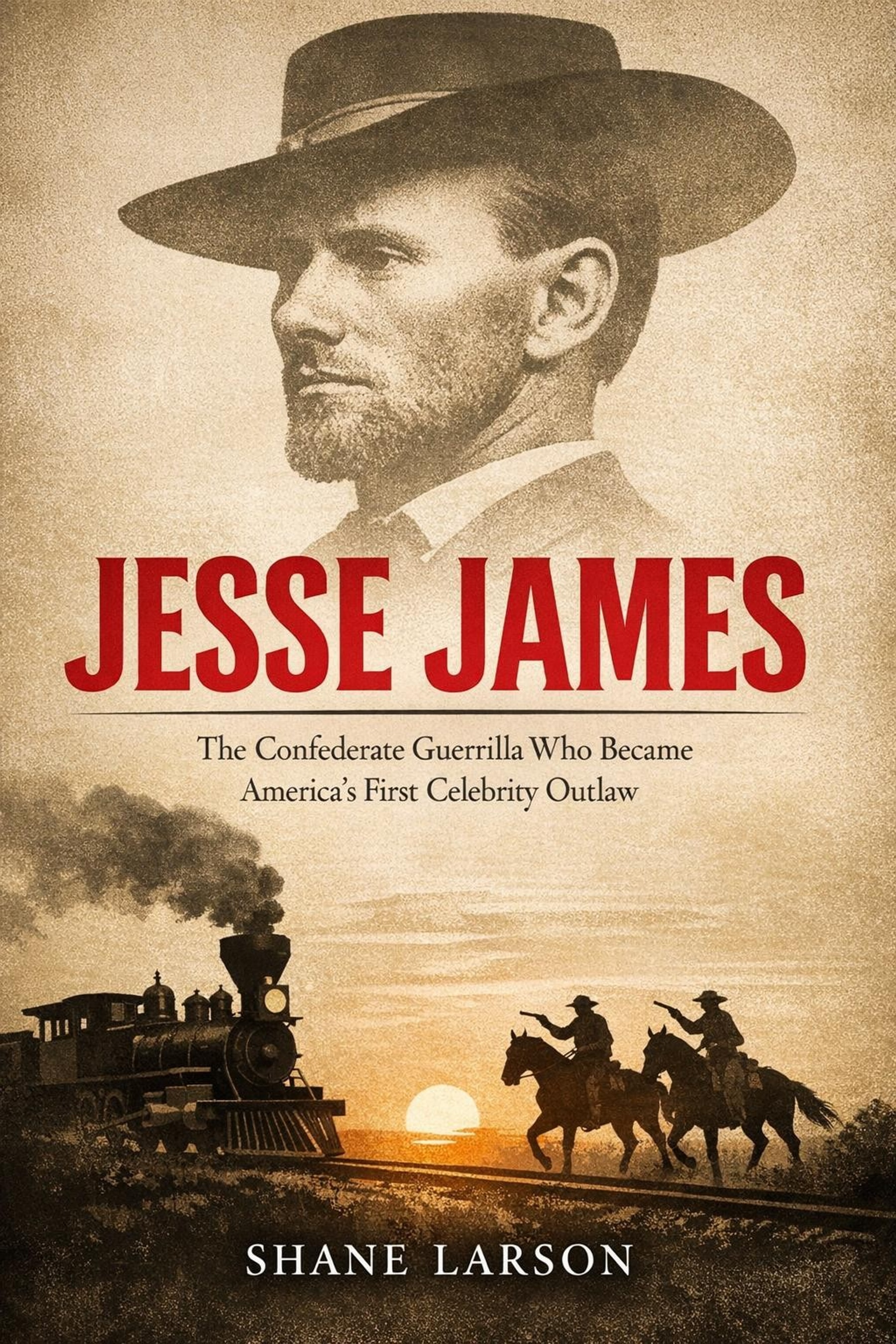
If you want the full documented story—the guerrilla war that made him, the editor who mythologized him, the Pinkerton blunder, and the betrayal in St. Joseph—it's all in Jesse James: The Confederate Guerrilla Who Became America's First Celebrity Outlaw, the anchor title in "The Wild West" series, available now on Kindle. It pairs directly with The James-Younger Gang at Northfield and The Pinkertons.
Jesse James
New posts and releases, straight to your inbox. No spam, unsubscribe anytime.