The Man Who Burned the Maya Library — and Then Wrote the Key to Reading It
October 4, 2026 · 7 min read
Here is a fact most educated people do not know: the Maya wrote books. Not glyphs on temple walls — books. Bound volumes, produced by professional scribes, kept in the households of priests and lords, covering astronomy, prophecy, medicine, ritual, and history. A civilisation that wrote for centuries ran a paper industry and trained its writers as a profession.
Four of those books survive. Four — and one of them spent fifty years under suspicion of being a forgery.
That both halves of this are surprising — that the books existed, and that so few remain — is the whole story in miniature. The erasure of Maya literature was so complete that most people never learned there was anything to erase. And unlike almost every other great loss of written knowledge, this one has a name, a date, a place, and a paper trail leading to one man: a Franciscan friar named Diego de Landa. Who then, in the strangest turn in the history of lost libraries, wrote down the very information that would one day let scholars read what was left.
What a Maya book actually was
A Maya book — a codex — was a strip of paper made from the pounded inner bark of a fig tree, coated with a smooth white lime gesso and folded like an accordion into a screenfold, often between wooden or jaguar-skin covers. Opened flat, a single codex could stretch several metres. The pages were painted in carbon black and iron-oxide red, with details in Maya blue, an indigo-and-clay pigment so chemically stable it still looks fresh after a thousand years.
The writing on those pages was a full logosyllabic script — a mix of word-signs and syllable-signs, like Japanese in principle — capable of recording anything that could be said aloud. The four surviving codices are working reference books: tables tracking the cycles of Venus with astonishing precision, eclipse warnings, almanacs for planting, hunting, and beekeeping, and the 260-day divinatory calendar that structured Maya ritual life. The monuments and painted pottery tell us the same script also recorded dynastic history — births, accessions, wars, and defeats of real kings. The books that carried that history are the ones we do not have.
Maní, July 1562
By the mid-sixteenth century the Yucatán was a Spanish colony, thinly settled and administered, with a small number of Franciscan friars responsible for an enormous Maya population of recent converts. Landa was their provincial — young, fluent in Yucatec Maya, energetic, and more familiar with Maya life than almost any other European in the colony.
In May 1562, near the town of Maní, a cache of idols was discovered in a cave. To Landa it was evidence not of scattered backsliding but of organised, concealed apostasy, and he responded with an inquisition-style investigation he had no clear legal authority to conduct. Over roughly three months, thousands of Maya were interrogated, many under torture; the colonial inquiry that followed recorded the numbers questioned, maimed, and dead. Those figures sit in the file to this day, set down by notaries.
The proceedings ended in July with an auto de fe in the square at Maní — a public sentencing ceremony at which the objects of the old religion were destroyed. Wooden idols and incense burners went onto the fire by the thousand. So did a stack of screenfold codices. Landa himself later recorded the event, noting that the Maya grieved the loss of their books intensely — a book-burner's own written acknowledgement that his victims understood exactly what had been taken from them.
Two points keep the story honest. First, the reaction against Landa came from inside his own world: settlers and clergy protested at the time, and when Francisco de Toral — a fellow Franciscan — arrived that August as the first bishop of Yucatán, he halted the proceedings, released prisoners, concluded the confessions had been produced by torture, and sent the affair up the chain. This was a documented dispute among sixteenth-century churchmen, and Landa's fiercest contemporary critics were priests. Second, Landa's fire was not the whole erasure. Books were destroyed in other towns, in other decades, by other hands; others simply rotted in the tropical climate or were never recopied once the priesthood that maintained them was gone. Maní is the emblem of the loss, not its sole cause. What makes it singular is that it is documented, dated, attributable — and acknowledged in writing by the man responsible.
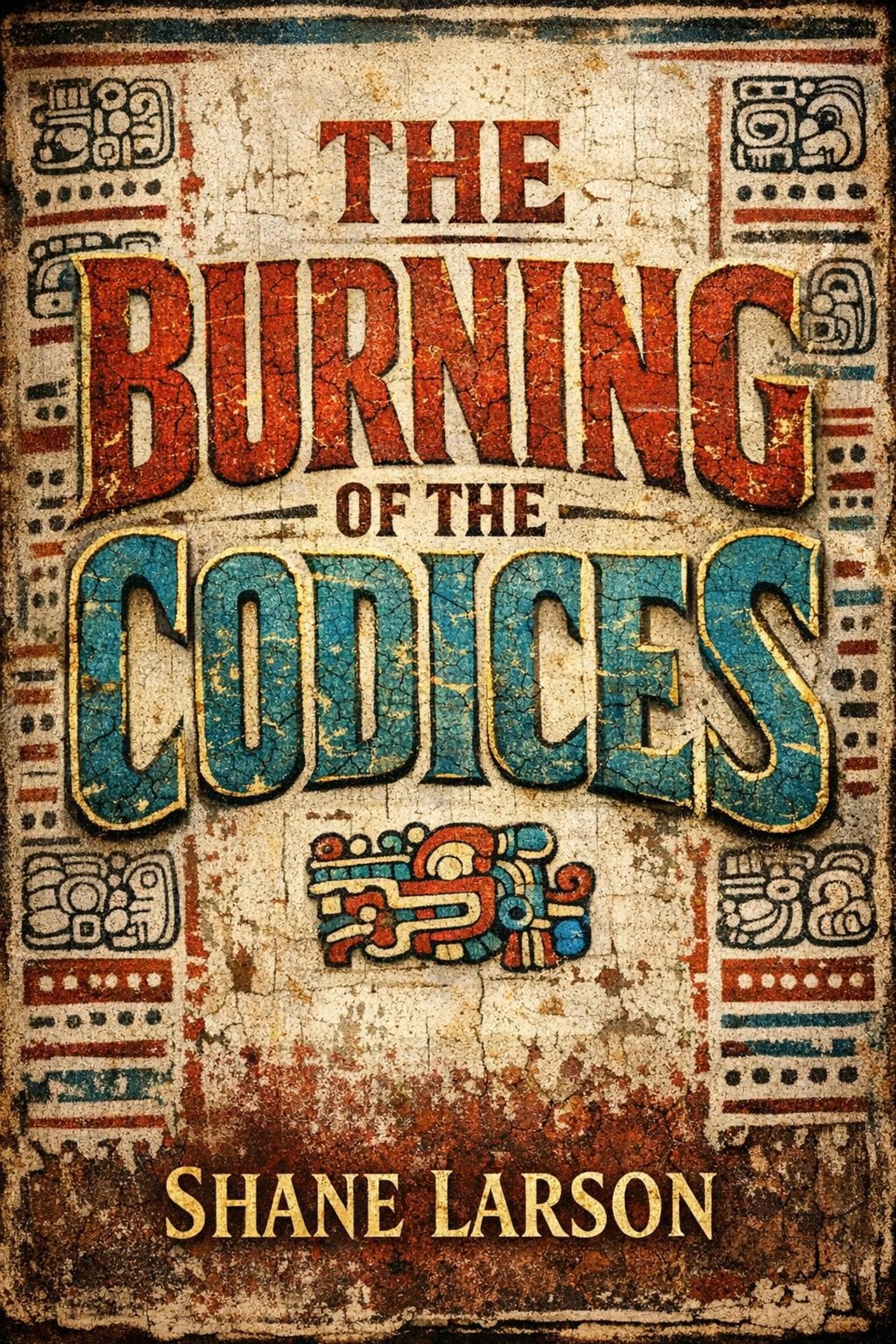
The Burning of the Codices
The strangest document in American history
Recalled to Spain to answer for the affair before the Council of the Indies, Landa spent his defence years writing. The result, composed around 1566, was an account of Maya civilisation so detailed it remains the foundational source of the entire field: the calendar and its festivals, agriculture, food, marriage, warfare, medicine, the great ruins, and — crucially — the writing system. The man defending himself for burning the books produced the most careful description anyone ever made of the world those books came from.
Then the document nearly vanished. Never published in his lifetime, it survived only as a later copyist's abridgement, which sat unnoticed in a Madrid library until a French scholar, Brasseur de Bourbourg, found and published it in the 1860s.
Inside it was a curiosity: what Landa believed was the Maya alphabet. He had asked a Maya informant to write the letters, pronouncing each Spanish letter name aloud — be, ce, ha. But the Maya script has no letters; it has syllables. The informant, quite reasonably, wrote the Maya sign for each sound Landa spoke. The result was gibberish as an alphabet — multiple signs per letter, signs that were clearly whole words — and scholars spent the next three centuries dismissing it as a blunder or a fabrication. Attempts to read the codices with it produced nonsense, and the field settled into a consensus that Maya writing was not phonetic at all.
Moscow, 1952
The consensus broke from an unexpected direction. Yuri Knorozov, a linguist working in Cold War Moscow with no access to the ruins, looked at Landa's list and saw what it actually was: not a failed alphabet but a partial syllabary — a couple of dozen genuine sound values correctly attached to genuine signs. Read that way, the list became a foothold, and Knorozov used it to produce readings from the codices that worked and cross-confirmed each other.
Western acceptance took twenty years, against the sustained resistance of the field's leading authority, but the approach won on the merits. Combined with the 1960 demonstration by Tatiana Proskouriakoff that the monument inscriptions record the lives of real kings — not just calendar ritual — it opened the decipherment sprint of the 1970s and 80s. Today the great majority of the Maya corpus can be read. The key that opened it was written down, wrongly but preservingly, by the man who burned the books.
The honest measure of the loss
It is tempting to inflate a story like this — to imagine vast halls of lost volumes. The honest accounting is harder and more interesting. We cannot know how many books existed in 1562; any figure is a guess with wide error bars. What we can say precisely is what kinds of knowledge died: the dynastic histories, the migration narratives, the long astronomical series, the medical texts — everything the script demonstrably recorded that the four surviving ritual almanacs do not contain.
And the sharpest measure of the erasure is not the number four. It is the ordinary ignorance this article opened with: that most people never knew the Maya wrote books at all. Destroyed knowledge does not look like a dramatic absence. It looks like nothing — like the natural state of things.
But the ending is not an elegy. Roughly six million people speak some thirty Mayan languages today. In the Guatemalan highlands, daykeepers still keep the same 260-day calendar that fills the pages of the Dresden Codex. And a generation of Maya epigraphers now reads Classic-period inscriptions professionally — descendants deciphering their ancestors' words, using a field built, unavoidably, on the account written by Diego de Landa. The books could be burned in an afternoon. The language could not, and that difference is the whole point.
The full story — the world that made the books, the events at Maní and the trial that followed, the four survivors and their near-misses, and the three-hundred-year detective story of the decipherment — is told in The Burning of the Codices: Diego de Landa and the Erasure of Maya Writing, part of the Lost Knowledge series. It ends, as the history does, with the language still alive.
The Burning of the Codices
New posts and releases, straight to your inbox. No spam, unsubscribe anytime.