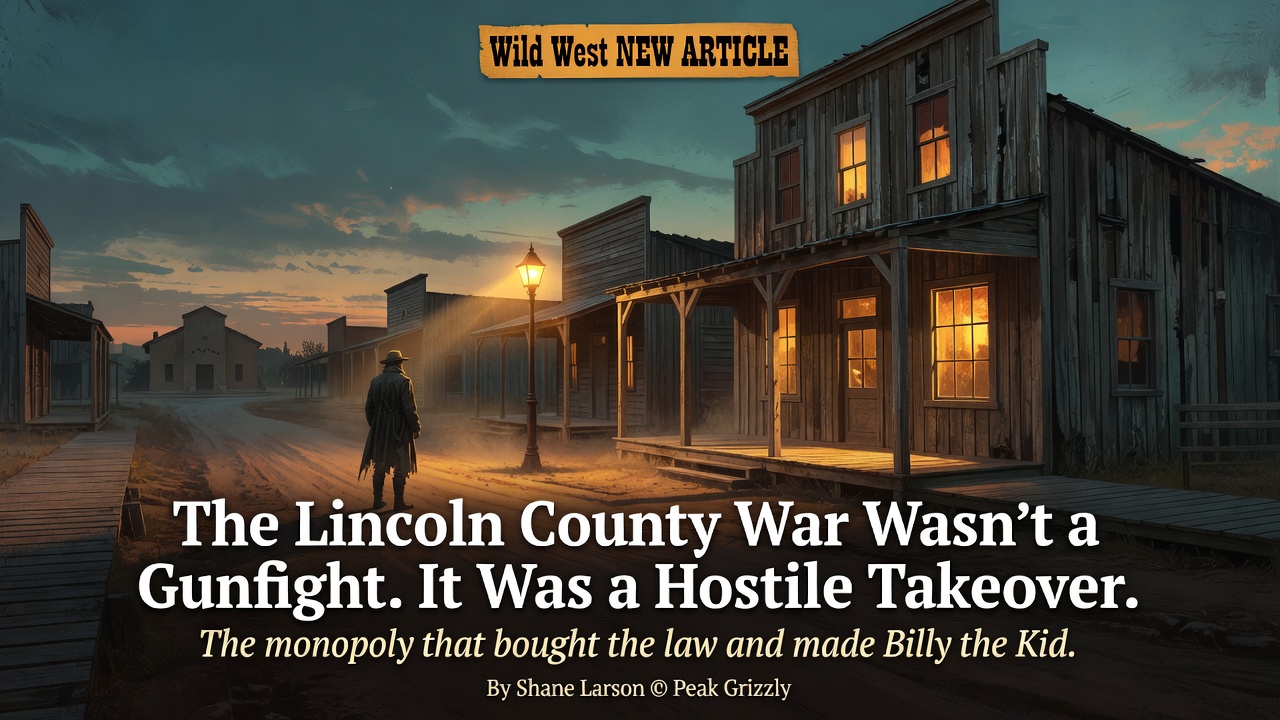
The Lincoln County War Wasn't a Gunfight. It Was a Hostile Takeover.
July 8, 2026 · 7 min read
Ask most people what the Lincoln County War was, and you'll get some version of the same answer: it's the war that made Billy the Kid. Cowboys, six-guns, a dusty street, a teenage outlaw. Young Guns. That's the picture.
It's not wrong, exactly. The gunfights were real, the bodies were real, and Billy Bonney was right in the middle of them. But the picture leaves out the only part that actually explains the war. Because the Lincoln County War was not, at bottom, a story about gunfighters. It was a story about money, monopoly, and a government that had been quietly bought. Strip away the legend and what you find underneath is a hostile takeover that turned into a shooting war because there was no one left to appeal to who wasn't already on the payroll.
Here's how that happened.
One store, one county
In the 1870s, Lincoln County was the largest county in the United States — a vast, thinly governed stretch of New Mexico Territory bigger than several eastern states combined. And its economy ran through a single door: the mercantile house of Lawrence Murphy and James Dolan, known to everyone simply as "the House."
Calling it a store undersells it. The House was the bank, the supplier, the grain dealer, and the middleman for the most lucrative business in the territory: the federal contracts to feed the Army at Fort Stanton and the Mescalero Apache reservation. If you were a small rancher or farmer in Lincoln County, you bought on credit from the House, you sold your beef and grain to the House at the price the House named, and you carried a debt to the House that never quite went away. To owe the House money — and nearly everyone did — was to live at its mercy.
That's the first thing to understand. The House didn't rule Lincoln County primarily with guns. It ruled with the ledger. Economic power was the engine. The violence came later, and only when the economic power was threatened.
The part that turns a monopoly into a machine
A monopoly store is one thing. A monopoly store that also controls the law is something far more dangerous.
The House was the local end of a territory-wide political machine that historians call the Santa Fe Ring — a loose, powerful network of lawyers, officials, and businessmen who controlled appointments, land deals, and courts across New Mexico. Through that alliance, the House's reach extended into exactly the institutions that were supposed to check it. The county sheriff was the House's man. The district attorney was friendly. The judges were connected. The territorial governor was an ally.
Think about what that means. In a healthy system, if a powerful business cheats you, you have somewhere to go: a court, a prosecutor, an honest sheriff. In Lincoln County, every one of those doors opened into the same room. The store extended the credit, and the store's friends decided your lawsuit. There was no neutral arbiter anywhere in the structure. The institutions still existed — there were warrants, writs, courts, and elections — but they had all been captured by one faction.
This is the condition that makes the rest of the war inevitable. When every lever of justice is owned, ordinary disputes can no longer be settled by appeal. They can only be settled by force.
The newcomers who didn't understand the rules
Into this closed system rode two outsiders with capital and nerve. John Tunstall was a young Englishman — idealistic, ambitious, and twenty-four years old — who arrived with family money and a plan to open a competing store and bank in the town of Lincoln. Beside him stood his lawyer, Alexander McSween, sharp and combative, and behind both of them loomed John Chisum, the most powerful cattleman in the Pecos Valley, who had his own bitter grievances against the House.
They didn't just want a slice of the business. They wanted to break the monopoly outright — to offer farmers credit on fair terms, to bid on the federal contracts, to end the House's grip. And the House understood precisely what that meant. A second store wasn't competition. It was an existential threat to a system that depended on having no alternative.
So the House did what captured power always does. It didn't compete on price. It reached for the law it already owned.
A murder the law couldn't punish
The pretext was a tangled dispute over an insurance debt — the kind of dry financial quarrel that, in a functioning system, ends in a courtroom. Instead, it ended with a sheriff's writ to seize Tunstall's property, and a posse riding out to enforce it.
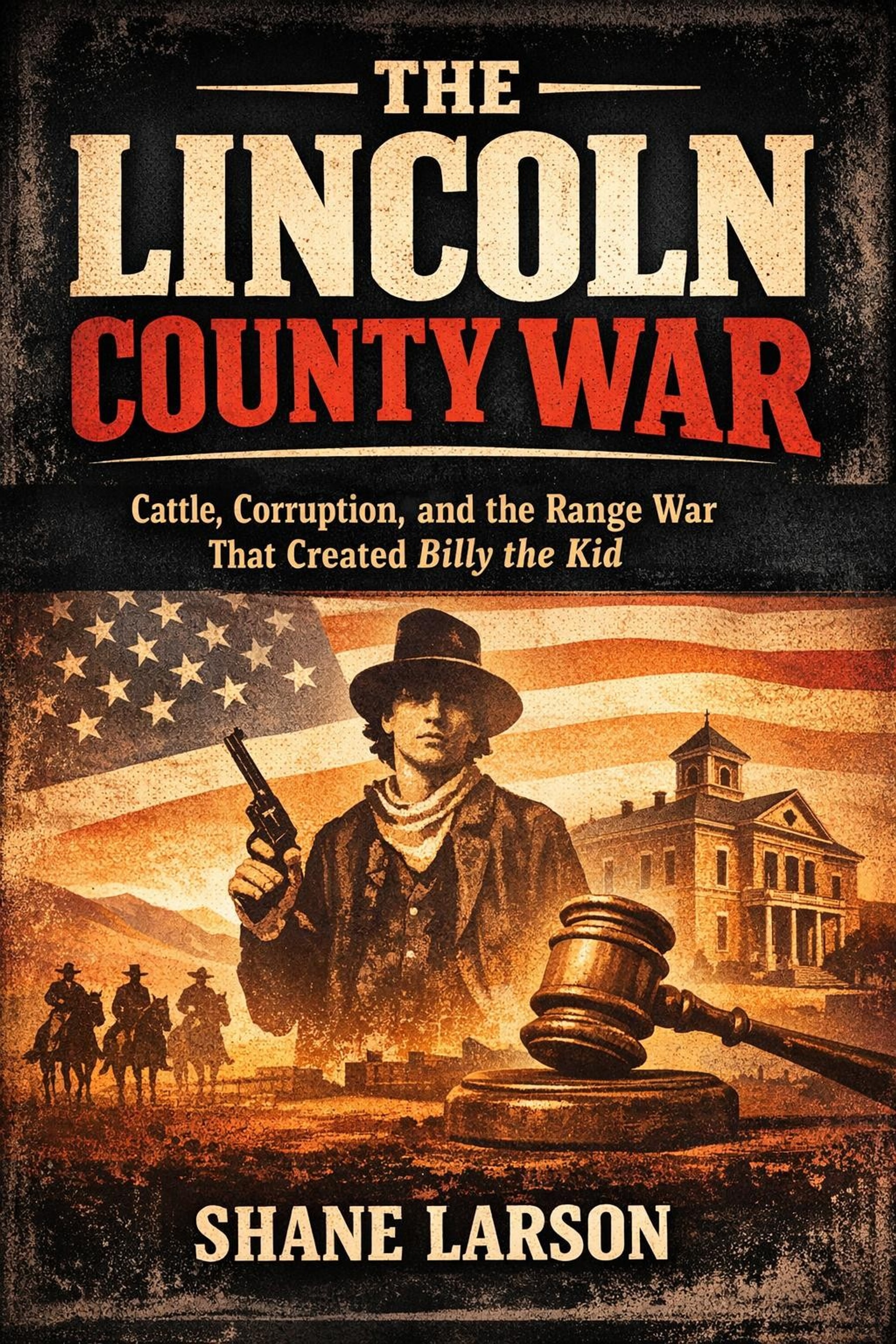
The Lincoln County War
On February 18, 1878, that posse caught John Tunstall on a lonely trail. They shot him out of his saddle. Then, with him on the ground, they shot him again. They laid his hat under his dead horse's head, a small private joke, and rode off. He was twenty-four.
And nothing happened to them. That's the hinge of the entire story. A young man was murdered in broad daylight by men whose identities were known — and the legal machinery that should have answered for it was owned by the very faction that ordered it. The coroner's inquest went nowhere. The courts went nowhere. The killers answered to the sheriff, and the sheriff answered to the House.
That single unpunished killing is the moment the law lost its legitimacy in Lincoln County. After that, both sides simply stopped pretending there was any authority above the gun.
A war fought with warrants
What makes the Lincoln County War so strange — and so revealing — is that both sides kept insisting they were the law.
Tunstall's outraged men got themselves deputized by a friendly justice of the peace, called themselves the Regulators, and rode out with warrants of their own to arrest the killers. In practice, "arrest" often meant "kill." They gunned down Sheriff William Brady in the street of Lincoln. They fought a bloody, confused skirmish at Blazer's Mills that left their own leader dead. Each side waved real or invented legal paper. Each side claimed legitimacy. And the territorial government, captured by the Ring, could not or would not impose order on either.
It built toward one catastrophe. In July 1878, the war collapsed into the town of Lincoln itself for what became known as the Five-Day Battle — the largest gunfight of the entire frontier era, dozens of men firing across a single street for the better part of a week. It ended when the house where the Regulators were besieged was set ablaze and the defenders were shot down as they ran from the flames, McSween among them.
And then came the detail that should stop anyone who thinks this was just a local feud: to break the stalemate, the Army commander at nearby Fort Stanton marched soldiers and a cannon into the civilian town and tipped the balance. The federal government, in the form of artillery, effectively decided a private war. It became a scandal in its own right, complete with a court of inquiry — but by then the House had won. Tunstall and McSween were dead, the Regulators scattered, and the corruption that started it all was still firmly in place.
The only man ever convicted
So who paid for all of it?
After the war, the reform-minded governor Lew Wallace arrived, issued amnesty proclamations, and even met secretly with a young Regulator who offered to testify in exchange for a pardon. The deal fell apart. The powerful men walked. The Ring survived. And out of every killer on every side of a five-month war that left dozens dead, exactly one man was ever convicted of murder.
A teenage ranch hand named William Bonney. Billy the Kid.
That's the fact that reframes the whole legend. We remember the Lincoln County War as the story of a famous outlaw, but the outlaw was the war's product, not its cause — and ultimately its scapegoat, the one body the system was willing to offer up while the men who built the machine kept their freedom and their fortunes. The war didn't just make Billy the Kid famous. It manufactured him, and then it convicted him alone.
Why this story still lands
It's easy to file the Lincoln County War under "Wild West trivia." But look at the shape of it again: a dominant business that controls credit and supply, an alliance that captures the regulators and the courts, a threat that gets crushed under the color of law instead of fair competition, and a justice system that punishes the powerless while the powerful walk. That's not a frontier curiosity. That's a pattern, and it's one we recognize.
That's why I wanted to tell this war as what it actually was — an institutional tragedy, built from the documented record: the federal Angel investigation, the Dudley court of inquiry, the surviving court files, Governor Wallace's papers, and the period newspapers. The gunfights are all there, rendered in full. But they're where they belong: as the consequence of a captured government, not as the point of the story.
If you want the war straight — the money, the monopoly, the machine, and the legend it left behind — that's the book.
Read the whole story in The Lincoln County War: Cattle, Corruption, and the Range War That Created Billy the Kid — Book 3 of The Wild West series, available now. For the full arc, read it alongside its companions Billy the Kid and Pat Garrett.
The Lincoln County War
New posts and releases, straight to your inbox. No spam, unsubscribe anytime.