The University Where the Entrance Exam Was an Argument at the Gate
August 22, 2026 · 6 min read
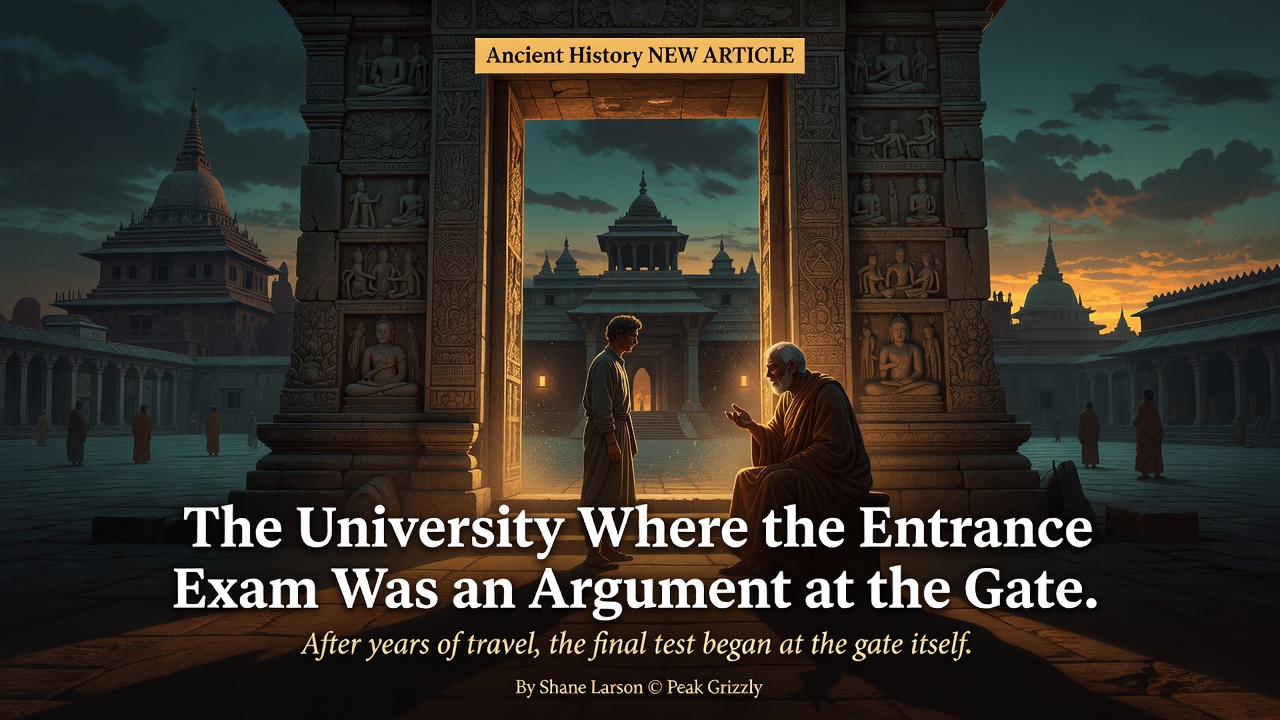
Imagine arriving at a university after traveling for several years. You have crossed deserts and mountain passes to get there. You may have spent time in a foreign port learning Sanskrit, because the entrance examination is conducted in it. And now, at the gate, a scholar stationed there for exactly this purpose begins to question you — not to check what you have memorised, but to attack whatever position you take, in front of anyone watching, until you either hold your ground or fold.
Most applicants folded. The reported rejection rate at the gate ran as high as seven or eight out of ten.
This was Nalanda, a Buddhist monastic university in the Ganges plain of northern India. It was founded under the Gupta emperors in the fifth century CE and operated continuously for roughly seven hundred years — a run that Bologna, Europe's oldest university, did not match until the end of the eighteenth century. At its height it housed something on the order of ten thousand people and kept a library in three buildings, one of which was said to rise nine storeys. Almost everyone has heard how it ended. Almost nobody knows how it worked. The second question is much more interesting, and the evidence to answer it actually exists.
The Examination Tested the Skill the Place Existed to Teach
The gate examination makes sense once you see what Nalanda was for. The institution's core intellectual technology was formal public debate. A scholar defended a stated thesis against an opponent whose job was to dismantle it, before an audience and a judge, under recognised rules, with real consequences — by convention, a scholar who lost badly enough could end up as the winner's student. Reputations, teaching positions, and even royal patronage turned on these contests.
So the man at the gate was not quizzing applicants on doctrine. He was checking whether they could survive the house method. An institution that examined its members in public every afternoon had no use for students who could not hold a position under pressure, and it filtered for that ability at the door.
The method left fingerprints everywhere. Indian logic developed into a rigorous technical discipline largely inside this debate culture, as thinkers such as Dignaga and Dharmakirti worked out what counts as valid inference and what counts as a genuine source of knowledge — questions that then occupied Indian philosophy, well beyond Buddhism, for centuries. Even the texts took their shape from the practice: thesis, imagined opponent, objection, reply, commentary layered on commentary. The curriculum was built to be argued, and arguments have to live in trained memories. That detail turns out to matter enormously later in the story.
Who Paid for Ten Thousand Residents
A residential population in the thousands, none of whom grew food, is an enormous standing cost. Nalanda met it with a mechanism recorded on copper plates: kings assigned the tax revenue of specific villages to the monastery, permanently. By the seventh century, the number of villages supporting the institution reportedly ran into the hundreds. The monastery was, among other things, a major landlord, and its abbot was an administrator running granaries, kitchens, water systems, and a copying operation, on agricultural revenue that arrived whether or not any individual donor stayed generous.
That endowment is what made everything else possible. Students paid nothing to attend. The institution could keep a resident faculty, maintain a fixed curriculum, and plan across generations. Excavation shows the operational scale: rows of residential courtyards with individual cells, wells, ovens, stone-lined drains, storage buildings — the physical plant of a large organisation, not a hermitage.
It also built in a structural weakness. All of that revenue came from one class of patron: whoever held political power in the region. Nalanda had no lay congregation to fall back on and no independent income. For seven centuries, patrons kept appearing — the Guptas, then Harsha, then two centuries of the Pala dynasty. When Pala authority finally dissolved in the twelfth century, the institution's income dissolved with it, before any raider reached the gate. The design that bought seven hundred years of stability also determined the manner of the ending.
Nalanda
A Curriculum That Included the Opposition
Nalanda's syllabus centred on Buddhist philosophy, but it was deliberately wider than that. Students worked through grammar — Panini's system, the most sophisticated linguistic analysis produced anywhere in the ancient world — plus logic, medicine, mathematics, and astronomy. And they studied the non-Buddhist philosophical systems of India in detail, for a bluntly practical reason: the debate method meant you would eventually face a live opponent from one of those schools, and you cannot beat an argument you have not learned properly.
We know this partly from the students themselves. The most detailed accounts of Nalanda come from Chinese monks who studied there and wrote for readers back home. Xuanzang left China without permission in the 620s, crossed Central Asia on foot, spent years at Nalanda, and returned with a caravan of manuscripts that occupied a state-sponsored translation bureau for the rest of his life. A generation later, Yijing came by sea, stayed a decade, and wrote what amounts to an operations manual — meals, bathing, timetables, the handling of property — explicitly so monasteries in China could correct their practice. Between the pilgrims' accounts and the excavated ground, a working day at Nalanda can be reconstructed almost bell to bell.
The Ending Everyone Knows, and the Evidence for It
The standard story is that a Turkic cavalry commander, Bakhtiyar Khalji, destroyed Nalanda around 1193 and burned a library so vast it smouldered for months.
Here is what that story rests on: a single Persian chronicle, the Tabaqat-i Nasiri, written in the 1260s — some seventy years after the event — by a man who never saw the place, reporting at second hand. Read closely, the passage describes the raid on a fortified monastery that is probably Odantapuri, a different institution some distance away. It does not clearly name Nalanda at all.
The archaeology at Nalanda does show burn layers, and there is no doubt the region was violently overrun in the 1190s. But the site also shows something the simple story cannot accommodate: a Tibetan monk named Dharmasvamin visited in the 1230s and found teaching still going on in the ruins — a ninety-year-old master, a few dozen students, a diminished and frightened community, but a functioning one, forty years after the supposed annihilation. Put together, the evidence describes a long ending: a century of failing patronage, a raid or raids, fire, and an abandonment that took decades — an institution that ended more than once, from more than one cause. A fire has a date and a villain; a funding collapse has neither. That is why the simple version wins the retelling, and it is worth noticing how often ancient endings work this way.
What Actually Survived
The strangest part of the story is that Nalanda's loss was partial. Its curriculum had already left — carried over the Himalayas and across the sea in the baggage of its foreign students. Tibetan kings imported Nalanda-trained scholars, built institutions on the model, and commissioned translations so systematic that a Sanskrit text lost in India for eight hundred years can be recovered from Tibetan nearly sentence by sentence. Scholars are still doing exactly that, volume by volume. And in Tibetan monastic colleges today, monks still meet in debate courtyards every afternoon and put objections to defended theses under formal rules — the same method the man at the gate was testing for, still running, eight centuries after the buildings fell.
The buildings are gone. The reading list is not.
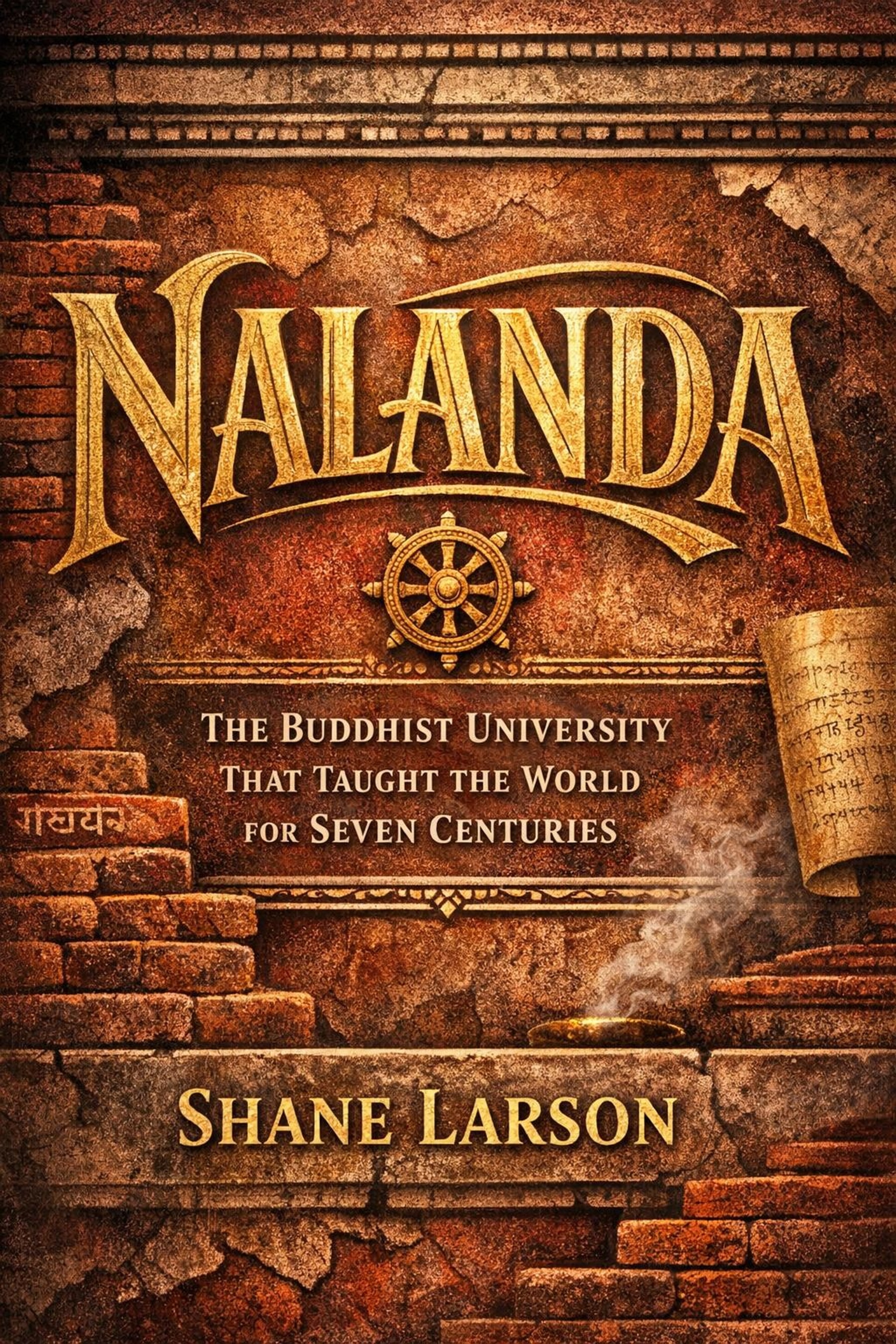
This article draws on my book Nalanda: The Buddhist University That Taught the World for Seven Centuries, which reconstructs the institution in full — the admissions examination, the curriculum, the funding, a day inside the walls hour by hour — and then takes the evidence for the ending apart piece by piece. It is part of the Lost Knowledge series, alongside The Library of Alexandria. If seven hundred years of an institution nobody ever taught you about sounds like your kind of history, the book is available in ebook and paperback.
Nalanda
New posts and releases, straight to your inbox. No spam, unsubscribe anytime.