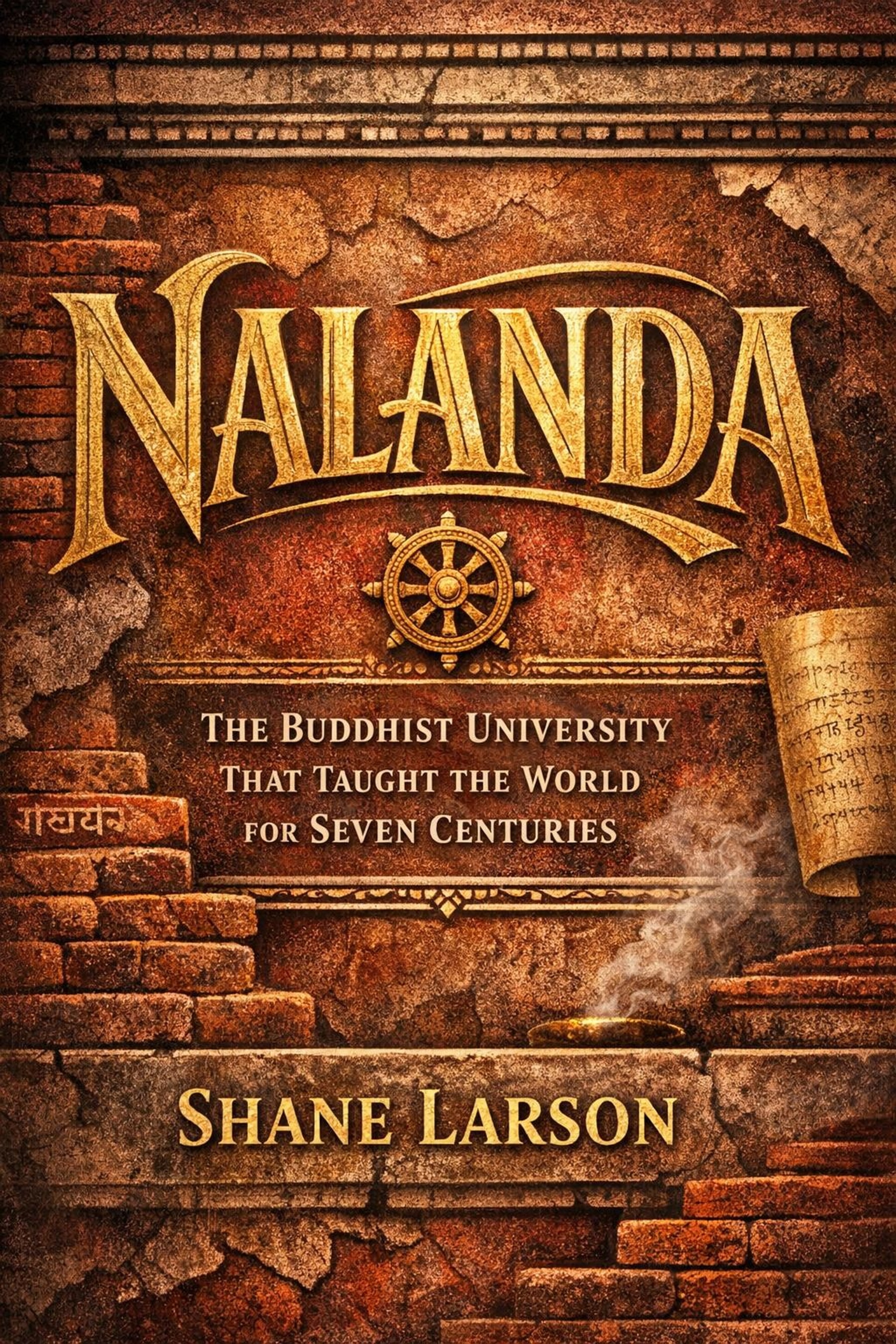
Nalanda
The Buddhist University That Taught the World for Seven Centuries
By Shane Larson
About This Book
A man arrives at a gate in northern India in the seventh century, having walked across a continent to get there. He is not admitted. Before anyone asks his name, a scholar posted at the entrance puts a question to him and waits to see what he does with it.
This was standard procedure, and by every surviving account most people who presented themselves at that gate did not get through it. The examination was oral, adversarial, and not a test of memory. It measured one thing: whether the applicant could take a position and hold it while someone competent tried to dismantle it. That was the skill the institution existed to manufacture, and it made sense to check for the raw material first.
Behind the gate stood a residential campus of roughly ten thousand people — students, teachers, cooks, copyists, administrators — in eleven brick monasteries facing a row of temples. Fixed syllabus, resident faculty, endowment, bureaucracy, and a library in three multi-storey buildings. It ran for some seven hundred years. Today it is a field of foundations in Bihar, and almost nothing written inside it survives in the language it was written in.
The Argument
The strange thing about Nalanda is not that it was destroyed. Most ancient institutions were. The strange thing is how consistently it gets written about as a place — a monument to admire, a ruin to mourn — when what makes it remarkable is that it was an organisation, and organisations can be reconstructed. This one had an admissions process, a sequenced curriculum, a payroll, a supply chain, and a revenue model that had to balance every year for seven centuries.
All of that is recoverable. The excavated ground gives up the kitchens, the granaries, the wells and drains, the cells with their brick beds and lamp niches, the seals that name the place. The copper-plate grants show how it was paid for: kings assigned it the tax revenue of named villages, which made a monastery into a landlord and its abbot into an administrator. And the Chinese pilgrims recorded the daily texture of it — best evidence there is, and skewed toward the impressive, which this book handles rather than ignores.
The funding model explains both halves of the story. An institution supported entirely by royal grants, with no independent endowment and no lay congregation to miss it if the monasteries closed, is durable exactly as long as the kings are. When the patronage narrowed, it had nothing else to stand on.
Then there is the ending, which almost everyone gets wrong — because the popular version comes from a single Persian chronicle written decades later by a man who was never there. What the ground shows is a burn layer that cannot be pinned to a year or a hand, at a site that had burned and recovered before. What the Tibetan record shows is a reduced community still teaching at Nalanda in the 1230s, decades after the annihilation it supposedly did not survive.
Why I Wrote This
I came to Nalanda from a run of books about lost libraries — Alexandria, Baghdad, the carbonised scrolls at Herculaneum, the manuscripts that went west out of Constantinople — and expected the fifth version of the same shape. It is not. It is the one where the loss turned out to be survivable, and I did not see that coming.
The buildings are gone and the collection is gone, but the reading list is not, because it had already left. Students carried it out of India in their luggage, into Tibetan and Chinese, and it is still being worked through in monastic colleges eight hundred years later. The interesting question stopped being what was destroyed and became what an institution actually is — and whether the thing worth preserving was ever the building.
The other reason is the ending. I kept following the destruction story back toward its source and finding there was only one, that it was late, and that it did not quite say what everyone reports it as saying.
Frequently Asked Questions
Was Nalanda really the world's first university?
It depends on what you mean by university, and the book takes the question seriously rather than scoring a point with it. Nalanda had an entrance examination, a defined curriculum, a resident faculty, an endowment, and residential students from a dozen countries, in one place across centuries. It did not have degrees, corporate legal personality, or an endowment that outlived its patrons. It was the largest and longest-running teaching institution of the ancient world and needs no borrowed category to be impressive.
Do I need to know anything about Buddhism to read this?
No. The philosophy is here because people spent their lives on it, and it is explained only as far as you need to follow why they cared — always through a specific argument between named people, never as doctrinal summary.
Did Bakhtiyar Khalji really burn the library for months?
That claim comes from one Persian chronicle, the Tabaqat-i Nasiri, written in the 1260s by a man reporting at second hand under a patron in Delhi. Two chapters cover what the text says — including whether the site it describes is Nalanda at all, or the nearby monastery at Odantapuri — what the archaeology supports, and where the gap between them is.
Is this book about Hindu-Muslim conflict?
No, and it deliberately declines to be. The narrative ends in the pre-modern period and treats the thirteenth-century campaigns as military and political history. Buddhism's retreat from India is examined as an institutional process well advanced before any army reached Bihar — a monastic religion with no household ritual life had no constituency to miss it. Modern political uses of the story get one paragraph, which notes they exist and declines to adjudicate them.
How much of this is guesswork?
Some of it, and the book says so rather than smoothing it over. Chapter 14 closes by stating confidence levels item by item — what the evidence supports, what it merely permits, and what it does not support at all. Where the reconstruction is inference rather than something a source states, that is flagged where it happens.
If You Liked This, You Might Like
- The Library of Alexandria — The other great library whose destruction story rests on far less evidence than everyone assumes.
- The Mauryan Empire — Ashoka and the earlier Magadhan world, on the same stretch of the Ganges plain, and the patronage precedent that made a place like Nalanda thinkable.
- The Indus Script — What it looks like when a civilization's writing does not survive at all.
- The Khmer Empire — Another vast Buddhist institution in stone, with a disappearance slower and stranger than the legend.
Seven centuries of scholarship, an examination most applicants failed, and a library that no longer exists — reconstructed as the working institution it was, with the evidence and its limits stated plainly.
What You'll Learn
- How the entrance examination at the gate worked, who administered it, and how much of what we think we know rests on one admiring foreign account
- What ten thousand residents studied: the Buddhist core plus compulsory grammar, logic, medicine, mathematics and astronomy — and rival philosophical systems taught deliberately as the opponent's position
- Why formal public debate was the engine of the whole system, and how it drove Indian logic into a technical discipline rival schools had to answer
- A day at the mahavihara reconstructed from excavated fabric rather than praise literature — including the plumbing, because ten thousand residents are first and last a sanitation problem
- Xuanzang's years at Nalanda and the manuscript caravan he carried home, and Yijing's sea route via Sumatra with the most granular account of daily monastic life that survives
- How assigned village revenue funded seven centuries of scholarship — and why the same design decided how it ended
- Why a Sanskrit text lost in India can be recovered from Tibetan almost sentence by sentence
- What the evidence about 1193 actually supports, and where the popular story outruns it
Included with Kindle Unlimited — read it free if you're a member.
New Ancient History releases and free chapters — no spam, unsubscribe anytime.
More in This Genre
View all →