Penelope's Weaving Trick Fooled a Hall Full of Armed Men for Three Years — and Bronze Age Economics Explains Why It Worked
October 5, 2026 · 7 min read
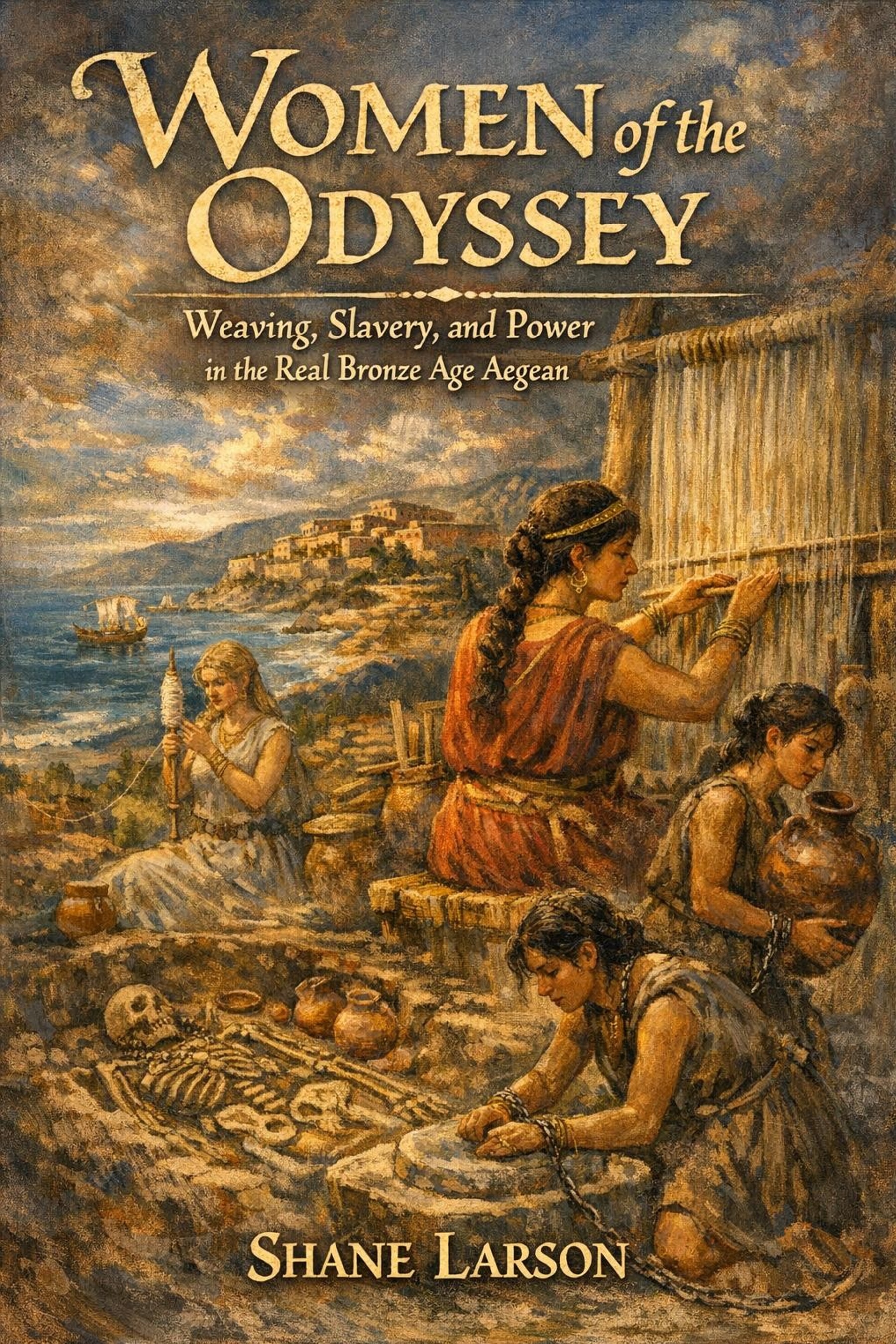
Everyone knows the trick. Penelope, besieged by suitors who want her hand and her missing husband's estate, promises she will choose one of them — but only after she finishes weaving a burial shroud for old Laertes, her father-in-law. It would be a scandal, she tells them, for a former king to lie in death without a proper cloth. The suitors agree. So by day she weaves at the great loom in the hall, in full view, and each night she picks the day's work apart, thread by thread. For three years the shroud advances and retreats, until one of her own household women gives her away.
It gets told as a charming story about a clever wife. Read it with a colder eye and a question surfaces that the charm papers over. The suitors were not fools. They were dozens of men with a direct financial interest in the timetable, living in the same house as the loom. They accepted "when the shroud is done" as a real deadline — and then watched a single weaver work at one loom for three years before anyone suspected fraud.
For that to be believable inside the story, and believable to the poem's original audience, everyone involved has to share an assumption so solid nobody needs to state it: that a great cloth, woven by one woman, honestly could take years.
Here is the remarkable thing. We can now check that assumption. The numbers survive — in clay tablets, in loom weights, and in modern experiments with reconstructed Bronze Age tools — and they say the suitors were right to wait.
The Palace That Counted Eighty Thousand Sheep
Start with what cloth was worth, because our instincts about fabric are exactly backwards. For us, cloth is the cheapest thing we own. In the Bronze Age Aegean, cloth was wealth — portable, durable, divisible, storable, and endlessly in demand. A fine textile concentrated hundreds of hours of skilled labor into an object you could fold and carry. Palaces warehoused textiles the way later states warehoused silver, and Egyptian tomb paintings show Aegean envoys arriving with folded cloth among their diplomatic gifts.
We know this because the palaces kept books, and some of the books survived. The Linear B tablets — unbaked clay administrative records, preserved only because the buildings that held them burned — include a vast block of records from Knossos on Crete that do nothing but track sheep. Flock by flock, shepherd by shepherd, the tablets add up to something on the order of 80,000 to 100,000 animals under palace supervision. The exact total depends on how you handle damaged tablets, but the scale is not in doubt. And these flocks were overwhelmingly castrated rams — wool animals, not meat. The palace set wool targets per flock, recorded the yields, and noted the shortfalls in writing.
Follow the wool inward and you find the other half of the ledger: tablet series recording cloth production targets assigned to work groups, wool allocated for the purpose, and inventories of finished textiles by type and grade. The Cambridge scholar John Killen spent decades on these records, and his central finding has held up for over half a century: the palace at Knossos ran an integrated, targeted wool-to-cloth industry. Flocks assessed, wool weighed out to work groups against production quotas, finished goods collected and stored. Seen through its own accounts, Mycenaean palace civilization was, to a remarkable degree, a machine for turning grass into cloth.
And the hands inside that machine belonged to women. The parallel archive at Pylos, on the Greek mainland, records roughly 750 women workers with their children — the single largest labor force in the archive — organized into named trades: a-ra-ka-te-ja, the spinners; pe-ki-ti-ra₂, the carders; a-ke-ti-ri-ja, the finishers; even a-pu-ko-wo-ko, makers of headbands. A divided, specialized, industrial workforce, fed monthly rations of wheat and figs, recorded to the unit. When the poem puts a loom in the great hall and a woman at it, it is placing at the center of the house exactly what the tablets place at the center of the economy.
Spinning, Not Weaving, Is the Bottleneck
Now for the number that rescues Penelope's alibi — and it hides in the part of cloth-making that every ancient image shows and every modern reader skips.
Women of the Odyssey
Before anyone can weave, someone must spin. Every thread in the cloth has to be made by hand, meter by meter, on a drop spindle — a slender stick with a small clay or stone flywheel. Spindle whorls litter Aegean archaeological sites almost as thickly as loom weights do, and for good reason. Modern experimental archaeology — above all the systematic program at the Centre for Textile Research in Copenhagen, where Eva Andersson Strand, Marie-Louise Nosch, and colleagues put reconstructed Bronze Age tools into the hands of experienced craftspeople and timed the work — has established the real shape of textile labor. The headline finding: spinning, not weaving, is the bottleneck. It takes on the order of a hundred hours of spinning to produce the thread that a weaver can then weave up in something like ten. The ratio shifts with thread fineness, but the imbalance never goes away. The picturesque part of cloth-making — the loom with its rising web — is a small fraction of the labor. The invisible part is the overwhelming majority.
Put the whole chain together — sorting and combing the wool, spinning, dressing the loom, weaving, finishing — and a large textile represents somewhere between roughly 450 and well over 1,200 person-hours, depending on the fineness and density you assume. Estimates vary, and honesty requires the range rather than a false point. But the order of magnitude is secure, and the order of magnitude is the point. A dense, decorated cloth fit for a king's burial was a significant fraction of a working year for a palace workshop — and far longer for one woman weaving alone, at queenly pace, with a household to run.
Walk back into the hall of Ithaca carrying those numbers and every joint of the story tightens. The suitors — men of property from a world saturated in textile work, every one of them raised within earshot of a spindle — do not scoff at a timetable measured in years, because nothing in their experience says a lone weaver should be faster. Penelope's deadline was credible because the labor was real.
And the nightly unraveling is better engineering than it looks. Pulling out the day's weaving does not destroy the thread — it returns it to yarn, ready to be woven again. Each night she spends the cheap half of the labor twice while banking the expensive half once. If you set out to design a delay that maximized apparent progress per hour of real progress, you would design exactly this.
The Only Capital Equipment She Controlled
Step back and the loom itself comes into focus as the real instrument of a twenty-year holding action. Penelope commands no soldiers, holds no assembly, and controls no legal process. Her son is too young; her husband is presumed dead. What she has is the standing of the great house — and the loom, the one productive engine of that house that is unquestionably, customarily, entirely hers. Cloth is the wealth a woman makes and, within the household, disposes of. When Penelope needs to convert her position into time, she reaches for the only capital equipment she controls, and it holds off dozens of armed men for three years.
Let me be exact about which claims live in which register, because the difference matters. That cloth was central palace wealth is what the tablets record. That women performed the bulk of textile labor is likewise documented, trade by trade and ration by ration. That a large textile cost hundreds to over a thousand hours, most of them spinning, is scholarly inference from experiment — strong, replicated, published with its assumptions showing. But Penelope wielding the loom as an economic instrument is a reading — an interpretation of a poem, made credible by the documented world around it. No tablet says a woman used cloth as leverage; tablets do not say things like that about anyone. The evidence builds the stage and prices the props. The play is still the poem's.
What the evidence does insist on is that the world in which the trick makes sense was real. The wealth was cloth; the cloth was women's hours; and everyone knew it, down to the suitors' three-year patience. That famous ruse was never a housewife's charming delay. It was the deployment of the only economic instrument its author controlled — and the numbers say it should have worked.
If this way of reading the poem appeals to you — taking its women one by one as doorways into the tablets, the archaeology, and the hard evidence of the Bronze Age Aegean — my new book does exactly that, at length, for all of them: the queens, the priestesses, the working women of the ration lists, and the enslaved. It is history, not a retelling, and the evidence turns out to be more interesting than any invention.
Women of the Odyssey: Weaving, Slavery, and Power in the Real Bronze Age Aegean is available now on Amazon Kindle.
Women of the Odyssey
New posts and releases, straight to your inbox. No spam, unsubscribe anytime.