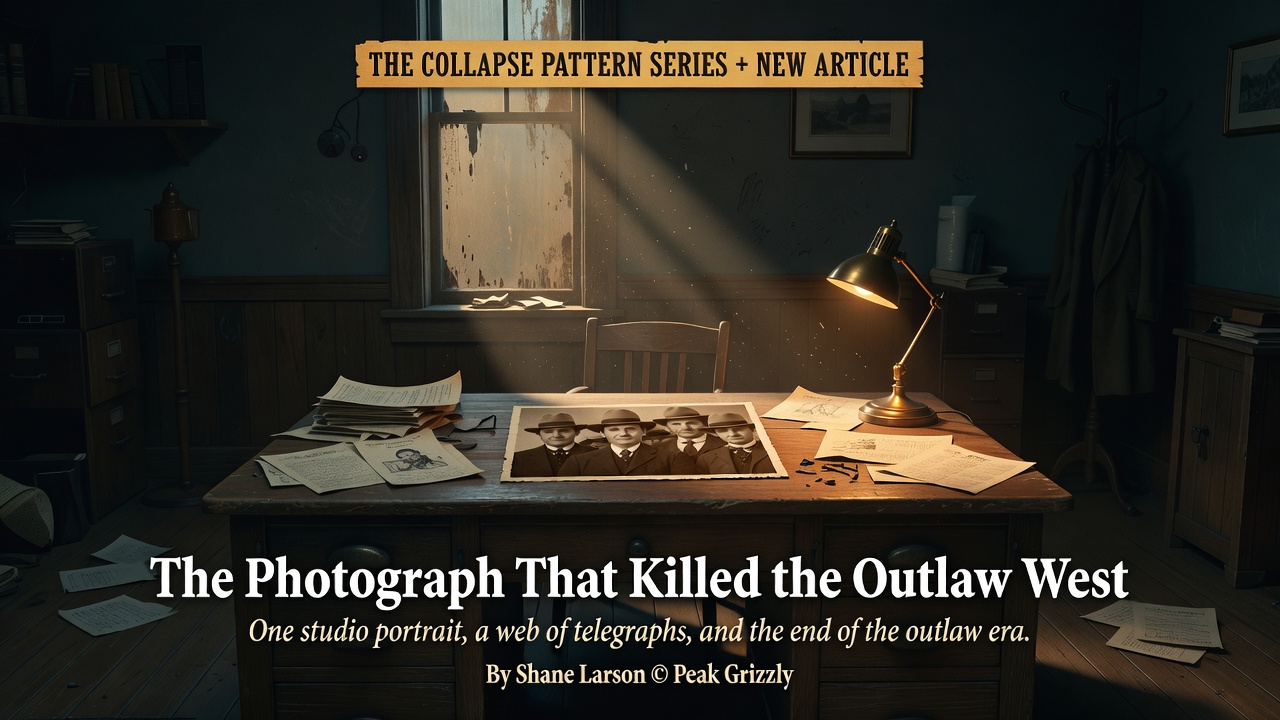
The Photograph That Killed the Outlaw West
June 26, 2026 · 5 min read
There is a photograph, taken in Fort Worth, Texas, in the autumn of 1900, that you have almost certainly seen. Five men in fine suits and derby hats sit and stand around a studio backdrop, looking prosperous and pleased with themselves. Two of them are seated in the front row: a round-faced, faintly smiling man on the right, and a sharper, harder-eyed man on the left. The first is Robert LeRoy Parker. The second is Harry Longabaugh. The world would come to know them as Butch Cassidy and the Sundance Kid.
It is one of the most reproduced images in the history of the American West. And here is the strange, almost unbelievable thing about it: that photograph is a large part of why both men are dead.
Outlaws who walked into a camera
To understand why a group portrait could be lethal, you have to understand what the West was in 1900, and what it was about to stop being.
For roughly thirty years, the interior West had offered something no settled country could: anonymity. A man wanted in Wyoming could ride south into Utah, change his name, grow a beard, hire on at a ranch, and effectively cease to exist as far as the law was concerned. There was no national database of faces. There were no fingerprints in routine use. A sheriff's authority more or less ended at his county line, and communication between jurisdictions moved at the speed of a horse or, at best, a sporadic telegram nobody was coordinating.
Butch Cassidy built an entire career inside that gap. Born in 1866 to a Mormon homesteading family in Beaver, Utah, he drifted from hard-luck ranching toward rustling under the wing of an older outlaw named Mike Cassidy, whose surname he borrowed. The nickname "Butch" came later, from a stint working as a butcher. By the late 1890s he was the organizing intelligence behind a loose, rotating confederation of robbers that the newspapers christened the Wild Bunch.
They operated out of a chain of natural fortresses known as the Outlaw Trail — Hole-in-the-Wall in Wyoming, Brown's Hole on the Colorado-Utah line, Robbers Roost in the Utah canyonlands. These were not clubhouses. They were remote, defensible, hard-to-reach country where a posse could be seen coming for miles and where a stranger could not approach unnoticed. The geography itself was the gang's security system.
Robbing the wrong target
For a while, the Wild Bunch did well. The 1896 bank robbery at Montpelier, Idaho. The audacious 1897 daylight grab of the Castle Gate mine payroll in Utah. Then the gang made the leap that would prove fatal: they started robbing trains.
The 1899 holdup at Wilcox, Wyoming, was spectacular — dynamite, a blown express car, banknotes scattered across the prairie. The 1900 robbery near Tipton was more of the same. These were headline crimes, and they generated enormous rewards. But more importantly, they changed who was hunting the gang.
A bank that gets robbed is a local problem, handled by a local sheriff. A train is different. Railroads and the express companies that shipped money on them were large, modern, national corporations, and they did not rely on county lawmen to protect their property. They hired the Pinkerton National Detective Agency.
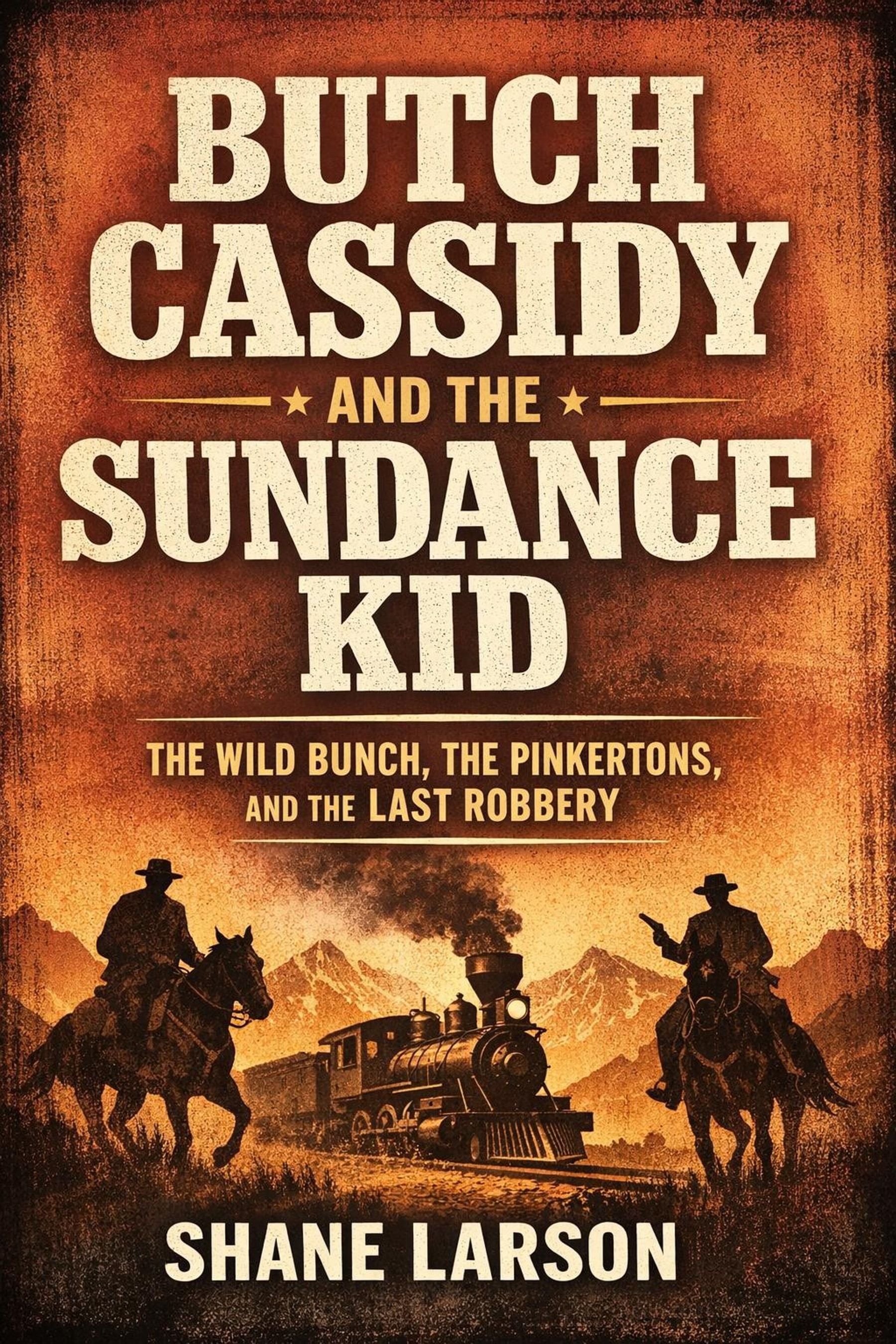
Butch Cassidy & the Sundance Kid
This is the pivot on which the whole story turns, and it is why Butch and Sundance belong in a conversation about modern history and not just frontier folklore. The Pinkertons were something genuinely new. They kept files. They built a "rogues' gallery" of criminal photographs. They circulated detailed descriptions and rap sheets. They used the telegraph not as an occasional convenience but as a coordinating nervous system, wiring a suspect's description ahead of him faster than he could ride. Agents like Charlie Siringo pursued the Wild Bunch not with a six-gun and a fast horse, but with paperwork, patience, and reach.
In other words, the railroads sent the future after them.
The vanity that became evidence
Which brings us back to Fort Worth.
In 1900, riding high, the core of the Bunch did something that, in hindsight, looks almost suicidal. They went to a studio and had their portrait taken — a confident, well-dressed group memorial to their own success. The story goes that the photographer was so pleased with the result he displayed it in his window. A Pinkerton man, or someone who passed it along to one, recognized a face.
And that was the end of the hideout West.
The Pinkertons obtained the photograph and turned it into the single most effective wanted poster of the era, circulating those clear, well-lit faces across the country and, eventually, around the world. The defensive geography of the Outlaw Trail was now worthless. It did not matter how remote Robbers Roost was if your face had already arrived, by wire and by mail, at every depot and police office between Wyoming and Buenos Aires. The anonymous frontier — the thing that had made a man like Butch Cassidy possible — no longer existed.
Outlaw vanity had produced the exact piece of evidence that ended their freedom. It is one of the great ironies in American history, and it is also a remarkably modern one. We live now in a world saturated with circulated images, where a face can travel faster and farther than the person attached to it. Butch and Sundance were among the first people on the continent to be destroyed by that fact.
Nowhere left to hide
Understanding the photograph explains everything that comes after, which is otherwise hard to make sense of. Why would two successful American outlaws abandon the only country and culture they knew?
Because there was nothing left for them in it. So in 1901, with Sundance's mysterious companion Etta Place, they sailed for Argentina. For several years they ranched legitimately in the Patagonian frontier at Cholila — a genuine attempt, the land records suggest, at a straight life. But the Pinkerton reach extended even there, and as the legitimate venture faltered they drifted back into robbery in South America. The trail ends in February 1908, in a high cold mining village called San Vicente, Bolivia, in a courtyard shootout that no North American ever witnessed and that the historical record still cannot fully reconstruct.
Whether the two men buried in those unmarked graves were really Parker and Longabaugh is a question that has never been definitively answered. But the deeper ending is not in doubt. The world that made them — wide open, unwired, anonymous — was already gone, killed off by telegraph wire, corporate persistence, and a single photograph they were vain enough to pose for.
That is the real story, and it is bigger than any gunfight.
Butch Cassidy & the Sundance Kid
New posts and releases, straight to your inbox. No spam, unsubscribe anytime.