Rome Lost More Ships to the Weather Than to Carthage
August 12, 2026 · 7 min read
In the early summer of 255 BC, a Roman fleet of more than 360 warships was working its way east along the southern coast of Sicily, heading home. Weeks earlier it had crushed a Carthaginian fleet off Cape Hermaeum, capturing 114 enemy ships with their crews. It had completed its mission — lifting the survivors of a beaten Roman army out of Africa — and it was carrying them home along with thousands of prisoners and the baggage of a sixteen-month campaign.
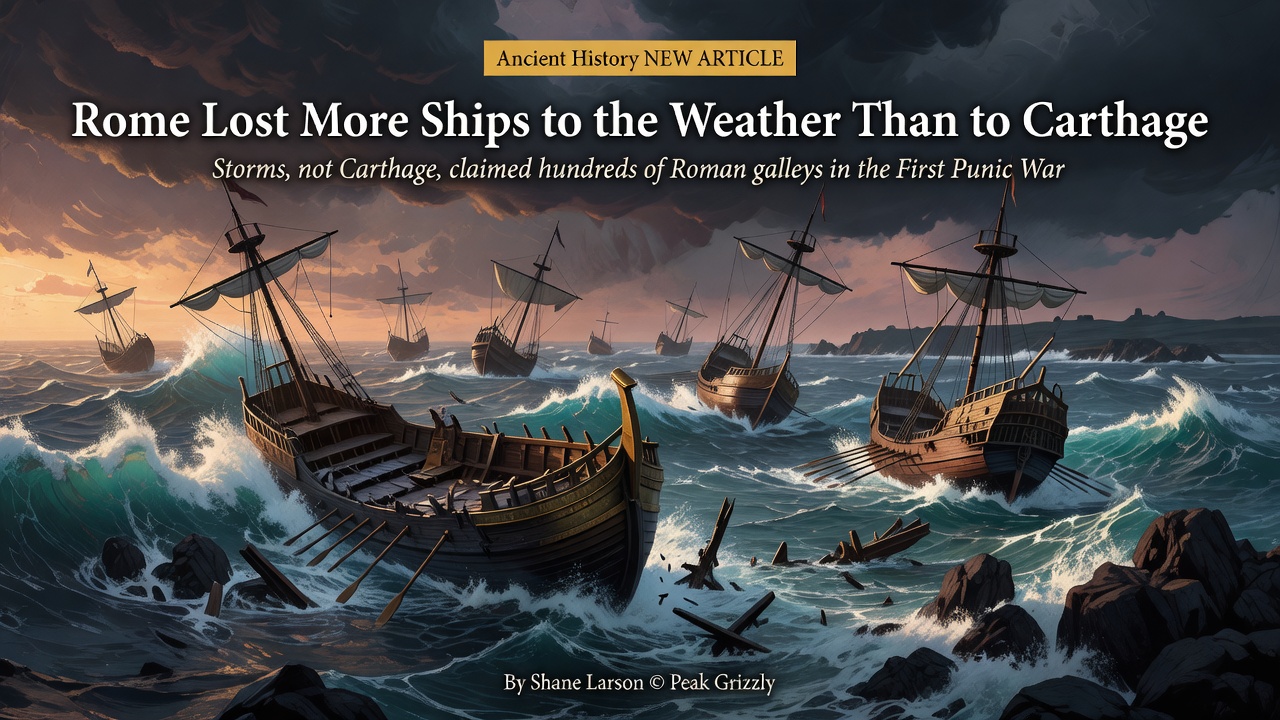
Then the wind came up from the south, and in a single afternoon the sea did what Carthage never managed in twenty-three years of war. Polybius, our best source for the period, reports that of more than 360 ships, 80 survived. The rest — something like 280 hulls — were driven onto forty miles of harbourless shore between Camarina and Cape Pachynus and broken apart in the surf. Modern estimates of the dead land in the neighbourhood of 100,000 men. If those figures are anywhere near right, no maritime disaster in recorded history is larger. The worst sinkings of the twentieth century's wars approach ten thousand dead. One gale in the third century BC took ten times that, and the enemy was nowhere in sight.
Here is the part that should reframe how you think about ancient naval warfare: this was not a freak event. It was the pattern. Across the First Punic War (264–241 BC), Rome lost roughly 700 quinqueremes — the standard heavy warship of the day — and the majority went down in storms, not battles. Two more fleets were destroyed by weather in 253 and 249 BC. Carthage, the finest naval power in the western Mediterranean, sank and captured Roman ships by the hundreds. The sea beat that total easily. The war's deadliest combatant was the weather, and it never signed the peace treaty.
Why a war galley could not survive a gale
To understand why the losses ran this high, you have to understand what an ancient warship actually was — nothing like the wooden warships of the age of sail that dominate our mental pictures of naval disaster.
A quinquereme was a rowing machine with a bronze ram on the front — roughly 45 metres of pine and oak, packed with around 300 oarsmen plus marines and officers. Everything about the design was bought at the edge of stability in exchange for speed under oar. The hull was a shell of planks edge-joined by thousands of wooden tenons, stiff and strong for its intended work, and its intended work was smooth water. Freeboard — the height of the deck above the waterline — was a few feet. The oars ran out through ports barely above the sea. There was no ballasted keel, no meaningful cargo hold, and room for only a few days of water for the rowers, which is why ancient fleets crawled from beach to beach and hauled out at night. These were coastal animals. The open sea was a risk they took in short, calculated doses.
Now put that machine on what sailors call a lee shore: a coastline with the wind blowing onto it from the sea. A lee shore is the defining terror of the sailing era, because the only way to survive one is to claw your way to windward, against the wind. A quinquereme could not do it. Its single square sail could run before the wind or take it on the quarter; against the wind it was useless. Its oars — the backup engine — failed at exactly the moment they were needed most, because in a heavy sea those low oar ports ship water with every roll, and oar blades cannot grip broken, foaming water anyway. Anchors were light by later standards and dragged through the sandy bottom. Every ship caught on that Sicilian coast in 255 faced the same short menu: drag slowly ashore at anchor, run deliberately for the beach and hope to strike bow-on, or be caught broadside in the breakers and rolled. A tenon-joined hull pounded on sand in surf does not sink so much as come apart, opening along its seams.
And below deck were three hundred rowers, packed shoulder to shoulder, with a few ladders between them and the air. Most of the men the First Punic War killed did not die by the sword. They drowned, many of them within sight of land.
The pilots said no
The bitterest detail: the disaster of 255 was predicted, specifically, by professionals, in advance.
The First Punic War
The fleet's gubernatores — its pilots, mostly Greeks and Italians from Rome's maritime allies — advised the consuls not to take the southern route at all. Their objections were pure accumulated knowledge. First, the coast: the southern shore of Sicily had no real deep-water harbour along the entire stretch — nothing but open roadsteads and beaches, tenable in settled weather and lethal in a southerly blow. Second, the calendar: the fleet would be sailing in the weeks between the rising of Orion and the rising of Sirius — late June into July — a window the Mediterranean sailing tradition had marked for generations as violently unstable. Ancient seafaring ran on exactly this kind of star-calendar rule, and the rules encoded real climatology: centuries of drowned men compressed into a sentence about when not to be at sea.
The consuls overruled them. Their motive, as Polybius records it, was to make a show of force along the coast and intimidate a few towns into switching sides. A demonstration cruise. Behind that small reason sat a structural one: a Roman consul held command for exactly one year, and whatever he had not achieved when the year ended became another man's opportunity. The pilot was a hired professional with no standing to insist; the consul's single summer outranked the sailing master's lifetime of local knowledge. Polybius, delivering his verdict on the wreck, widens it into a rare piece of national character analysis: the Romans, he observes, treat every obstacle as something to be overcome by force and will, and against human enemies that usually works — but the sea does not notice being defied. The same command structure would drown another fleet in 253, and another in 249.
There may also have been a mechanical culprit. Rome's great equaliser in this war was the corvus — the "raven" — a spiked boarding bridge mounted in the bow that pinned enemy ships in place so Roman infantry could storm across. It won every major fleet action from 260 to 255. It was also thirty-six feet of heavy timber standing high in the bow of a hull with almost no stability margin, and after the summer of 255 it disappears from the record without explanation. The inference — and it is a modern inference from silence, not an ancient statement — is that the weight that won the battles helped drown the fleets. The solution to the last problem became the next one.
The state that kept rebuilding
What happened next is, in its way, stranger than the storm.
The news reached Rome that the fleet was gone — the fleet that had won two of the most complete naval victories in ancient history, wiped out on the way home. The Senate ordered a new one. Polybius reports that 220 ships were laid down and completed within three months, a pace he flags to his own readers as barely believable.
It was believable, because of how the ships were built. A Punic warship excavated off Marsala in western Sicily carries letters of the Phoenician alphabet painted and incised on its timbers at the joints — assembly marks, keying each part to its place. That is prefabrication: hulls built to pattern by parallel work gangs rather than shaped plank by plank by a master's eye. It was a Carthaginian technique before it was a Roman one, and it is the answer to how both states could replace hundred-ship fleets within a year or two of losing them. Add the human ledger — the Roman census figures preserved from this period drop by tens of thousands of registered men across the years of the great fleet losses — and you get the real shape of the First Punic War. It was not decided by admirals. It was decided in shipyards and levy lists, by a state that could absorb the worst maritime disaster in recorded history as a line item and answer it with 220 keels.
Whether that capacity deserves admiration is a different question. Courage is a virtue of persons. What Rome displayed was capacity — an industrialised ability to absorb catastrophe and keep producing — and capacity has no natural stopping point. The storms tested it three times, and three times it held.
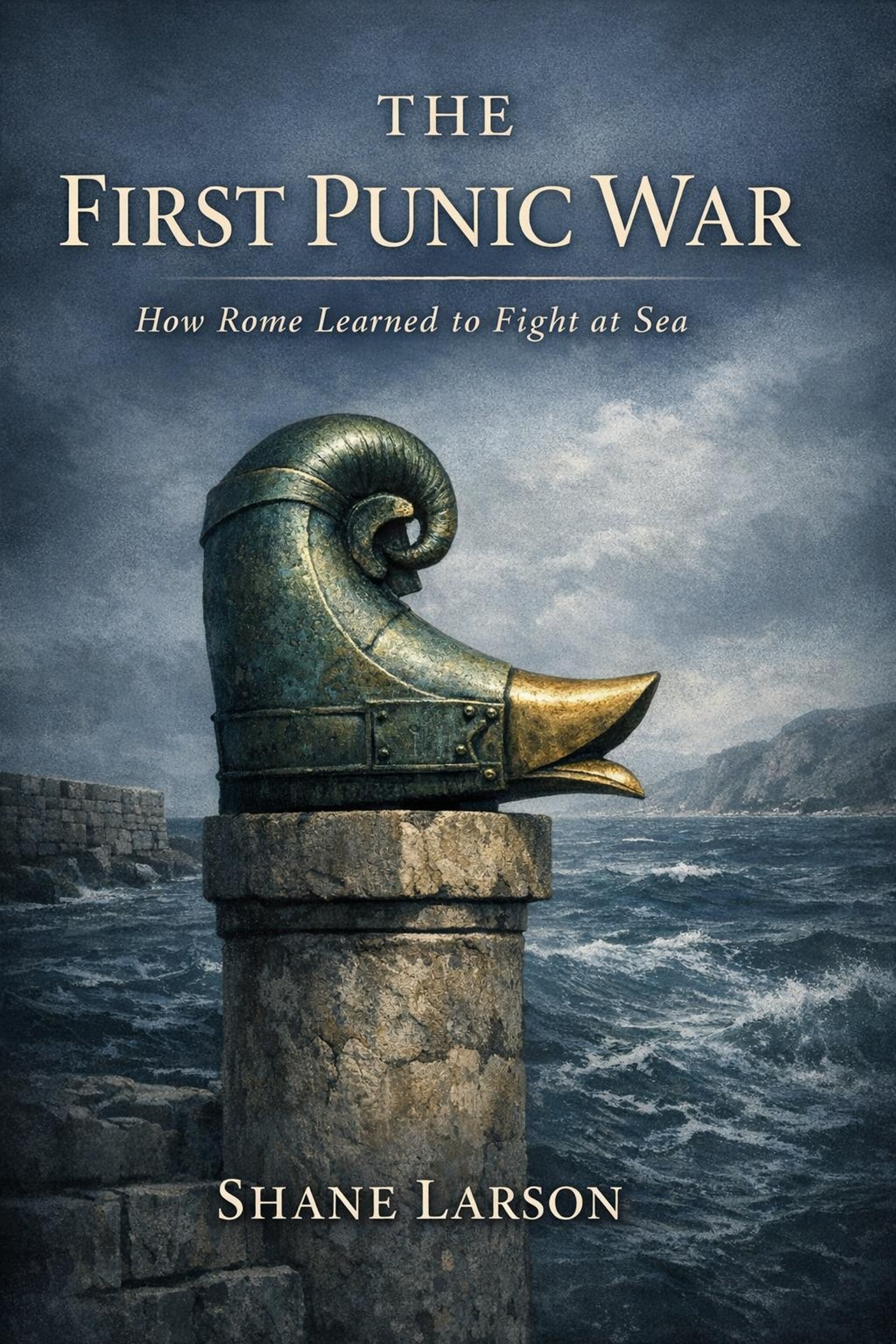
This article draws on material from my book "The First Punic War: How Rome Learned to Fight at Sea" — Book Four of the Rome: From Village to Empire series — which follows the whole twenty-three-year war, from the stolen city that started it to the bronze rams still being recovered from the seabed where it ended.
The First Punic War
New posts and releases, straight to your inbox. No spam, unsubscribe anytime.