Seven Thousand Towers and No Writing: Reading Bronze Age Sardinia from the Stone Up
September 20, 2026 · 7 min read
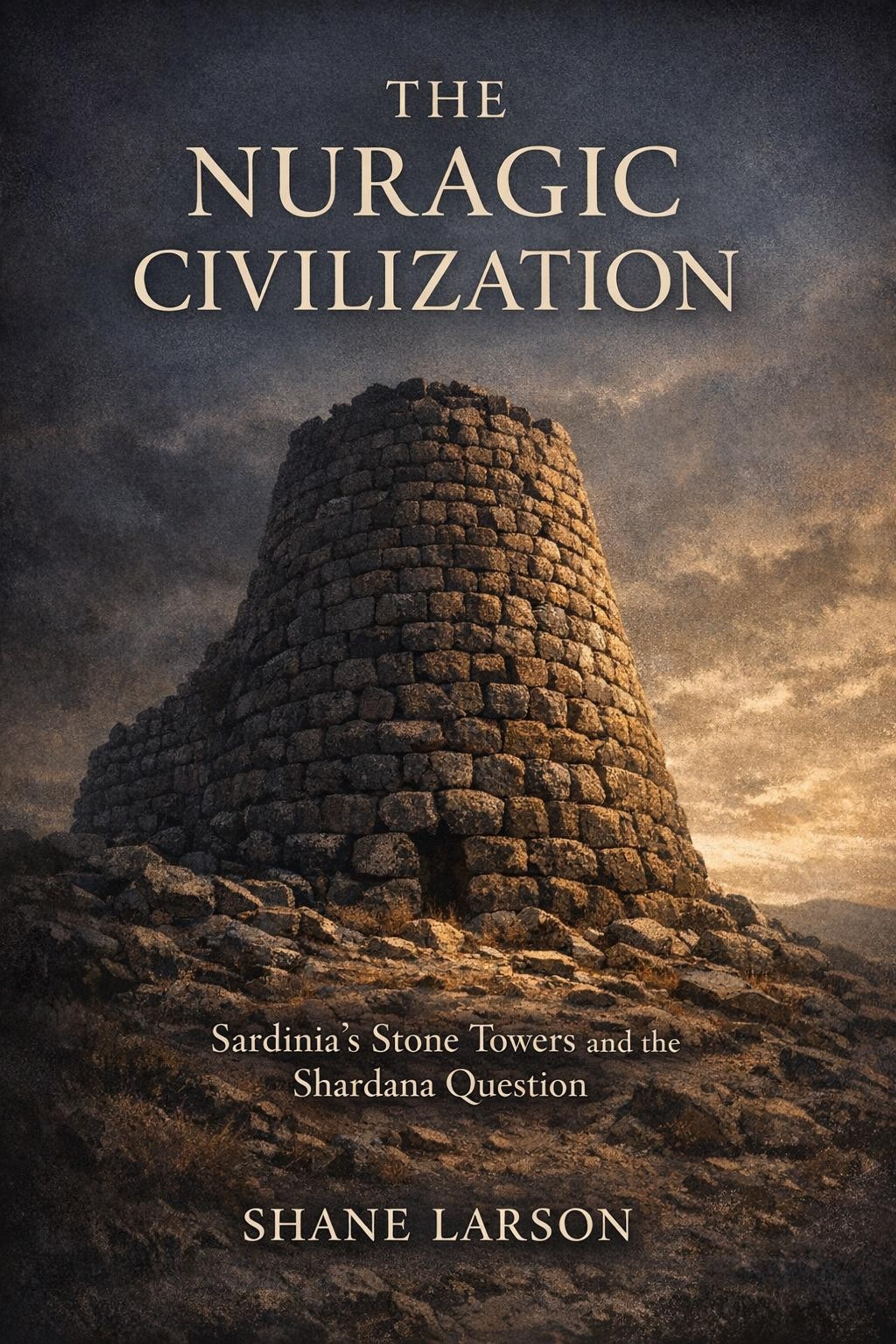
There are roughly seven thousand Bronze Age stone towers on the island of Sardinia.
That sentence deserves a moment before anything else gets said, because the number is doing more work than it appears to be. Sardinia covers about 24,000 square kilometres — the second-largest island in the Mediterranean, roughly the size of Wales, or of New Hampshire and Connecticut together. Seven thousand towers on that area works out to one for every three square kilometres or so, mountains included. They were built between about 1800 and 1000 BC, in the same centuries that Egypt was raising its New Kingdom temples and Mycenae its citadels, by an island population that cannot have been large. Egypt built taller and Mesopotamia built older, but nobody in the ancient world built more — not at this density, not across this much of a landscape at once. There is no comparable concentration of monumental architecture anywhere in Bronze Age Europe.
The towers are called nuraghi — singular nuraghe, a Sardinian word older than any record of it — and they are not roped-off ruins standing apart from the island's life. Farmhouses lean against them, using a 3,500-year-old wall as one side of a barn. Village churches sit on top of them. Their stones have been quarried for sheepfolds and field walls for two and a half millennia, and still seven thousand survive in countable form. Aerial survey keeps finding more, because a tower reduced to its lowest courses and mantled in soil looks, from the ground, like an ordinary low hill. Farmers have been ploughing around some of them for generations without knowing what they were ploughing around.
And here is the fact that turns an impressive statistic into a genuine problem: the people who built all of this left no writing. Not a tablet, not an inscription, not a scratched potsherd anyone can read. Seven thousand monuments and not one sentence.
How a tower stands for three thousand years without mortar
Start with the buildings themselves, because they are the least ambiguous evidence there is.
A nuraghe is a corbelled cone of dry-laid stone — very often basalt, of which volcanic Sardinia has an unreasonable supply. There is no mortar anywhere in it. Each course of the interior chamber oversails the one below by a controlled amount, ring above ring, until the circle closes at a point: a tholos vault, holding its own weight in compression, in the dark, for upwards of three thousand years. The walls are enormously thick, and inside their thickness runs a spiral stair to an upper chamber or a terrace. The simple version is a single tower. The developed version is something else entirely: a central tower ringed by additional towers, joined by curtain walls into bastioned complexes, with villages of round stone huts pooled around their feet. The greatest of them, Su Nuraxi at Barumini, is a UNESCO World Heritage Site and looks, in plan, less like a monument than a fortification a much later age would be pleased to have engineered.
Nobody involved could write down a load calculation. The knowledge lived in hands and in apprenticeships — how much oversail a course will tolerate, how to select and dress a stone, how to hold a consistent inward lean through ten metres of height — and it was transmitted, evidently without loss, across something like eight hundred years. The island's temple architecture sharpens the point. At the sacred well of Santa Cristina, a staircase descends through a keyhole-shaped cut to a corbelled chamber over the water table, and the masonry is cut and fitted with a precision that startles modern engineers. This is not rustic vernacular building. It is a tradition with specialists in it.
What you can read in stone
A society that writes nothing is not a society that says nothing — it just says it in a different medium, and the medium has one great virtue: it cannot exaggerate.
The Nuragic Civilization
Texts flatter. Royal inscriptions across the Bronze Age Near East record victories that were arguably defeats and tributes that may never have arrived. A tower is not like that. A substantial nuraghe represents years of labour by crews that had to be fed, directed, and kept at the work through building seasons; the multi-towered complexes represent generations of it. Nobody stacks two hundred thousand stones as a boast. So the towers encode, incorruptibly, what this society could actually organise: how many hands could be called on, whose land was whose, how much surplus grain existed to feed people who were building instead of farming. Seven thousand of them, spread in a dense mesh across the island — towers built in sight of other towers, in sight of others again — encode territories, boundaries, and neighbours who watched each other.
There is a second window too. These people portrayed themselves, in hundreds of small bronze figurines that archaeologists call bronzetti: warriors and archers in horned helmets, chiefs with staffs and cloaks, wrestlers, mothers, animals, and model boats with bird-headed prows, most of them left as offerings at sanctuaries. It is the rarest gift a textless culture can leave — a self-portrait — though like all self-portraits it has to be read with care, because nobody idealises quite like a portraitist.
And a third window: laboratory analysis. Copper ingots of a standard eastern-Mediterranean form have been found at dozens of Sardinian sites, and many of them are made of Cypriot copper — a finding of metallurgy, not interpretation. Whatever else is uncertain about Bronze Age Sardinia, it was in repeated, material contact with the far end of the Mediterranean. This island was inside the great Bronze Age trading network, not off its edge. Which matters enormously, because the eastern end of that network is where Sardinia may — the word is doing real work — have made it into somebody else's records. Egyptian scribes of exactly these centuries wrote about a seafaring people called the Shardana, who raided the Nile Delta, served in the pharaoh's own guard, and appear among the Sea Peoples. Warriors on the Egyptian reliefs wear horned helmets and carry round shields and long swords; so do the warriors of the bronzetti; and the name Shardana has sounded like Sardinia to everyone who has encountered the pair since the nineteenth century. Whether that resemblance is an identification or a coincidence is a genuinely open argument — serious people have read the same evidence in both directions for a hundred and sixty years — and it is one of the most interesting unresolved questions in ancient history precisely because it is unresolved.
The statement in the landscape
In 1974, at a place called Mont'e Prama on Sardinia's west coast, a plough turned up carved stone — and this time not a wall. Sculpture: fragments of human figures over two metres tall, boxers and archers and warriors with eyes formed of engraved concentric circles, deliberately smashed in antiquity and buried over a cemetery. Nothing else like them exists in the prehistoric western Mediterranean, from Sardinia or anywhere else. A civilisation nobody suspected of monumental sculpture had been making it after all, and the site is still only partly excavated. The island is, in a quite literal sense, not finished being discovered.
That may be the right note to end on. We are used to civilisations introducing themselves — telling us their kings' names, their gods, their grievances. The builders of the nuraghi never will. We do not know what they called themselves; even "Nuragic" is our word, taken from their buildings. But fame, as we have inherited it from the ancient world, is mostly an artefact of writing, and it is worth asking how much that accident has shaped which peoples we think mattered. Seven thousand towers are a statement about labour, land, and organisation that no chronicle could make more credible. It has simply taken three thousand years for anyone to start reading it.
Shane Larson's new book, *The Nuragic Civilization: Sardinia's Stone Towers and the Shardana Question*, tells the full story — the engineering of the towers, the bronze self-portraits, the giants of Mont'e Prama, and the case for and against identifying the island's builders with the Shardana of the Egyptian records, argued both ways and left, honestly, where the evidence leaves it. It joins his Bronze Age shelf alongside *Sea Peoples* and *When the World Burned*.
The Nuragic Civilization
New posts and releases, straight to your inbox. No spam, unsubscribe anytime.