In 91 BC, Italy Went to War Against Rome — for the Right to Become Roman
August 13, 2026 · 6 min read
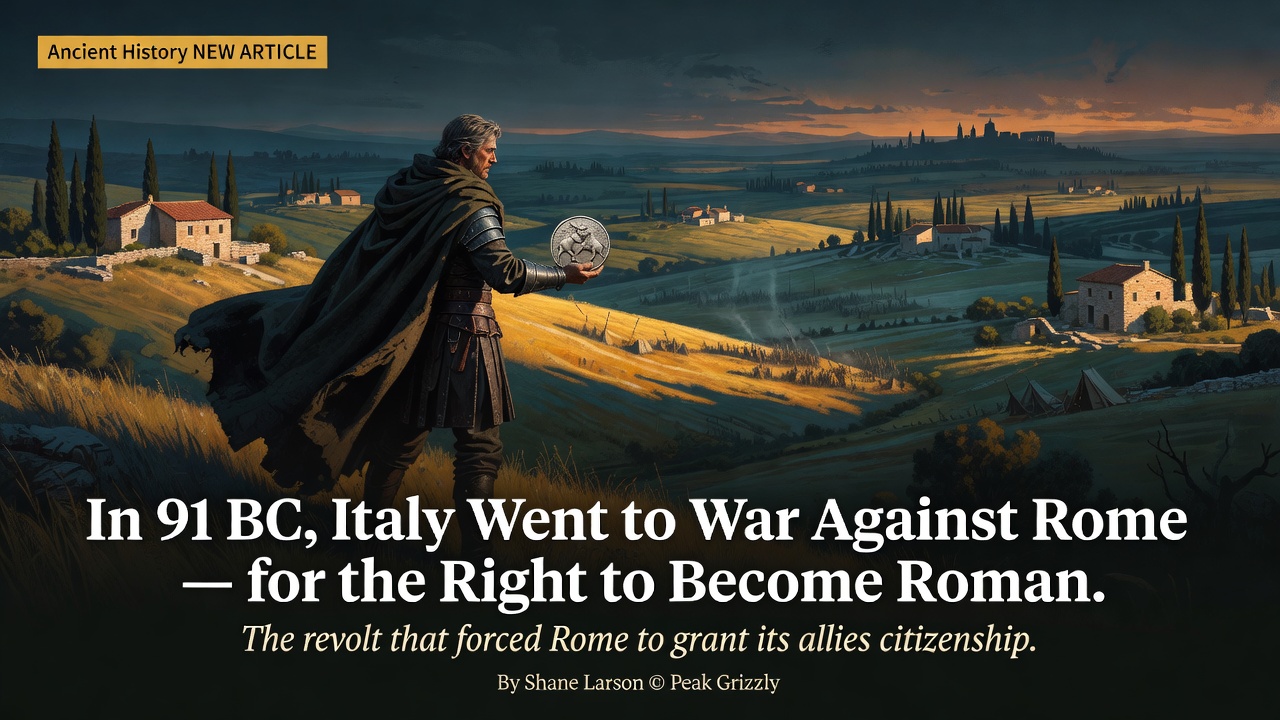
There is a silver coin from the early 80s BC, struck to the exact weight and fineness of a Roman denarius, that no Roman mint produced. On one face, a wreathed goddess. On the other, a bull has a wolf pinned under its forelegs, horn driven into its body, the wolf's head twisted back so that nobody could mistake how the fight ends. Every viewer in the Mediterranean knew that wolf: the animal that suckled Romulus. And where a Roman coin would say ROMA, some of these issues carry a different word. In Latin lettering, ITALIA. In the Oscan alphabet, running right to left, VÍTELIÚ — the same name in the other language of the peninsula.
That is the first time in history that Italy is the name of a state rather than a geographical expression. The idea that the peninsula was one political thing was invented by the losing side of a war almost nobody can describe, and stamped on silver to prove it.
The war those coins paid for killed more people in Italy than any conflict since Hannibal. Modern convention calls it the Social War, from socii, the Latin for allies — a name so bland it takes a moment to register what it means: the war against the allies. The war Rome fought against the other half of its own army. And at its center sits a paradox that makes it unlike any other rebellion in ancient history. The Italians did not rise to destroy Rome. They rose to be admitted to it.
Half of every army, and no vote
The grievance was arithmetic. The allied communities of Italy were bound to Rome by individual treaties, and the core obligation of every treaty was soldiers. When Rome counted every man of military age it could call on, in 225 BC, the total came to roughly 700,000 foot and 70,000 horse — and Roman citizens were well under half of it. A consular army was two legions of citizens plus an equal or larger force of allies, posted on the wings, where cavalry charges land and battles are lost. Allied soldiers had died at Cannae. They had died in the catastrophes against the northern tribes. They had dug the siege lines at Carthage and Numantia.
What they got for two centuries of that was a smaller share of plunder, no vote in the assemblies that declared the wars, and no right of appeal against a Roman magistrate — an allied notable could be flogged at a Roman official's whim in his own town, and the tradition preserved examples precisely because they rankled.
Three times the demand for citizenship was carried to Rome by constitutional means. In 125 BC a consul proposed it; the Senate maneuvered him out of the city, and the one Latin town that rose when the bill lapsed was demolished. In 122 Gaius Gracchus brought a franchise bill and lost it — not in the Senate but in the street, when his opponents asked the Roman poor whether there would still be room for them at the games once the Latins could vote. And in 91 Marcus Livius Drusus built the most intelligent legislative package of the age around the same grant, and was stabbed in his own doorway one evening. The killer was never found. The Italian leaders, who had negotiated with Drusus and hoped through him, concluded that the constitutional road was closed. They had watched it close three times in thirty-five years. It is hard to argue they misread it.
A rebel state, copied to the office
What the rebels built is the most revealing thing about them. They chose a capital — Corfinium, in the central Apennines — and renamed it Italia. They installed a senate of five hundred, two annually elected consuls, twelve praetors, and divided the military commands between the consuls exactly as Rome divided its own. They coined money on the Roman standard, exchanged hostages among the member peoples, and ran a federal war effort for years.
Blood in the Forum
Stop on that. Insurgents in a hurry do not write constitutions; these men did, and the constitution they wrote was Rome's, copied to the office. Nobody clones the thing they mean to annihilate. The bull gores the wolf on the coinage, but the institutions behind the coinage are the wolf's institutions, learned in two centuries of service under Roman command. The state called Italia was a Rome with the door open — governed by the men the actual Rome would not let in.
The war itself was as ugly as a war between two halves of the same army had to be. Both sides fielded roughly 100,000 men, by the ancient estimate. Both had the same equipment, the same drill, the same doctrine, in many cases veterans' scars from the same campaigns. There were no brilliant victories because neither side could be out-thought, only outlasted — so it became sieges, ambushes, burned towns. Rome lost two consuls in two years. The city formally set aside the toga and wore the military cloak for the duration. One ancient summary puts the total dead above 300,000; doubt the figure if you like, but not the scale.
The texture of it survives physically. Lead sling bullets from the sieges carry insults cast into the mold — in Latin and in Oscan, some addressed to enemy commanders by name — so the taunt left the foundry already built into the ammunition. At Pompeii, which joined the rebels, painted street-corner notices in Oscan still direct the town's defense, assigning each stretch of wall to a commander. They survive because the eruption that killed the town 168 years later sealed the paint. It is the one rebel town whose orders of the day can still be read on the masonry.
Rome wins by surrendering
By late 89 the grinding had produced a result that was not a victory. Rome had retaken Campania, broken the Picentes, burned its way across Samnium — and the demand the war was about stood exactly where it had stood when Drusus bled to death in his doorway. Sieges reach walls; the grievance was not behind any wall.
What broke the deadlock was a law, not a battle. Rome passed the lex Julia, granting citizenship to allies who had stayed loyal, then a second law extending it to almost anyone who applied. The rebellion collapsed — because its cause had been conceded. Within a few years the census of Roman citizens more than doubled, from under 400,000 toward a million. The state that could not survive a land bill without bloodshed absorbed the population of a peninsula in three years and was stronger for it.
There was a catch, and the catch drove the next decade: the new citizens were to be enrolled in a limited number of voting tribes, so that several hundred thousand new votes could be outvoted by the old ones. Rome conceded the principle and then spent ten years fighting over the arithmetic — a fight that ends with an army marching on Rome itself. But the concession was real, and it was permanent. Italy became Roman because Italians went to war to make it so, and Rome, having failed to beat them, opened the door it had held shut for forty years.
The wolf survived the bull by absorbing it. Within a generation, the descendants of the men who struck those coins were serving in Roman legions, voting in Roman assemblies, and sitting in the Roman Senate. The coins themselves went back to the mints as bullion; nearly every surviving example was buried in a hoard by someone who meant to come back for it and never did. The evidence of the losing side was preserved by the losing side's dead.
This article draws on material from my book "Blood in the Forum: The Gracchi, Marius, and Sulla" — Book Six of the Rome: From Village to Empire series — which covers the fifty-five years, from 133 to 78 BC, in which the Roman Republic discovered that its constitution had no procedure for a dispute neither side would lose.
Blood in the Forum
New posts and releases, straight to your inbox. No spam, unsubscribe anytime.