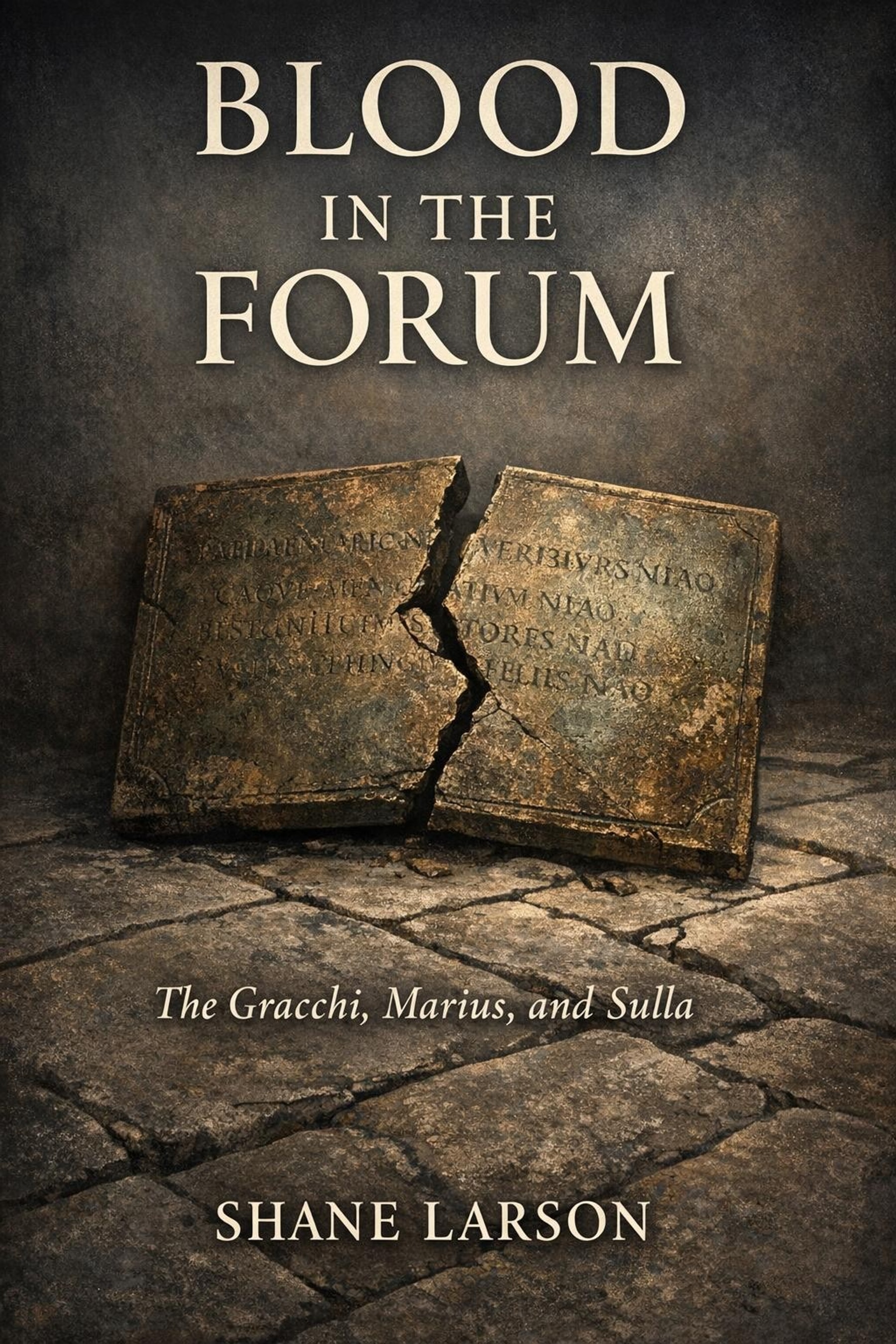
Blood in the Forum
The Gracchi, Marius, and Sulla
By Shane Larson · Rome: From Village to Empire (Book 6)
About This Book
In 79 BC the most feared man alive sent away his bodyguards and went home on foot. He had led a Roman army into Rome twice — the first commander in history to do it — won a civil war at the city's gates, and held a dictatorship with no term and no limit. Then he gave it all up, stood in the Forum as a man with no office and no guard, and offered to answer to anyone who cared to ask. No one did. No one has ever satisfactorily explained why he quit.
A few years earlier, mints in the Apennine hill towns had been striking silver coins that showed an Italian bull goring a Roman wolf. The men striking them were Rome's own allies, at war with Rome for the strangest of causes: not to destroy the city, but to be admitted to it. They built a rival capital, fought Rome to a standstill, and got what they wanted at the moment of their defeat. Their coins are the only substantial evidence in this story that speaks with a losing side's voice.
Between the bull on the coins and the dictator walking home unguarded runs the half-century in which the Roman Republic taught itself to kill its own citizens — while proving, against every expectation, that it could still turn a peninsula of outsiders into Romans in three years flat.
Rome had no written constitution and no court that could strike an act down. What it had was four centuries of habit: a veto any one of ten tribunes could cast, assemblies that made law, a Senate whose decrees carried no legal force and were obeyed anyway. Every device in the machine was a brake — it could block anything and decide almost nothing — and it ran on one unwritten assumption: that deadlock ends when somebody gives way, because somebody always had.
In 133 BC the tribune Tiberius Gracchus refused to give way, the Senate refused to let him win, and both sides discovered that no procedure existed for that situation. A crowd of senators filled the gap with clubs and broken bench-legs, several hundred bodies went into the Tiber, and no court ever examined any of it. That impunity — not the murder, the impunity — became a working part of Roman politics. Everything afterward is consequence: the decree invented twelve years later to give the killing of citizens legal cover, the fifty-year fight over the juries, the soldiers who learned that only a general could get them land, and at last the white boards in the Forum with names and bounties on them.
The argument of this book is that none of it needed villains. Ambition was nothing new in Rome — the city had run on it for centuries without a citizen dying over politics. What failed was narrower: a missing procedure for the dispute nobody would concede, and once violence filled that gap unpunished, each later escalation was a reasonable answer to the one before. The Social War at the book's center proves this was not general rot. Faced with allies demanding citizenship, Rome opened the door and more than doubled its citizen body in the middle of its worst internal crisis. The machine for making outsiders into Romans still ran. What Rome could no longer digest was a claim by one set of its own citizens against another.
Why I Wrote This
The Gracchi, Marius, and Sulla are names people recognize attached to events almost nobody can narrate. Caesar stands on one side of the gap, the early Republic on the other, and these fifty-five years — the ones that explain everything — sit in shadow between them. What finally pulled me in was the source problem, the worst in this series and not for the usual reason. It isn't thinness. It's hindsight: nearly every surviving account was written after the Republic was dead, by men who knew the ending and bent the story toward it. Work against that grain and you start trusting different witnesses — laws surviving on bronze, boundary stones still standing where the land commissioners planted them, sling bullets with insults cast into the lead. The documents don't know how the story ends. Building a book on them was a challenge I couldn't put down.
Frequently Asked Questions
Do I need to read the earlier books in the Rome series before this one?
No. This is Book Six of Rome: From Village to Empire, but each volume stands on its own. The introduction rebuilds what you need — the empire of 133 BC, the unwritten constitution, the Italian allies — before the narrative starts.
Is Blood in the Forum a narrative history or an academic textbook?
Narrative history for a general reader. The source problems are handled in the open: where the ancient accounts disagree or have an axe to grind, the book says so and shows why.
Does this book cover Julius Caesar?
Barely, and on purpose. Caesar appears on the final page, a patrician of eighteen or nineteen hiding in the Sabine hills after refusing Sulla's order to divorce his wife. His story belongs to a separate book; this volume supplies the world that made him possible.
How reliable are the ancient sources for the Gracchi, Marius, and Sulla?
Less than they look. Plutarch wrote moral biography two centuries after the fact; Appian's continuous narrative is shaped throughout by knowing where it all ends; Livy's books for these years are lost. The book checks the tradition against evidence that carries no hindsight — bronze legal texts, the Gracchan boundary stones, the rebel coinage — and Appendix C walks through each author's angle.
What was the Social War and why does it matter so much here?
The revolt of Rome's Italian allies in 91–88 BC — a war fought to become Roman, which Rome ended by granting the demand. It wrecks any simple decline narrative: a state that could not pass a land bill without bloodshed absorbed the free population of a peninsula in three years and came out stronger.
If You Liked This, You Might Like
- Mithradates — the king whose war becomes the prize Marius and Sulla tear the Republic apart to claim; his story runs through this book's final act.
- Spartacus — the slave war that erupts a few years after this book closes, in the Italy Sulla's veteran settlements had just redrawn.
- Julius Caesar — the young man in hiding on this book's last page, and what he did with the precedents these fifty-five years handed him.
- The Founding of Rome — Book One of the same series, where the citizenship machine that the Social War stress-tests was first assembled.
The Republic was built to stop things, and it worked as long as every deadlock ended in retreat; this is the record of the fifty-five years when retreat stopped coming. Rome: From Village to Empire, Book Six.
What You'll Learn
- A land bill that should have been routine — Tiberius Gracchus proposed enforcing a limit that had been law for generations, and the procedural chess match it set off is where the crisis really begins.
- The birth of the emergency decree in 121 BC, the Senate's instruction to "see that the state takes no harm" — an assertion, with no law behind it, that a citizen's right to trial could be suspended. Its first use killed three thousand people.
- Jugurtha's Numidia, where a king bribed his way through Roman justice and exposed a governing class with no working means of policing itself.
- The Marian army reforms tested against the evidence rather than the textbook legend — what Marius actually changed is smaller than the story says, and the truly fatal shift lies elsewhere.
- Arausio, 105 BC: two commanders who would not cooperate, annihilated separately on the same day, and the panic that made an outsider consul year after year against the law.
- The Social War at full length, from the assassination of the last man who tried to settle it legally, through the rebel state of Italia, to the concession that ended it — the most underserved war in Roman history.
- Sulla's marches, the Colline Gate, and the proscription lists, given plainly with the numbers and their provenance — then the constitutional settlement everyone skips, and the resignation nobody explains.
- Three reference appendices: the series' largest cast untangled family by family, the Republic's machinery with each failure point named, and a reckoning with every ancient author's agenda.
Included with Kindle Unlimited — read it free if you're a member.
New Ancient History releases and free chapters — no spam, unsubscribe anytime.
More in Rome: From Village to Empire
View series →