The Casket Letters: The Evidence That Condemned Mary, Queen of Scots, and Why Nobody Has Seen It Since 1584
October 29, 2026 · 8 min read
On 7 December 1568, in a chamber at Westminster, the commissioners of the Earl of Moray, Regent of Scotland, put a small silver-gilt box on the table in front of the Queen of England's councillors. It was worked with the letter F under a crown, which the Scots said made it a gift to Mary, Queen of Scots from her first husband, Francis II of France, and it had been forced open eighteen months earlier. Beside it they laid out what they said it had held: eight letters in French, twelve sonnets and two contracts of marriage, every one, they swore, in Mary's own hand, and every one written to or about James Hepburn, Earl of Bothwell, the man she had married three months after her second husband was found dead in a garden on the edge of Edinburgh.
Those documents are the case against Mary. Everything since said about her guilt in the murder of Henry, Lord Darnley, at Kirk o' Field on the night of 9–10 February 1567 comes back to them. And nobody has seen them for more than four hundred years.
How the lords said they found it
The story of the discovery was given at Westminster by the Earl of Morton, in a written declaration dated 9 December 1568. On 19 June 1567, four days after the queen's surrender at Carberry Hill, he was told at dinner that three of Bothwell's men had gone up to Edinburgh Castle. One of them, a servant named George Dalgleish, was caught the next day, shown the instruments of torture, and led Morton's men to a house in the Potterrow, where he pulled a locked silver box from under a bed. On the morning of 21 June it was forced open before witnesses, and Morton kept it from then on, he said, without alteration.
Two things sit awkwardly beside that account. Dalgleish's own deposition, taken on 26 June, says nothing about a casket as it survives. And the lords cited no letters when they imprisoned the queen on 16 June or forced her abdication on 24 July. The first official mention is a Privy Council act of 4 December 1567, describing letters written and signed in her own hand. Before the month was out Parliament had revised that to letters written wholly in her hand, and the word for signed had gone. The letters as produced a year later were unsigned, and most were undated and unaddressed.
York, Westminster and one day at Hampton Court
By then Mary had fled to England, and Elizabeth had set up a conference to hear the quarrel between the Queen of Scots and the lords who had deposed her. It opened at York in October 1568 before the Duke of Norfolk, the Earl of Sussex and Sir Ralph Sadler, who had last seen Mary in her cradle at Linlithgow in 1543, on the eve of the war told in *Jane Seymour*. Moray's party showed the letters to the three Englishmen privately. Their report to Elizabeth on 11 October said that, if genuine, the letters would prove the queen's guilt. It did not say they were forged.
The conference moved to Westminster in November. Moray made his formal accusation at the end of the month; Mary's commissioners demanded that she answer it in person before Elizabeth and the English nobility, were refused, and withdrew in the first week of December. The casket went on the table the next day, followed by the letters with Scots translations, Morton's declaration, the supporting depositions, and a long narrative of the queen's conduct that George Buchanan had helped to draft.
On 14 December, at Hampton Court, an enlarged council with several English earls added compared the letters with letters Mary had written to Elizabeth. The record says they found nothing to distinguish the hands. That one day is the only examination the originals ever received. Mary, at Bolton Castle, instructed her commissioners that the letters were false and that there were people in Scotland who could imitate her hand. She asked to see them and never did. On 10 January 1569 Elizabeth's commissioners found that nothing had been sufficiently proved on either side. Moray went home with a loan and the casket.
What the letters say
The weight of the case rests on one document, usually numbered Letter II, the long Glasgow letter. It runs to several thousand words in Scots; no full French text survives, only the opening French words left by a clerk. It reads as written from Glasgow in late January 1567, where Mary had gone to bring the sick Darnley back to Edinburgh, over more than one sitting late at night, to an unnamed man who is plainly Bothwell. The writer reports her bedside talks with her husband, who reproaches her coldness and begs to be taken back; she says she hates the deceit and is acting at the recipient's bidding. Nowhere does it say in so many words that Darnley will be killed.
Thomas Crawford, of Darnley's father's household, deposed at Westminster that Darnley had repeated those conversations to him and that he had written them down at the time. His deposition tracks the letter closely, in order and often in phrasing. That is either confirmation that the letter is real or evidence that one text was built from the other, and historians disagree about which way the copying ran.
Mary, Queen of Scots
The twelve sonnets are in French and survive only in the texts the accusers printed; the speaker sets her devotion against the coldness of her lover's wife, which would place them before Bothwell's divorce in May 1567. The two contracts, one in French and undated, one in Scots dated 5 April 1567, would if genuine show the marriage agreed before Bothwell's trial for the murder.
Three positions
The case that the letters are genuine goes back to David Hume and William Robertson in the eighteenth century and was made at length by T. F. Henderson in 1889. The long letter is rambling, self-reproachful and obscure, which is not how a forger writes; Crawford confirms it; the councillors at Hampton Court found nothing wrong with the hand; and forging the whole set in a queen's French and her handwriting would have been a formidable undertaking for Scottish lords in a hurry.
The case for forgery was begun in its modern form by Walter Goodall in 1754. The letters spent eighteen months in the sole custody of Morton, who confessed before his execution in 1581 that he had known of the murder in advance. The lords' description of them shifted from signed to merely written within a month. The texts exist only in the accusers' copies, and the Scots and English versions do not always agree. And Crawford's deposition, on this reading, matches the letter because the letter was built from it.
Few modern historians take either position whole. The middle view, in its several forms, holds that genuine material from Mary was worked over: a real letter from Glasgow with the bedside passages inserted from the Lennox papers; love letters to Darnley from their courtship re-pointed, since they are unaddressed, at Bothwell; or letters from another woman to Bothwell, for which Anna Throndsen, the Norwegian he had promised to marry and abandoned, has been proposed without direct evidence. Antonia Fraser read the collection as a mixture of genuine and forged. John Guy, re-examining the surviving texts in 2004, concluded that they had been assembled from material of different kinds and dates. Careful scholars, working from the same copies, do not agree.
Where the originals went
After Westminster the casket went back to Scotland with Moray, who was shot dead in the main street of Linlithgow in January 1570. The letters passed to the regents who followed him and came to rest with Morton. When Morton was executed in June 1581 they passed, through one of his servants, to William Ruthven, Earl of Gowrie, the Lord Treasurer. In the winter of 1582 Elizabeth's agent Robert Bowes tried to get them from Gowrie with promises of reward, and Gowrie would not give them up. He went to the block in May 1584, and after that the record simply stops. There is no inventory, no fire and no sale. The usual guess, and it is only a guess, is that James VI, then nearly eighteen and with no use for papers calling his mother an adulteress, had them destroyed.
A silver-gilt casket of French workmanship, long with the Dukes of Hamilton and bought by National Museums Scotland in 2022, is traditionally identified as the box. The tradition is old and the object fits the description. It is still a tradition, and it is empty.
Why this cannot now be settled
Had the originals survived, a modern examination could ask the questions nobody asked in 1568: whether the hand is Mary's throughout, whether the paper and watermarks are consistent, whether the ink changes where an interpolation might begin. None of that is possible. What exists is Scots and English translations, a French copy of some letters among William Cecil's papers, and the versions Buchanan published with his Detectio in 1571, whose French edition of 1572 gives for some letters not the original French but a translation back from the Latin or the Scots.
So every argument about the Casket Letters, for four and a half centuries, has been an argument about copies made by interested parties. The historian who believes Mary wrote them is defending documents she has never seen; the historian who believes they were forged is in the same position. The honest answer remains the one the English commissioners gave on 10 January 1569: nothing sufficiently proved, on either side.
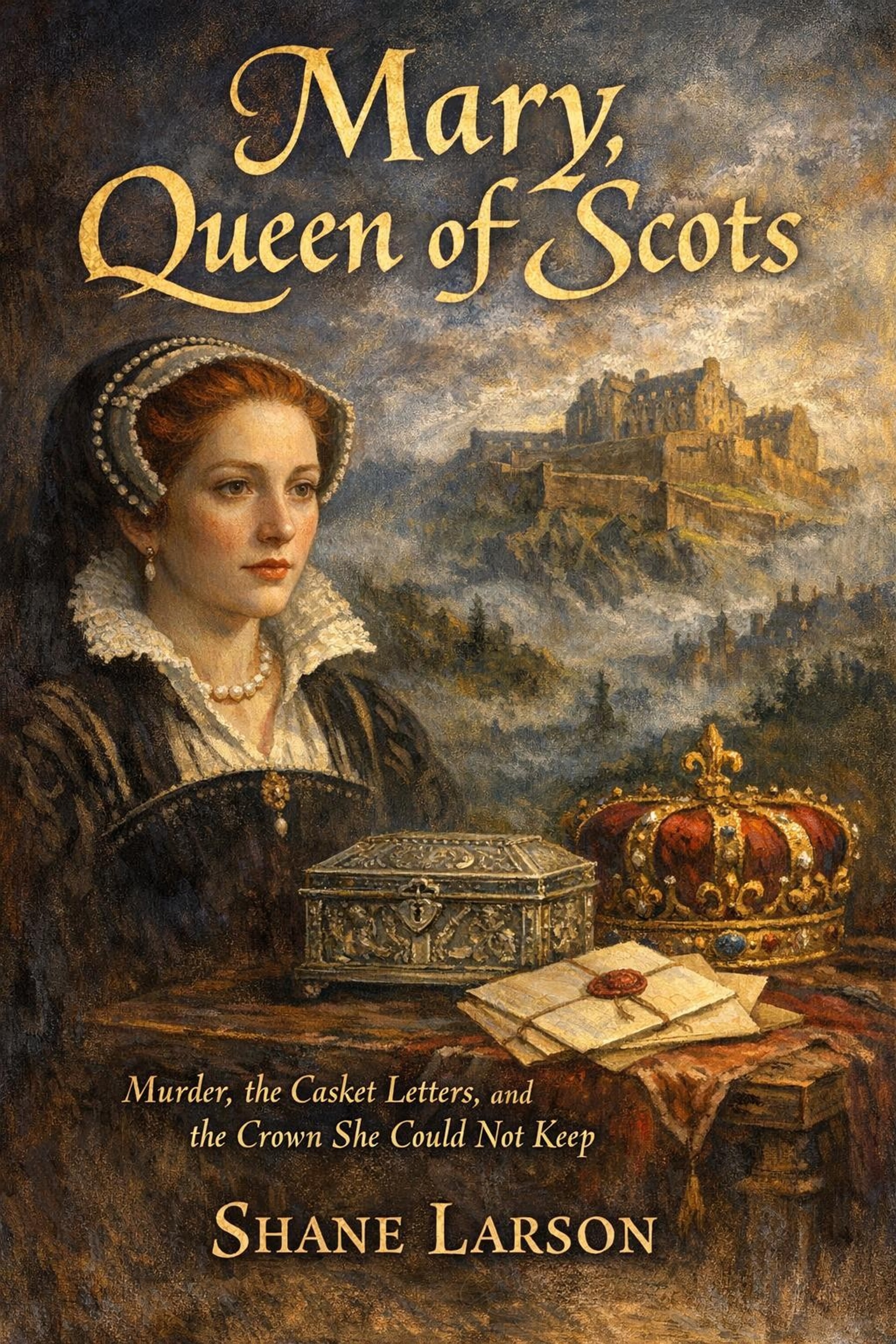
*Mary, Queen of Scots: Murder, the Casket Letters, and the Crown She Could Not Keep* is a standalone companion to the series on the six queens of Henry VIII and to Elizabeth I. It follows Mary from Linlithgow in 1542 to Fotheringhay in 1587, treats Kirk o' Field, Dunbar, the Casket Letters and the Babington reply as open questions with evidence on more than one side, and gives the letters an appendix of their own.
Mary, Queen of Scots
New posts and releases, straight to your inbox. No spam, unsubscribe anytime.