The Letter That Was Still in the Oven When the City Died
June 9, 2026 · 5 min read
The Letter That Was Still in the Oven When the City Died
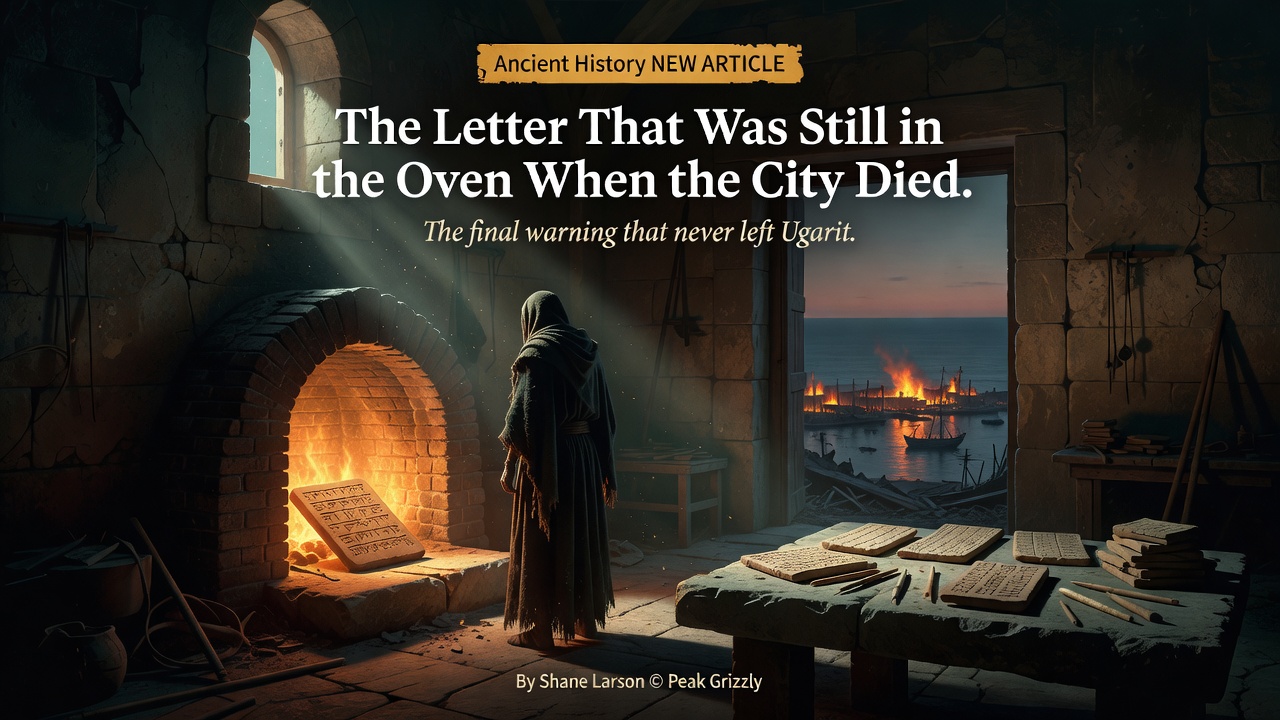
Sometime around 1185 BC, a scribe in the Syrian port-kingdom of Ugarit pressed a stylus into wet clay and wrote a letter that would never be read by the person it was meant for.
It was an urgent letter. Enemy ships had been sighted. The king's own fleet and soldiers were away—posted elsewhere, far from home, exactly when they were needed most. The message went into the kiln to be baked hard for the journey, the way important tablets always were.
The kiln never finished its work. The city burned down around it.
When archaeologists dug through the ash layer of Ugarit thousands of years later, they found those tablets still sitting where they had been left—unfired, or only half-fired, frozen at the precise moment the world ended. We are reading words that were written, quite literally, in the final hours of a civilization. The clay preserved the panic because the fire that destroyed everything also accidentally baked the evidence solid.
There is no more vivid image in all of ancient history. A city wrote its own obituary, and the catastrophe filed it for us.
A small kingdom that punched far above its weight
To understand why this matters, you have to understand what Ugarit was before the ash.
It was not an empire. It was a compact, fabulously wealthy port-kingdom on the coast of what is now Syria—small enough to walk across, important enough that its kings exchanged letters with pharaohs and Hittite emperors. Its harbor at Minet el-Beida was crowded with merchant ships. Its streets mixed Canaanites, Hurrians, Cypriots, and traders from across the Late Bronze Age world. Copper and tin, wine and oil, timber and textiles, ivory and luxury goods all flowed through its warehouses.
This was the first true international age. Around 1300–1200 BC, the great powers of the eastern Mediterranean—Egypt, the Hittites, Babylon, Assyria, the Mycenaean Greeks—were locked into a dense network of trade, diplomacy, royal marriages, and mutual dependency. Tin had to come from far away to make bronze. Grain moved by ship between regions. Prosperity in one place depended on stability everywhere else.
Ugarit sat at a crossroads of that network and grew rich on it. And here is the thing modern readers should sit with: by every visible measure, it looked permanent. The markets opened. The scribes recorded routine business. The temples held their festivals. Nothing in the ordinary paperwork of the last good year hints that there was a last good year.
That's the quiet horror of the archive. We can see the ending coming. They could not.
The archive that lets us eavesdrop on the dead
What makes Ugarit extraordinary is that it didn't leave us monuments and silence. It left us paperwork—thousands of clay tablets from palaces, temples, and private houses.
Most history of this period is written from above, surveying the whole Mediterranean collapse like weather seen from orbit. Ugarit lets us do something almost no other ancient site allows: zoom all the way in, to the level of a single household, a single contract, a single bad harvest.
We have trade ledgers showing exactly what moved through the port. We have ration lists and grain receipts. We have dowries, lawsuits, and legal disputes between neighbors. We have diplomatic dispatches revealing the obligations of a small vassal state surviving among giants. We have the famous literary tablets—the Baal Cycle and related myths—that show us how Ugaritians understood their own cosmos, their kings, and the threat of catastrophe.
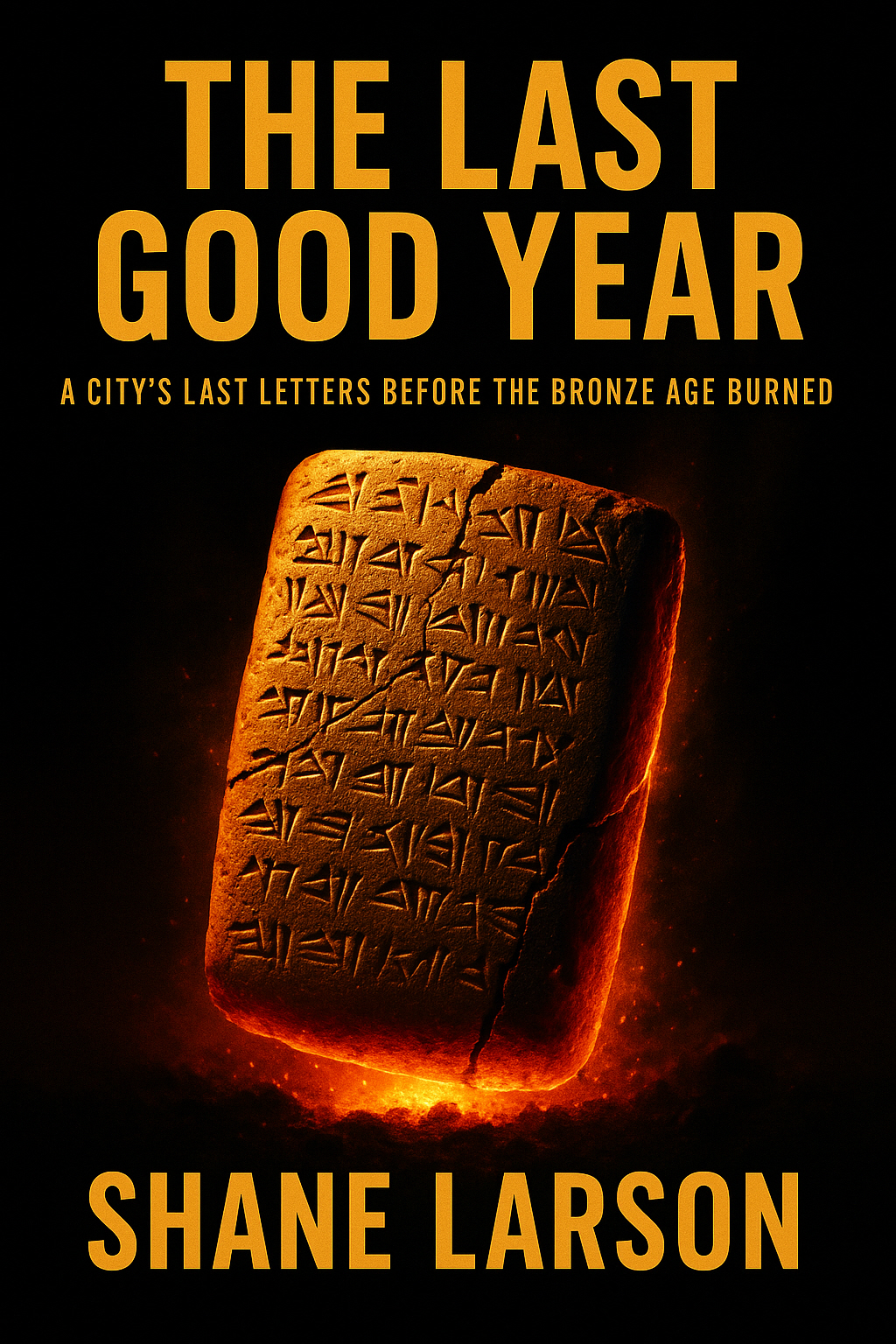
The Last Good Year
And we have the letters from the end.
Reading them in sequence is like watching a storm assemble in slow motion from inside the house. First there are references to grain shortages and emergency shipments—the system straining under environmental stress, drought rippling through the trade network long before any enemy appears. Then the city's protector, the mighty Hittite empire, starts making demands it has no right to make: send grain, send ships—even as it can no longer guarantee Ugarit's security in return. The safety net frays precisely when it's needed.
Then come the rumors on the water. Reports of raiders. Ship movements. Unrest. Intelligence in the Bronze Age traveled slowly, partially, and often too late.
And finally the desperate cluster of military letters. Send ships. Send soldiers. Reports of enemy fleets. The agonizing detail that Ugarit's own forces were deployed elsewhere when the blow fell.
The state machinery is still working in these documents. Scribes are still writing. Records are still being filed. Control is slipping away even as the bureaucracy keeps dutifully describing its own collapse.
How a world vanishes in a season
What killed Ugarit? The honest answer is: not one thing.
The popular villains are the "Sea Peoples," a still-mysterious confederation of seaborne raiders who appear in Egyptian records around the same time. The rubble of Ugarit does contain arrowheads, evidence of a fight. But the tablets suggest the city was already under strain from the inside—famine, drought, the weakening of its imperial protector, the brittleness of an economy that depended on a long-distance network that was failing everywhere at once.
This is the real lesson, and it's why Ugarit feels so unnervingly modern. Complex, interconnected societies don't die from a single cause. They die from a cascade. Prosperity itself masks the risk: the more efficiently connected a system becomes, the more catastrophically it can fail when several pressures arrive together. Drought weakens the food supply. A failing overlord removes security. Raiders exploit the opening. Trade routes that meant wealth in good times become channels for collapse in bad ones.
Ugarit didn't decline slowly over centuries. It was a thriving, cosmopolitan, fully functioning city—and then it was a burn layer, never rebuilt, abandoned to silence. The gap between those two states was, as far as we can tell, about a season.
The markets were still open. And then they were ash.
Why a 3,000-year-old port still matters
We rarely get to hear a dead civilization speak in its own ordinary voice—not in carved boasts of kings, but in grain receipts and worried letters and the unglamorous business of a Tuesday. Ugarit handed us that gift by accident, baked into clay by the very fire that killed it.
It's worth remembering the next time someone says a system is too big, too rich, or too connected to fail. The people of Ugarit would have said the same. They left us the receipts to prove it.
If this glimpse into a doomed city pulled you in, there's a great deal more in the full story—the merchant houses, the gods, the diplomacy, and the closing hours reconstructed entirely from the tablets the Ugaritians wrote themselves.
The Last Good Year is available now.
The Last Good Year
New posts and releases, straight to your inbox. No spam, unsubscribe anytime.