The Story Behind *The Nineveh Variant*
June 10, 2026 · 5 min read
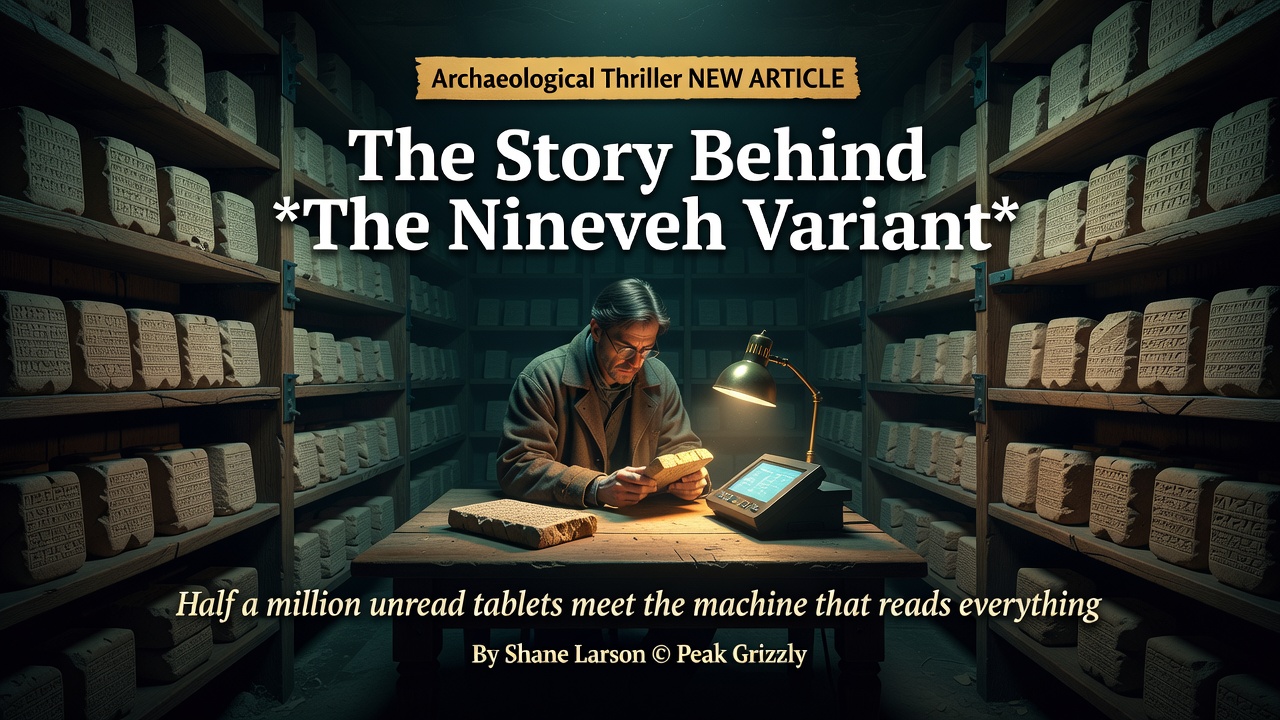
A few years ago, I came across a number I couldn't shake loose: somewhere north of half a million cuneiform tablets sit in museum collections around the world, and the overwhelming majority of them have never been read. Not lost. Not destroyed. Just unread—catalogued, boxed, shelved in basements from London to Philadelphia to Baghdad, waiting for a specialist who may never have the time. Many of these tablets come from the great palace archives of Nineveh or the merchant houses of Kanesh, yet even the ones that were photographed decades ago often sit in queues behind grant applications and teaching loads. The scholars who can read them number in the low hundreds worldwide, and each new find only lengthens the line.
Think about that. We have the words of people who lived three thousand years ago, pressed into clay by their own hands—receipts, letters, complaints, prayers, the small accounting of ordinary lives—and we simply haven't gotten to them. There aren't enough Assyriologists on Earth to make a dent. The bottleneck isn't the past. It's us.
So I started asking the question that became this book: what happens when something finally reads all of it at once?
A machine that reads what no one has
We live in the age of large language models. Whatever you think of them, they are extraordinary pattern-finders—and a corpus of unread tablets is nothing if not a haystack waiting for a needle. The premise of The Nineveh Variant is straightforward and, I think, genuinely plausible: a small nonprofit trains a translation model on the entire body of digitized and scanned cuneiform, and the model starts flagging something strange. Administrative records from cities separated by centuries and hundreds of miles that correlate in ways no human scholar could have noticed, because no human has ever held them all in mind at the same time. One tablet from a Hittite storeroom might list grain shipments; another from a Babylonian temple might record the same supplier's seal three generations later; a third from Ugarit might note an unusual payment schedule. Only a machine scanning every digitized example at once would see the thread.
The fun—and the dread—of the story is that the anomaly isn't a glitch. It's a fingerprint. A trace of something that was deliberately scrubbed from the record at the end of the Late Bronze Age, that violent, still-mysterious window around 1200 BCE when an interconnected world of palaces and trade routes came apart almost all at once. Historians call it the Bronze Age Collapse. My characters come to suspect it wasn't only a collapse. It was also, in part, a cover. The same pattern of missing or altered tablets appears across widely separated sites, suggesting the erasure was coordinated rather than random.
I want to be clear, because I care about this: the conspiracy is invented. The world it lives inside is not. The tablets are real. The collapse is real. The basements are real. I've tried to be scrupulous about the seam between fact and fiction, and there's an author's note that lays it out plainly.
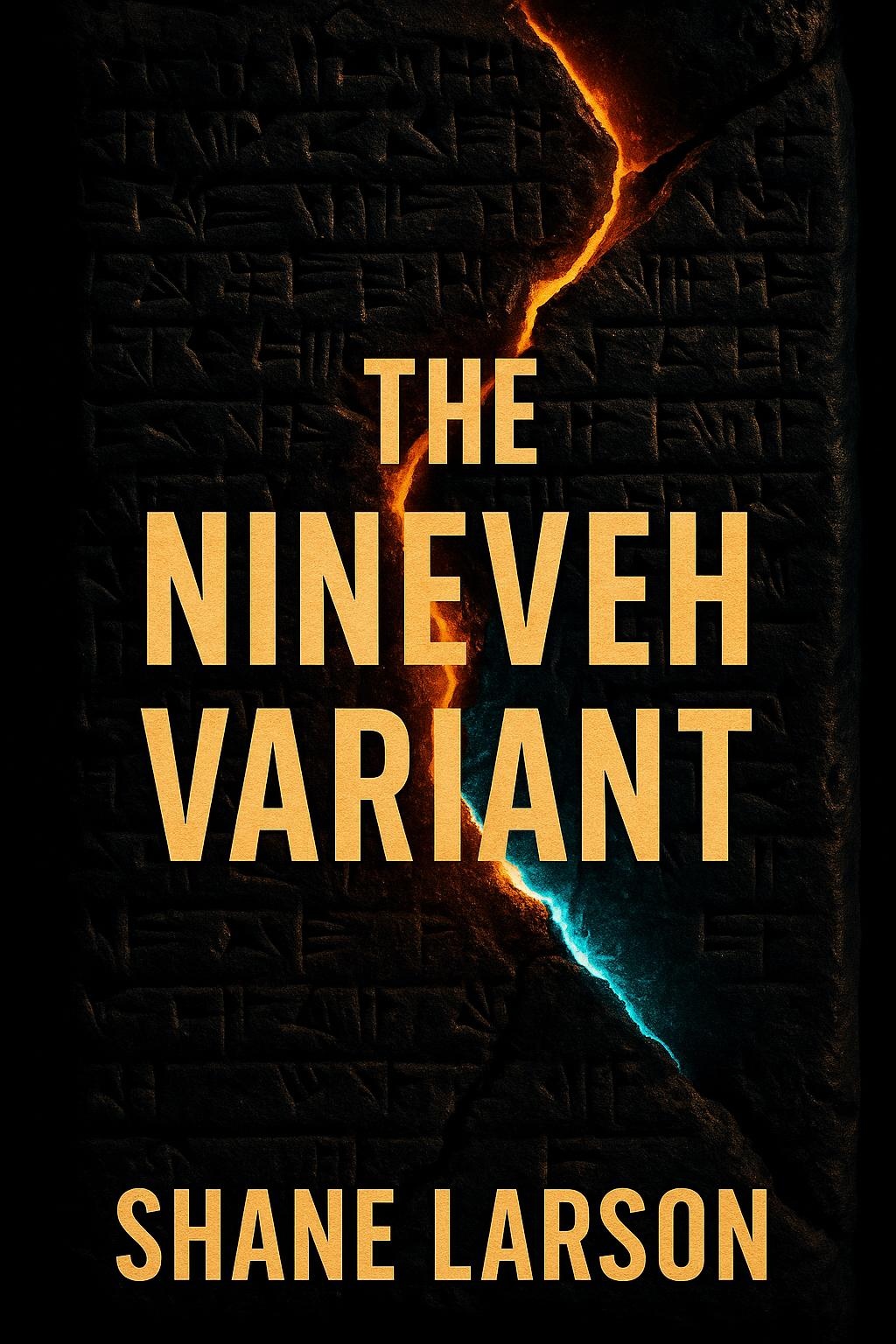
The Nineveh Variant
The people in the clay
A thriller is only as good as the person you follow through it, and Dr. Mara Veyrat arrived almost fully formed. She's a forty-one-year-old Assyriologist whose career stalled after she was right too loudly about a famous tablet's date. She's brilliant, impatient, happiest pacing a storeroom at midnight. And she desperately wants the model to be wrong—because if a machine saw in a weekend what a lifetime of human scholarship missed, what is her life's work even for? That reluctance is the engine of the book. She fights the truth every step of the way, which is exactly why I trust her when she finally accepts it. Her skepticism isn't stubbornness; it's the same caution that once made her double-check every sign before publishing.
Around her: Daniel, the sleep-deprived engineer who built the model and now can't shut off what it's saying; Aram, a Kurdish-Iraqi fixer who has saved more tablets than most museums and sold a few too, and whom Mara can never quite read; Sana, a salvage archaeologist racing a rising dam reservoir; and Eleanor Pryce, my antagonist, who is the kind of villain I find most frightening—cultured, patient, learned, and entirely convinced she's the hero. Pryce believes some truths topple the present, not just the past, and that someone has to decide what stays buried. The book's real argument is the one she and Mara have over that.
And then there's Iddin-Nabu, a temple scribe in 1200 BCE, who appears in interleaved chapters. He's ordered to record an account and then to unmake it—and his quiet, clever defiance, hidden in the clay itself, is the breadcrumb trail Mara follows across thirty-two centuries. Writing him was the heart of the whole thing. His small acts of resistance—subtle changes in phrasing, extra wedges pressed into signs that shouldn't be there—mirror the modern characters' own choices about what to preserve.
What you can expect
This is a propulsive book—there's a chase across the antiquities underworld, from a Geneva freeport to an Istanbul auction to a flooding dig site, and people who get too close to the variant don't stay safe. If you like Steve Berry's documentary texture, Dan Brown's big-idea reveals, or James Rollins's globe-spanning pace, I think you'll feel at home.
But it's also a book about reading—about philology as suspense, about who controls the historical record, and about the genuinely unsettling questions AI is forcing on every field that touches the past. I wanted the cleverness to be earned, the math to actually matter, and the awe of real discovery to survive the gunfire. The climax turns on a 3,200-year-old idea that I find quietly beautiful: a pattern that is its own proof.
One last thing. If reading it makes you want to try this for yourself, you can. A live cuneiform translator I've been playing with is up at peakgrizzly.com—go put some clay in front of it and see what comes back.
The Nineveh Variant is available now. If you read it, come find me and tell me what you think the clay remembers. I've been living in those basements for a long time, and I'm glad to finally have company down there.
The Nineveh Variant
New posts and releases, straight to your inbox. No spam, unsubscribe anytime.