The Treaty of Versailles Didn't Cause World War II — and the Proof Is a Ten-Year Gap Nobody Talks About
September 8, 2026 · 6 min read
Ask almost anyone what caused the Second World War and you will get the same answer: the Treaty of Versailles. It was too harsh. Germany was humiliated and beggared. Hitler was the bill coming due. The explanation is tidy, it is morally satisfying, and it has a serious problem that a single date exposes.
In May 1928 — nine years after the treaty was signed, with every clause of it still in force — the Nazi Party stood in a free national election and won 2.6 percent of the vote. It was losing members. Germany was stable, growing, governed by the parties of the centre, and sitting inside the League of Nations as a member in good standing. If the treaty was the mechanism that produced Hitler, it is a strange mechanism that ran for a decade and produced nothing. Four years later the same party polled 37.3 percent and was the largest in the Reichstag. Whatever happened to Germany happened between 1928 and 1932, and the treaty text had not changed a word in that window.
Something else had changed, and it was money.
The oldest explanation in the book
It is worth being clear about how old the "harsh treaty" account actually is. It was substantially in print by December 1919, when John Maynard Keynes published The Economic Consequences of the Peace and called the settlement a Carthaginian peace — before a single reparations payment had been collected, before the republic the treaty supposedly doomed had held its first normal election. The account was written first and the history happened afterward, and for a century the account has largely refused to update.
The last fifty years of scholarship have dismantled it piece by piece. Not because the treaty was gentle — it wasn't — but because the standard version misstates what the treaty said, ignores what Germany itself had just done to a defeated enemy, and, above all, cannot survive the chronology.
What the treaty actually said
Three claims carry the popular version, and each one shrinks on inspection.
The "war guilt clause." Article 231 does not contain the words "guilt" or "honor." It was drafted by two young American lawyers as a legal liability clause — the technical foundation for a reparations claim, establishing responsibility for damages the way an insurance finding does. Nearly identical language was inserted into the treaties with Austria and Hungary, where it caused no lasting outrage at all. In Germany it was read — and was energetically encouraged to be read — as a confession of moral guilt for the war. The grievance was real. It was also, in large part, manufactured from a misreading.
The reparations bill. The famous figure is 132 billion gold marks, and it was designed to be famous. The London Schedule of 1921 split the sum into A, B, and C bonds — and the C bonds, roughly 82 billion of the total, were a fiction, scheduled for payment only in circumstances everyone at the table knew would never arrive. They existed so that Allied electorates could be shown a big number. The real obligation was about 50 billion, it was rescheduled downward twice, and the sum Germany actually transferred over thirteen years was a fraction even of that. The headline was published; the bond structure was not. That asymmetry did political work in Germany for twenty years.
The harshness itself. Germany lost about thirteen percent of its territory and had its army capped at 100,000 men. Severe terms — until you put them beside the treaty Germany had imposed on defeated Russia at Brest-Litovsk eighteen months earlier, which stripped away territory containing roughly a third of Russia's population and the bulk of its coal and iron. Versailles was harsher than Woodrow Wilson wanted. It was far softer than what the German high command dictated when it was the one holding the pen. Any honest account of 1919 has to hold both facts at once.
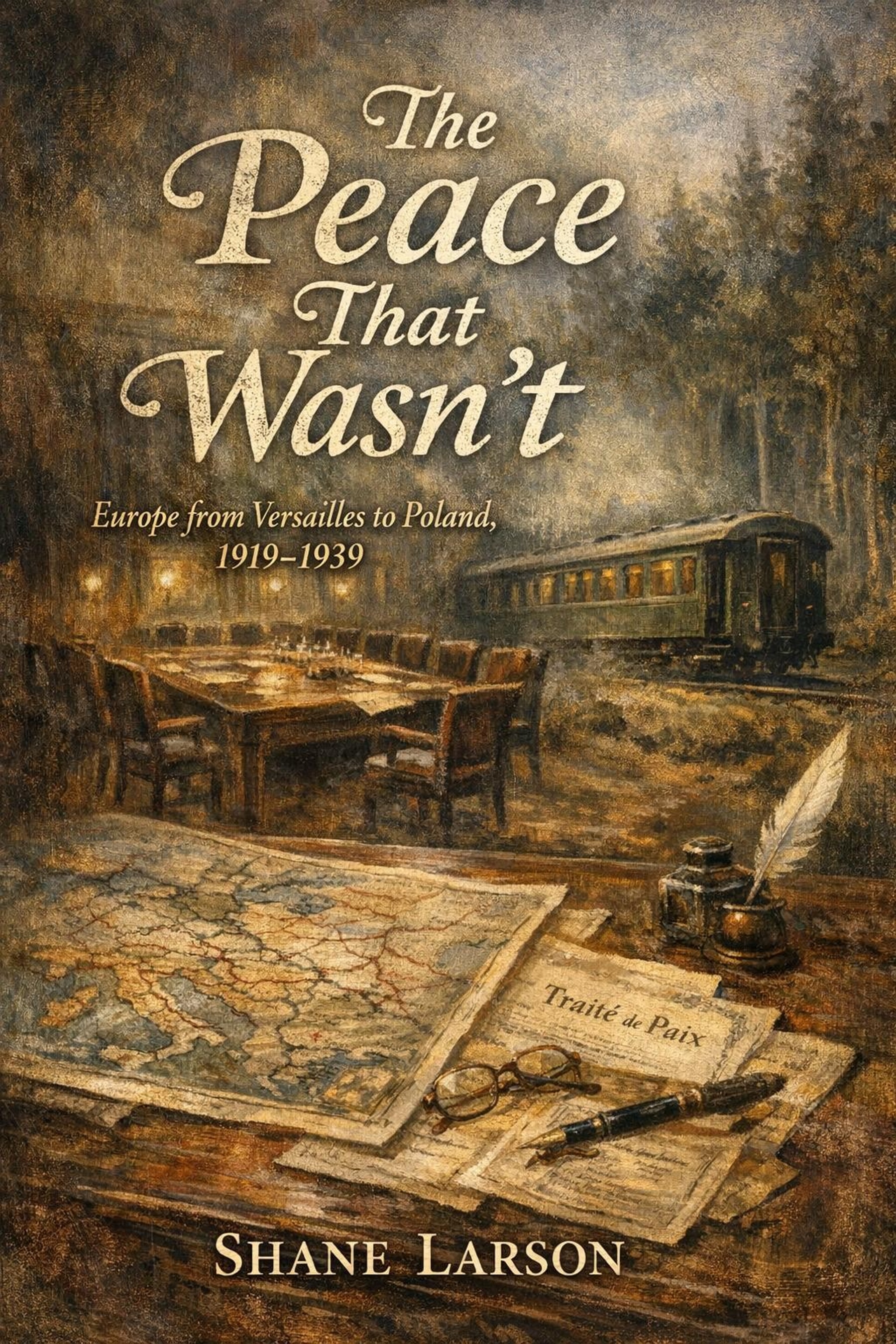
The Peace That Wasn't
The republic that refused to die on schedule
Here is what the treaty's supposed victim actually did. The Weimar Republic survived the treaty's signing. It survived an attempted putsch from the right in 1920 and risings from the left. It survived the French occupation of the Ruhr in 1923 and the hyperinflation that followed — the wheelbarrow-money catastrophe that lives in every documentary. And then it stabilized, and for five years it worked.
The stabilization ran on American credit. The Dawes Plan of 1924 rescheduled reparations, but its real significance was the channel it opened: New York lent to German banks, municipalities, and industry at every maturity, and the loans underwrote everything from reparations payments to municipal swimming pools. Germany entered the League in 1926. By 1928 serious people — not fools, not naifs — looked at Europe and concluded the postwar settlement was holding.
The structure had one flaw, and almost nobody was watching it: the money was short-term, and it was borrowed long.
Eighteen months that did what the treaty couldn't
Beginning in 1928, the American money went home — first because Wall Street's own boom offered better returns than lending to Bremen, then because Wall Street's collapse destroyed the lenders themselves. Credit that had taken five years to extend was withdrawn in roughly eighteen months. The contagion ran through the Creditanstalt collapse in Vienna in May 1931 into a full German banking crisis by July. Chancellor Brüning answered with deflation — cutting wages, benefits, and prices into a contraction, on purpose — and governed by emergency decree under Article 48 as the Reichstag legislated less each year, so that the machinery of rule-without-parliament was built and running before Hitler ever touched it.
German unemployment went from 1.4 million to over six million in three years. The Nazi vote went from 2.6 percent to 37.3 percent across the same window. Lay one curve over the other and you are looking at the actual mechanism of the catastrophe.
So what was Versailles, then?
The grievance — and grievances matter. The depression did not radicalize a contented country; it detonated a charge that had been deliberately cultivated for a decade, by nationalist politicians, by the army's stab-in-the-back legend, by a press that never accepted the defeat of 1918 as real. The German army had marched home in November 1918 under flags and triumphal arches, greeted by the republic's own leaders as men undefeated in the field. A public prepared for that scene could be told, forever after, that the war had been lost by treachery and the treaty was its instrument.
Versailles loaded the weapon. The credit withdrawal pulled the trigger. Neither, alone, fires. That is the formulation the evidence supports, and it explains what the popular version cannot: the ten quiet years, the sudden collapse, and why the collapse tracked the loan books rather than the treaty text.
This argument has a distinguished history of its own — it was A. J. P. Taylor's The Origins of the Second World War in 1961 that first scandalized the profession by refusing the tidy villain-and-document account, and historians have been arguing over the wreckage ever since. The debate matters beyond the seminar room, because the lesson you draw depends entirely on the mechanism you believe in. If Versailles caused the war, the lesson is about magnanimity to defeated enemies. If an eighteen-month credit withdrawal caused it, the lesson is about what financial contagion does to a society with a primed grievance — a lesson with considerably more to say to the present.
The full case — the treaty in figures, the loan books, the two curves, and the four times the postwar security system was tested and declined before a shot was fired — is the subject of my book The Peace That Wasn't: Europe from Versailles to Poland, 1919–1939, the opening volume of The Second World War Chronicles. It begins in a railway carriage in the forest of Compiègne, used twice, twenty-two years apart, for two surrenders running in opposite directions.
The Peace That Wasn't
New posts and releases, straight to your inbox. No spam, unsubscribe anytime.