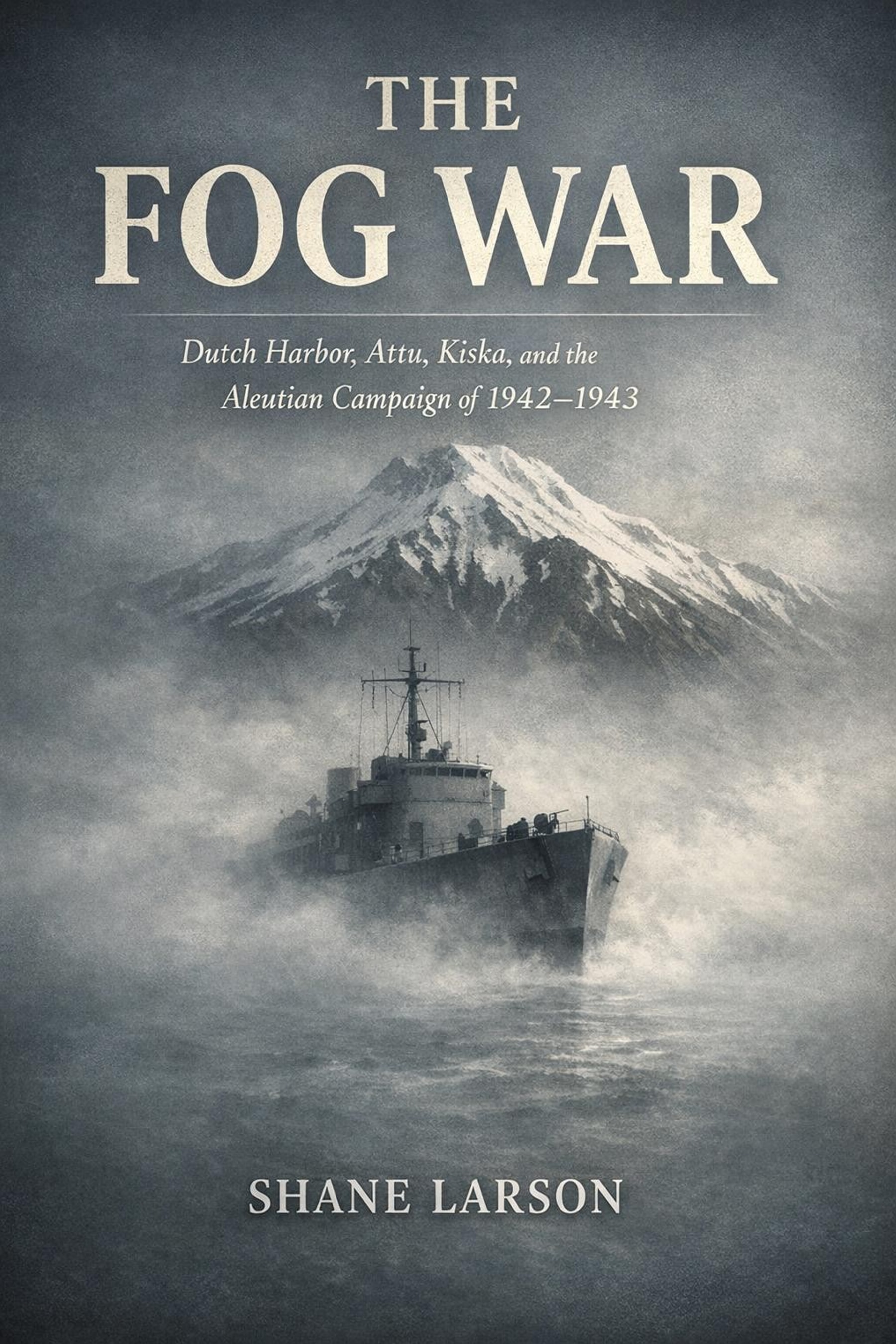
The Fog War
Dutch Harbor, Attu, Kiska, and the Aleutian Campaign of 1942–1943
By Shane Larson
About This Book
On the morning of June 4, 1942, a Japanese pilot named Tadayoshi Koga tried to set his damaged Zero down on what looked like a level meadow on Akutan Island, east of Dutch Harbor. The meadow was a bog. The fighter flipped onto its back and Koga was killed in the cockpit. His wingmen, under orders to destroy any Zero that came down within the enemy's reach, circled and did not fire. Then they flew back to a carrier already being recalled toward Midway, and the fog came down over the bog.
Five weeks later a Navy patrol crew spotted the upturned fighter. It was the first intact Zero to fall into American hands, and by autumn test pilots were flying it over San Diego. The campaign that produced it is remembered, when it is remembered at all, for almost nothing else.
That is the shape of the Aleutian campaign of 1942–1943. It was fought where the weather decided more than the admirals did, and nearly every episode turns on something nobody saw: carriers hidden in cloud, airfields the enemy never knew existed, a garrison lifted off an island under a blockade that noticed nothing, and nine villages of American citizens carried away from their islands.
Japanese carriers struck Dutch Harbor on June 3 and 4, 1942, and within the week Japanese troops held Attu and Kiska at the far end of the chain, the only occupation of North American soil in the Second World War. When the United States landed on Attu in May 1943, it sent a division trained for the desert into snow and muskeg in leather boots and lost more men to the cold than to Japanese fire. The fighting ran from May 11 to May 30 and ended with one of the largest banzai charges of the Pacific war to that point: about 2,350 Japanese counted dead, 28 taken alive, about 549 Americans killed. Eleven weeks later, some 34,000 American and Canadian troops stormed Kiska and found that Admiral Masatomi Kimura had taken the whole garrison off in under an hour on the night of July 28–29, eighteen days before. They took more than 300 casualties on an island with nobody on it.
The civilian story runs alongside, and The Fog War: Dutch Harbor, Attu, Kiska, and the Aleutian Campaign of 1942–1943 gives it a Part of its own. In June 1942 the Japanese found about forty-two Unangan people living at Attu; in September they shipped the whole village to Otaru, on Hokkaido, where somewhere between sixteen and twenty-two of them died over three years. That same summer the United States removed about 881 Unangan from the Pribilof Islands and seven villages along the chain to abandoned canneries, a mine camp, and a disused CCC camp in Southeast Alaska. No destination had been readied before the ships sailed; roughly one in ten died in those places. Who went was decided by blood: anyone of one-eighth or more Aleut descent was taken, and white neighbors in the same villages were not. Congress apologized and paid $12,000 to each surviving evacuee under the Civil Liberties Act of 1988, forty-six years after.
The argument is that these were not two subjects but one campaign. The village the Americans fought over on Attu was the one the Japanese had emptied. The soldiers who looted the Unangan's houses were the men fighting the fog and the garrison. Both removals happened in the same month for the same reason: the Japanese were on the islands.
Why I Wrote This
I live in Alaska, and this is local history to me in a way it is to few people who write about the Pacific war. Dutch Harbor is a place people I know fly to for work. Attu is the far end of a map on my wall.
What hooked me was a gap I kept running into. The books about the battles give the Unangan removal a paragraph. The books about the removal give the battles a paragraph. Each treats the other as background. But the people were taken off their islands because the Japanese had landed on other islands, and the Americans then fought for one of those islands over the ruins of a village the Japanese had emptied. That is one story, and nobody had told it as one in a single book.
Frequently Asked Questions
Is this a history of Japanese American internment?
No. The incarceration of Japanese Americans under Executive Order 9066 is a different event with a different rationale, and this book does not cover it. The same federal commission investigated both in the early 1980s, and the Unangan restitution was Title II of the same 1988 law. The book draws that comparison once, in Chapter 6.
Does the book cover the Battle of Midway?
In one paragraph. Midway is told in full in The Oil Was a Clock; this book explains only why Kakuta's carriers were recalled south as the larger battle was lost. You do not need to have read that book or any other in the series first.
Is this a military history of the Aleutian campaign or a book about the Aleut evacuation?
Both, in four parts. Parts One and Three are the campaign, from the Washington Naval Treaty to Kiska. Part Two is the Attuans in Hokkaido and the Unangan in the camps, placed between them deliberately. Part Four follows the islands through the Cold War to restitution.
How reliable are the casualty figures?
As reliable as the sources allow, which is the point. Attu's American cold-injury count runs from about 1,200 to about 2,100 depending on what is counted, and the camp deaths from 74 to 80. Every figure carries its source in the sentence, usually the Army's official history or the commission report Personal Justice Denied.
Can you visit Attu and Kiska today?
Not easily. Both lie inside a national wildlife refuge, reachable only by expedition cruise or special permit, and unexploded ordnance is still a hazard. Dutch Harbor is different: its museum and the Aleutian World War II National Historic Area are open, and Adak has scheduled flights. Appendix C covers what is accessible and what is not safe.
If You Liked This, You Might Like
- The Oil Was a Clock — The Midway plan from the other side: Operation AL was the northern half of the plan that book covers.
- The End in the Pacific — Where the 7th Infantry Division went after Kiska, from Kwajalein to Okinawa.
- The Pioneer Road — The Alaska Highway was pushed through in 1942 out of the same fear of a Japanese landing that drove this campaign.
- The Alaska Purchase — How the Pribilof fur-seal lease and seventy years of federal wardship made the Unangan the easiest Americans to move in 1942.
A campaign in which the fog was the senior commander, and the people who paid for it were, as often as not, the ones who had been there longest.
What You'll Learn
- **Whether Operation AL was a feint.** The postwar account called the Aleutian strike a diversion to pull the American fleet north before Midway; later work from Japanese records argues it was a concurrent operation with its own aims. Both cases are set out, and the book's lean is stated as one.
- **Fifty days alone on Kiska.** Aerographer's Mate William House escaped into the hills and lived on plants and worms until he surrendered, starving, at around eighty pounds.
- **The last daylight gun duel of its kind.** Off the Komandorski Islands in March 1943, Charles McMorris fought a Japanese force with twice his firepower for three and a half hours until it turned away. Attu and Kiska never received a surface convoy again.
- **The camps, one by one.** St. Paul's people to the Funter Bay cannery, St. George's to the mine across the bay, Atka's to Killisnoo, five smaller villages to Wrangell Institute and then Ward Lake, Unalaska's to Burnett Inlet, with the officials' own reports of what they found there.
- **The 1943 seal harvest.** With the camps in their second year, the government brought the Pribilof men home to take the fur seal harvest, which was federal revenue, then returned them to the canneries.
- **The long tail.** Three underground nuclear tests on Amchitka, the 1981 commission hearings in Unalaska and Anchorage, and Attu uninhabited since its LORAN station went dark in 2010.
New Military History releases and free chapters — no spam, unsubscribe anytime.
More in This Genre
View all →