Vesuvius Didn't Destroy This Library. The People Trying to Read It Nearly Did.
October 3, 2026 · 7 min read
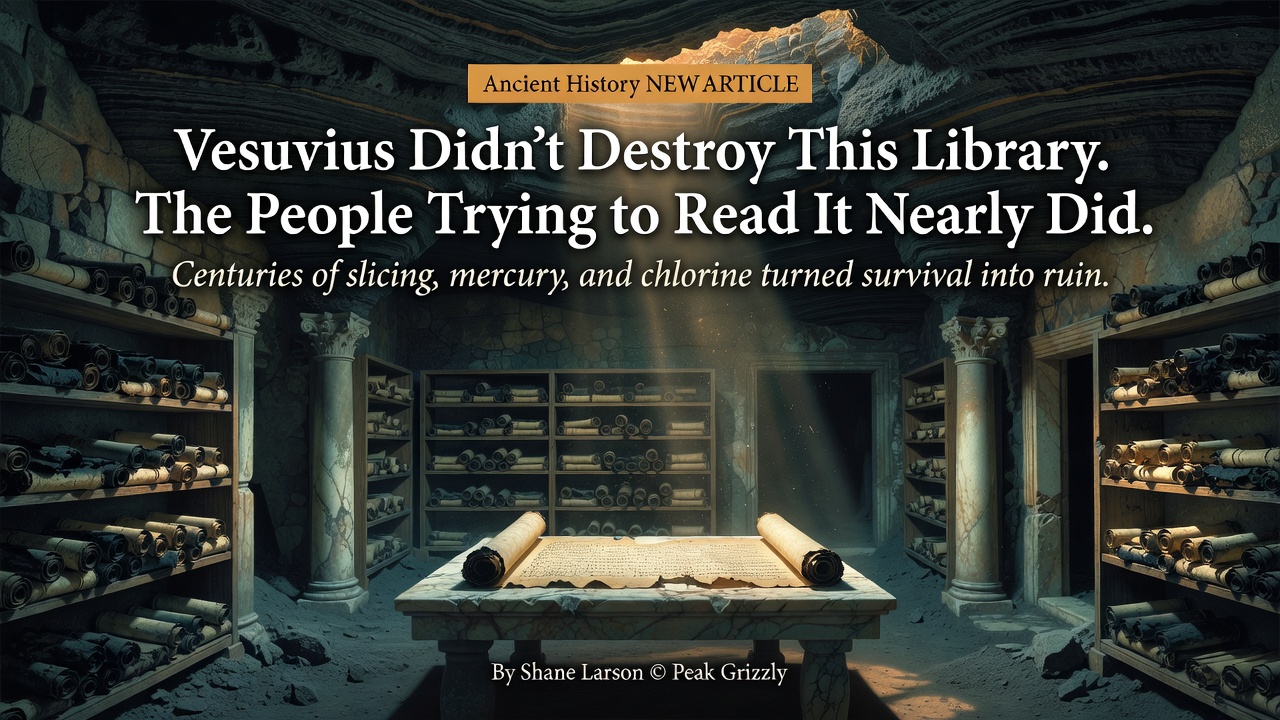
Every library of the ancient world is a ghost. Alexandria, Pergamon, the imperial collections of Rome — we know them only from other people's descriptions, the way you might know a house that burned down before you were born. There is exactly one exception. Under sixty feet of volcanic rock on the Bay of Naples sits a Roman seaside villa whose owner kept a working library of some eight hundred scrolls, and in August of 79 the eruption of Vesuvius sealed it — books, shelves, and all.
Here is the part most people get wrong: the volcano is not the villain of this story. The volcano is the reason the library exists at all. The villains, if the story has any, arrive seventeen hundred years later, carrying scalpels, mercury, and the best scientific intentions of their age.
Charcoal is not ash
Start with what actually happened to the books, because everything else depends on it.
Herculaneum did not die the way Pompeii died. Pompeii was buried slowly under falling pumice; Herculaneum was hit by surges of hot gas and ash moving off the mountain, then entombed under a deposit that set hard as concrete. For papyrus, that violence turned out to be a strange mercy. The surges were hot enough to drive the water out of the scrolls — cooking them through, the way wood becomes charcoal in a kiln — but the burial was fast enough, and the oxygen scarce enough, that they never caught fire. Burning needs oxygen. Carbonisation just needs heat.
The difference matters totally. Ash is gone. Charcoal is still an object — chemically stable, structurally intact, and capable of sitting in the dark for seventeen centuries without decaying, because there is nothing left in it for mould or insects to eat. Every scroll in the villa came through the eruption as a fragile black cylinder with all of its text still on it: rolled up, fused layer to layer, and completely unreadable. The eruption preserved the library perfectly and locked it at the same time.
That is the trap the next two hundred and seventy years walked into. The scrolls survived because nothing touched them. Then people started touching them.
Thrown out as firewood
The villa was found by accident and mined like a quarry. Workmen tunnelling for the Naples court in the eighteenth century — a programme that ran on candlelight and treasure, hunting bronzes and marbles — kept turning up black lumps and tossing them aside as charred wood. Nobody knows how many scrolls were destroyed that way, because nobody was counting; you do not inventory firewood. Only in 1752, when tunnels reached a small room lined with shelves of the things, did someone look closely enough to see writing on one.
What followed was the recognition every collector dreams of and every conservator dreads: the realisation that these were books — the only library of the classical world anyone would ever hold — followed immediately by the question of how to open them. The layers of a carbonised scroll are fused. Unroll one by hand and it comes apart in flakes. The court's early answers were the answers of men in a hurry: scrolls were sliced down the middle lengthwise so the inner surfaces could be read, which sacrificed everything written on the layers the knife passed through, and scraped down layer by layer, which read each surface once by destroying it.
Four years per scroll
Then came the first person in this story to treat the problem with the patience it deserved — and even he is a cautionary tale.
Antonio Piaggio, a conservator summoned from the Vatican, built a machine for the job: a frame in which a scroll hung while silk threads, tensioned by small weights, coaxed the outermost layer away from the body of the roll a hair's breadth at a time. It worked, in the way a glacier works. A single scroll took him around four years. The machine produced the first substantial readable text ever recovered from the villa — real columns of Greek — and, in the same motion, a trail of ruined outer layers, because the outside of the scroll generally had to suffer for the inside to be freed.
The court had artists engrave copies of the opened text as it emerged. Those engravings, the disegni, have since become primary sources in their own right, because much of the papyrus they copied has crumbled in the years since it was opened. Sit with that for a moment: the act of opening a scroll started a clock on its destruction, and for some of these books the eighteenth-century facsimile — errors and all — is now the only surviving witness. Opening and losing turned out to be the same event, run at different speeds.
The Villa of the Papyri
The chemists arrive
The nineteenth century decided the problem was chemical. If the layers were stuck, something should unstick them, and candidate somethings were applied on plausible theory and no evidence: solvents, vapours of mercury, treatments that would horrify a modern conservator on a much less irreplaceable object.
In 1818 the problem attracted Humphry Davy — genuinely one of the great chemists of his era, the man who had isolated element after element — who came to Naples and went at the scrolls with chlorine gas. His method worked exactly well enough to justify continuing, which is the most dangerous amount of working a destructive method can do.
The bleakest episode belongs to diplomacy. Six scrolls were presented as a gift to the Prince Regent, the future George IV, and shipped to Britain, where the attempts to open them consumed them. What was left never came home. Of a library that survived a volcano intact, some fraction now exists as scattered fragments and blank regret in a foreign country, undone not by catastrophe but by courtesy.
By the end of the century, the honest scorecard read something like this: some hundreds of scrolls opened whole or in part, real text gained — much of it the work of Philodemus, the Epicurean philosopher whose working library this seems to have been — and an enormous, unrecoverable cost paid in scrolls destroyed, mutilated, or given away.
The wisdom of stopping
The twentieth century did better. A technique developed in Oslo, using gelatine to support the layers as they parted, opened scrolls with real care and real gains. But the gains got thinner and the surviving scrolls got harder — the easy openings had all been tried — and eventually the field arrived at a conclusion that sounds like defeat and was actually the first fully wise decision in the story: stop. No physical method could open the remaining rolls without destroying them. The several hundred scrolls still intact would stay closed, because two centuries of confident men had proved, one ruined scroll at a time, exactly where confidence leads.
That standstill held for decades, and it should be read not as failure but as the lesson finally learned. Every generation in this story did something reasonable by the standards of what it knew. The tunnellers could not know charcoal from charcoal. Piaggio's machine was a marvel of restraint by the standards of the scalpel. Davy was applying the best chemistry alive. And every one of them subtracted from a finite, irreplaceable total. When the object is unique and the act is irreversible, being right eventually is not enough — you have to be right the first time, and nobody ever is.
The lock finally picked
The ending — or rather, the current chapter — belongs to a different kind of tool. X-ray tomography can image the interior of a rolled scroll without touching it, and for years that promise stalled on a brutally simple obstacle: the ink is carbon and the page is carbon, so to a scan that reads density, the writing is invisible — the letters and the paper are chemically the same thing. What broke the stalemate was a reframing: the ink does not soak into the papyrus, it sits on the surface, and it subtly changes the surface's texture. Teach a machine to find that texture in the scan data, map the crumpled spiral of the scroll in three dimensions, flatten it mathematically, and text comes off a roll that no hand has opened — first letters, then words, then whole columns of Greek. The scrolls were unreadable for nineteen hundred years. They have been readable for about three.
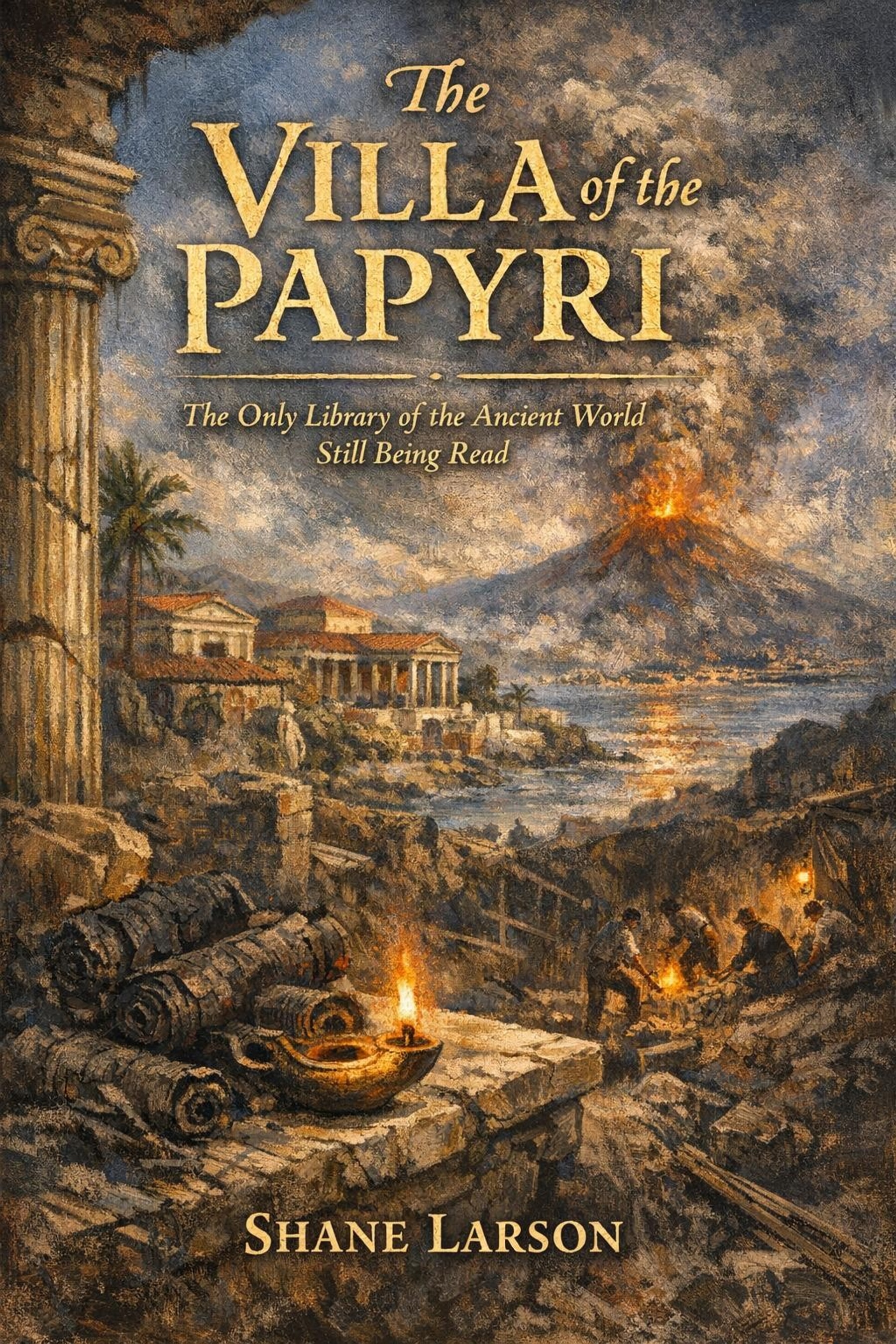
The full story — the villa and the family that likely owned it, Philodemus and his patron, the twenty-four hours of the eruption, the whole catalogue of ruinous rescue, and a clear-eyed account of how virtual unwrapping works and what the odds really are on the two floors of the villa nobody has yet excavated — is the subject of my book, *The Villa of the Papyri: The Only Library of the Ancient World Still Being Read*. If the Alexandria story has always struck you as an elegy, this is the one ancient library whose story is still being written.
The Villa of the Papyri
New posts and releases, straight to your inbox. No spam, unsubscribe anytime.