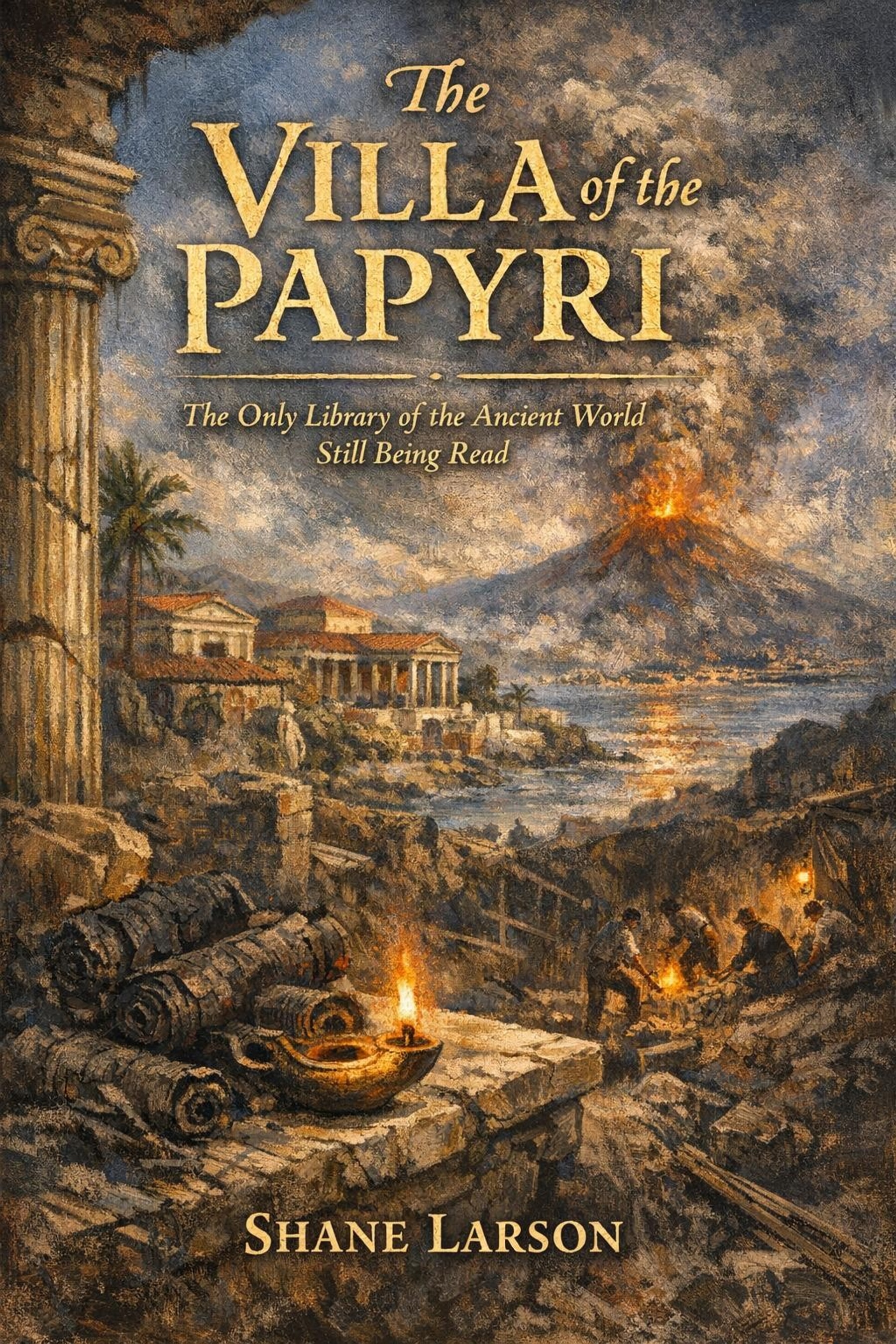
The Villa of the Papyri
The Only Library of the Ancient World Still Being Read
By Shane Larson
About This Book
In the autumn of 1752, deep under the town of Resina on the Bay of Naples, workmen were cutting tunnels through volcanic rock set hard as concrete. They worked by lamplight, sixty feet down, hunting marble statues for a Bourbon king. Mixed into the rubble they kept finding small black cylinders, brittle and light, that looked like sticks of charcoal — and were treated like charcoal. An unknown number were shovelled aside before somebody held one close to a lamp and saw, running across its surface in neat columns, Greek letters.
The cylinders were books. The tunnellers had broken into the library of the grandest seaside house on that coast — rolls that had sat on their shelves since the August afternoon in 79 when Vesuvius entombed Herculaneum. Roughly eight hundred survive. They are the only library of classical antiquity that still physically exists — every other, Alexandria included, survives only as descriptions in other people's books.
One problem defined the next two hundred and seventy years: a carbonised scroll shatters when opened. The tunnellers had found the last library of the ancient world, and nobody on earth could read a page of it.
The house became known as the Villa of the Papyri, and the story of its scrolls is really three stories stacked on top of each other. The first is Roman: a luxurious villa above the sea, probably belonging to the family of Lucius Calpurnius Piso — Julius Caesar's father-in-law — with a Greek philosopher named Philodemus in residence and a library shaped by his school: heavily Greek, heavily Epicurean, including drafts that may be in the philosopher's own hand. A shelf chosen by one household is a more intimate kind of evidence than any imperial catalogue, and this is the only such shelf we have.
The second story is a long, painful comedy of destruction. Generations of serious people tried to get the rolls open, and nearly every method they invented ruined what it touched. Scrolls were sliced apart lengthwise and scraped layer by layer, or dosed with solvents and mercury vapour on theories that tested nothing. A Vatican conservator, Father Antonio Piaggio, built an apparatus of silk threads and hanging weights that peeled a scroll open a hair's breadth at a time — four years per roll, with wreckage trailing every success. Humphry Davy tried chemistry at Naples; six rolls presented to the Prince Regent went to Britain and were largely destroyed there. By the twentieth century the field had reached a conclusion both defeatist and correct: the responsible thing to do with the remaining scrolls was nothing at all.
The third story is the reason this book exists. It became possible to see inside a rolled scroll without touching it — X-ray tomography can map its internal layers — and then to solve the harder problem: carbon ink on carbonised papyrus is chemically almost identical to the page it sits on. The answer lay not in density but in texture, because ink rests on the surface and subtly changes how that surface behaves in a scan. Pair that signal with machine-learning models trained to recognise it, add the craft of virtually unwrapping a crumpled spiral into a flat page, and Greek text starts coming off rolls that have never been opened. The recovered material is Epicurean philosophy — Philodemus and his school, speaking directly at last instead of through hostile summaries. And underneath it all sits the fact that keeps the story open: two lower floors of the villa have never been excavated.
Why I Wrote This
I had already written a book about Pompeii, which meant I had already written about the afternoon of the eruption — and I kept snagging on what happened a few miles up the coast. Same volcano, same day, completely different afterlife. Pompeii gives you a city; Herculaneum gives you the one place on earth where a volcano turned an entire working library into charcoal without burning a single word off the page. That fact would not leave me alone.
Then I got into the history of the attempts to open the scrolls, and it was the best material I'd found in years: two centuries of intelligent, well-meaning people destroying unique objects for excellent reasons. Most treatments compress that into a paragraph on the way to the imaging story. It deserved a book that gives the ruin and the recovery equal weight — and that states the odds on what's still down there honestly.
Frequently Asked Questions
Can the Herculaneum scrolls actually be read without opening them?
Some of them, partially — an astonishing sentence to be able to write. Tomographic scanning plus machine-learning ink detection has recovered passages and whole columns of Greek from rolls that remain sealed. But the great majority of the scrolls have not been read, the work is slow and expensive, and every claim must clear a high evidentiary bar. The book explains what has been recovered and what standard a claimed reading must meet.
Is there a lost library still buried at the Villa of the Papyri?
Possibly. Two lower floors of the villa were reached by excavators in the 1990s and left undug, and the library room is too small for the number of scrolls recovered around it — hints the collection may be incomplete. A second, Latin library is a hypothesis with circumstantial support and no direct evidence. The book lays out the case for it, the case against digging at all, and why both deserve respect.
Do I need to have read Pompeii first?
No. This book stands on its own and covers the eruption from Herculaneum's side of the bay. If you have read Pompeii, you'll recognise the day but almost nothing else — that contrast is part of the point.
Is this a technology book or a history book?
Both, deliberately. The first two-thirds are Roman history and archaeology; the last explains the imaging and machine learning in plain language, with no equations. If you can follow a good heist story, you can follow the science here.
How long is the book?
About 83,000 words: an introduction, seventeen chapters, a conclusion, and three appendices — a full accounting of the scroll numbers, a walkthrough of virtual unwrapping, and a catalogue of every work identified from the villa so far.
If You Liked This, You Might Like
- Pompeii — the same twenty-four hours seen from the other town, where the volcano preserved a city's streets instead of its books.
- The Library of Alexandria — the great lost library this book answers: one is an elegy, the other a recovery still in progress.
- Epicureanism — the philosophy the villa's shelves were built around, and the school Philodemus spent his life defending.
- Stoicism — the rival school of the same era, for the other half of the argument the villa's owner had already picked a side in.
Under sixty feet of rock outside Naples, the last shelf of the ancient world is still giving up its books, one sealed roll at a time. This is the story of how it got there, how it nearly didn't survive its rescuers, and how it is finally being read.
What You'll Learn
- **The thermal accident at the heart of everything** — the surge that drove the water out of the papyrus at a temperature just below combustion, and why "carbonised" and "burned" are opposite fates for a book.
- **An owner read from his shelves.** The case for Piso, the job of a client philosopher in an aristocrat's household, and what a private library reveals that no institutional collection can.
- **The Bourbon tunnels** — treasure-hunting by candlelight, a royal monopoly that strangled scholarship, and the maps that were never drawn.
- **Every failed opening, in detail:** the slicing, the mercury, Piaggio's machine, and the engraved copies that now preserve text the openings themselves destroyed.
- **How reading-without-opening actually works** — scanning, segmentation, flattening, ink detection — with the failure modes stated as plainly as the successes.
- **What Philodemus argued** about music, poetry, anger, and death, and why Epicureanism as its adherents held it bears little resemblance to its enemies' caricature.
- **The two floors nobody has dug**, the arguments for and against excavating them, and honest odds on the wish list — lost Sophocles, Ennius, the missing books of Livy.
New Ancient History releases and free chapters — no spam, unsubscribe anytime.
More in This Genre
View all →