Were the Bog Bodies Human Sacrifices? What Tollund Man, Lindow Man and the Others Actually Show
November 17, 2026 · 6 min read
Ask most people what a bog body is and you will get the same answer: an Iron Age human sacrifice. A victim fed a ritual meal, led out to the bog in the dead of winter, killed for a goddess and laid in the water. It is the explanation on most museum walls and in most documentaries, and it may well be right for some of the bodies. But it is one of three verdicts that archaeologists have argued over for seventy-five years, and the evidence for it is thinner in places than its popularity suggests.
Here is what the bodies show, and what has been read into them.
What a bog body is
Raised bogs are cold, acid and almost without oxygen below the surface. Sphagnum moss, as it decays, seems to add chemistry of its own that slows bacteria and tans skin. The result is that a body put into the right bog at the right time of year can keep its skin, hair, fingernails and stomach contents for thousands of years, while the bones inside may soften or dissolve altogether.
Several hundred such finds are reliably recorded from Denmark, northern Germany, the Netherlands, Britain and Ireland, and a 2023 survey that counted skeletons and partial remains as well put the total above a thousand individuals. Most were found by people cutting peat for fuel. The best preserved, and the most violent, cluster in the Iron Age, roughly the last five centuries BC and the first two AD.
The evidence for sacrifice
The case rests on a pattern.
The violence. Tollund Man, found in Denmark in 1950, was hanged with a plaited leather noose that was still round his neck. Grauballe Man, found two years later, had his throat cut from ear to ear. Lindow Man, found at a Cheshire peat works in 1984, had been struck on the head, had a thin cord at his neck and a wound at his throat. Old Croghan Man, found in Ireland in 2003, was stabbed, and hazel rods had been threaded through cuts in his upper arms. In several cases there is more violence than killing a person requires.
The care. Tollund Man's eyes and mouth were closed and he was laid on his side as if asleep. Somebody did that.
The place. Bogs and lakes are where northern Europeans put valuable things for a very long time: weapons, cauldrons, wagons, butter, plaits of hair. If objects were offerings, the argument goes, so were some people.
The texts. Roman writers said that Gauls and Germans sacrificed human beings. Tacitus describes slaves drowned in a lake after serving a goddess.
Put together, this is a strong case. The Danish archaeologist P. V. Glob made it in 1965 in a book that sold around the world, and it has been the default ever since.
What the same evidence also fits
Every one of those points has another reading.
Hanging, strangling and cutting a throat are how communities have executed people throughout history, and an execution carried out by a crowd is not a restrained event. Tacitus, in the same short book, says that the Germans hanged traitors from trees and pressed cowards and the disgraced down into the marsh under hurdles. Several bog bodies were pinned down with stakes or branches. On that reading these are criminals or outcasts, killed by their own people and refused the cremation that everyone else received.
Care for the body fits that as well. An executed man has relatives.
The People in the Peat
And bogs are where anyone hides a body. In 1983 part of a skull turned up at Lindow Moss, and a local man, believing it belonged to his wife, confessed to killing her more than twenty years before. The skull turned out to be Roman in date. The confession stood. A bog is a good place for a murderer in any century.
Then there is Tacitus himself. He wrote around AD 98, at second hand, about peoples he never visited, and Tollund Man had been dead for nearly five hundred years by then. Reading the bodies through him is a little like explaining a medieval grave with a Victorian newspaper.
The stories that did not survive a second look
This is the part of the subject that deserves to be better known.
The Windeby "girl." In 1952 a slight body was found in a bog in northern Germany with a band across the face and the hair on one side of the head apparently shaved. A man's body lay nearby. The excavators reached for Tacitus, who says adulterous wives had their hair cut off, and for fifty years the body was shown as a young adulteress drowned beside her lover. When the remains were re-examined in the 2000s the "girl" proved to be probably a boy of about sixteen who had been ill or hungry repeatedly as a child. The band was most likely a hair band that had slipped. The hair had decayed unevenly. The man died about three centuries earlier. There may have been no killing at all.
Grauballe Man's torture. His fractured skull and broken leg were long taken as proof that he was beaten before his throat was cut. A restudy with CT scanning concluded that the skull was most probably crushed by the weight of the peat after death.
The poisoned victim. Ergot fungus in Grauballe Man's gut led to the idea that he was drugged or mad. The amount turned out to be far too small to have had any effect.
The ritual last meal. Tollund Man's gruel of barley, flax and weed seeds was read for decades as a special winter porridge. A 2021 re-analysis found it was a fairly ordinary meal, and that he had eaten fish with it.
The count. For years books repeated a figure of nearly two thousand bog bodies, from the catalogue of one German researcher. An audit in 2006 found that much of it could not be verified.
In every case the correction ran against the better story.
So were they sacrificed?
Some of them, very possibly. A man who is hanged, laid out with his eyes closed and placed in an old peat cutting was killed by a group of people acting with purpose. Whether that purpose was to give him to a god or to punish him, the body cannot say.
It may also be the wrong question. A community that condemns someone in an assembly, kills him, and gives the death to the powers that live in the water has not chosen between execution and sacrifice. Those are our categories. And some bodies, like the Windeby adolescent, probably belong in neither.
What the bodies offer is rarer than an answer. They give a last meal, a haircut, a set of fingerprints, a wound with edges: the kind of detail that prehistory almost never gives up about one person. The honest way to treat that is to say what each body shows before saying what it means.
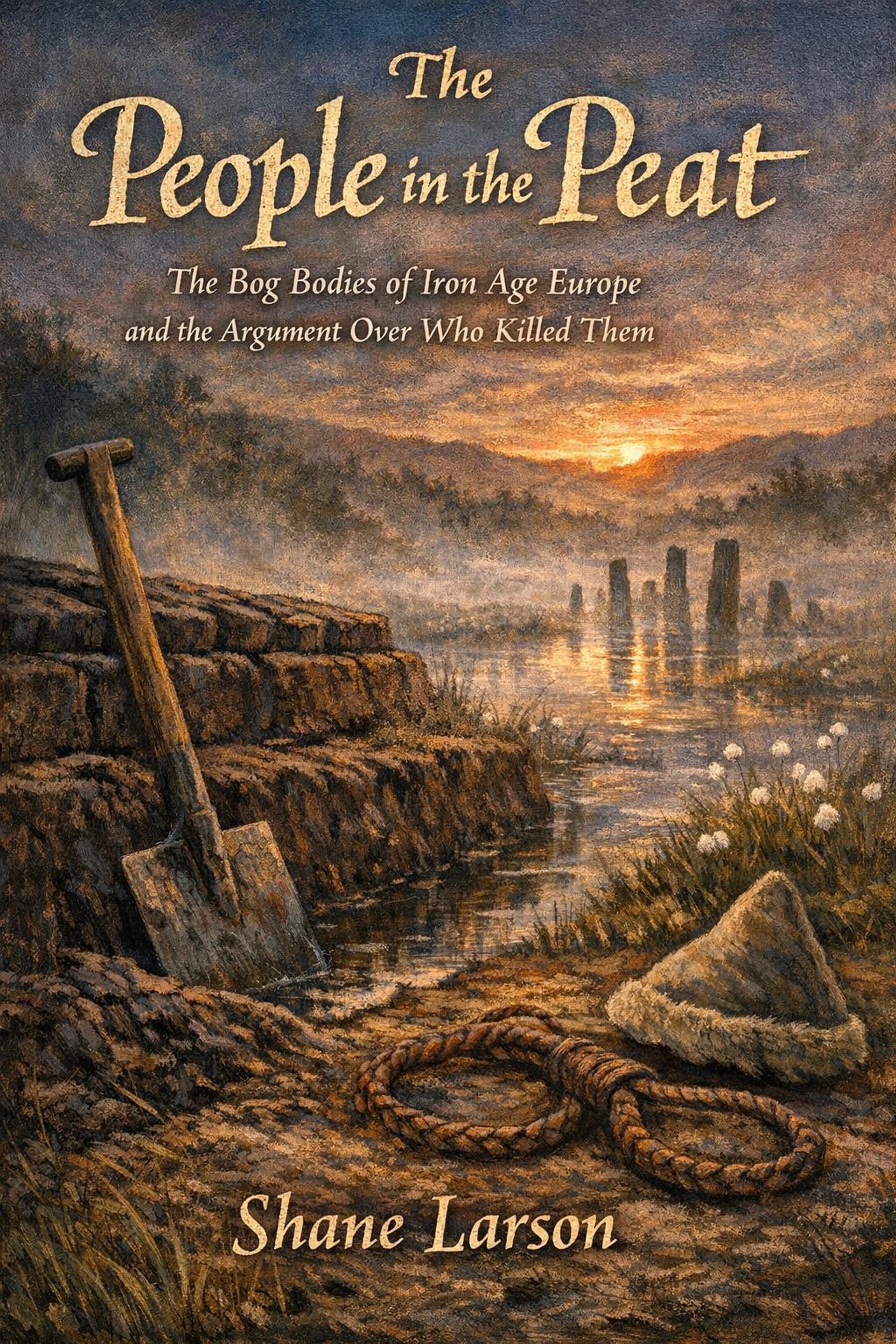
That is the method of *The People in the Peat: The Bog Bodies of Iron Age Europe and the Argument Over Who Killed Them*, which takes Tollund Man, Grauballe Man, Lindow Man, the Yde Girl, the Irish bodies and a dozen others as case files, one at a time, and gives all three verdicts a fair hearing.
The People in the Peat
New posts and releases, straight to your inbox. No spam, unsubscribe anytime.