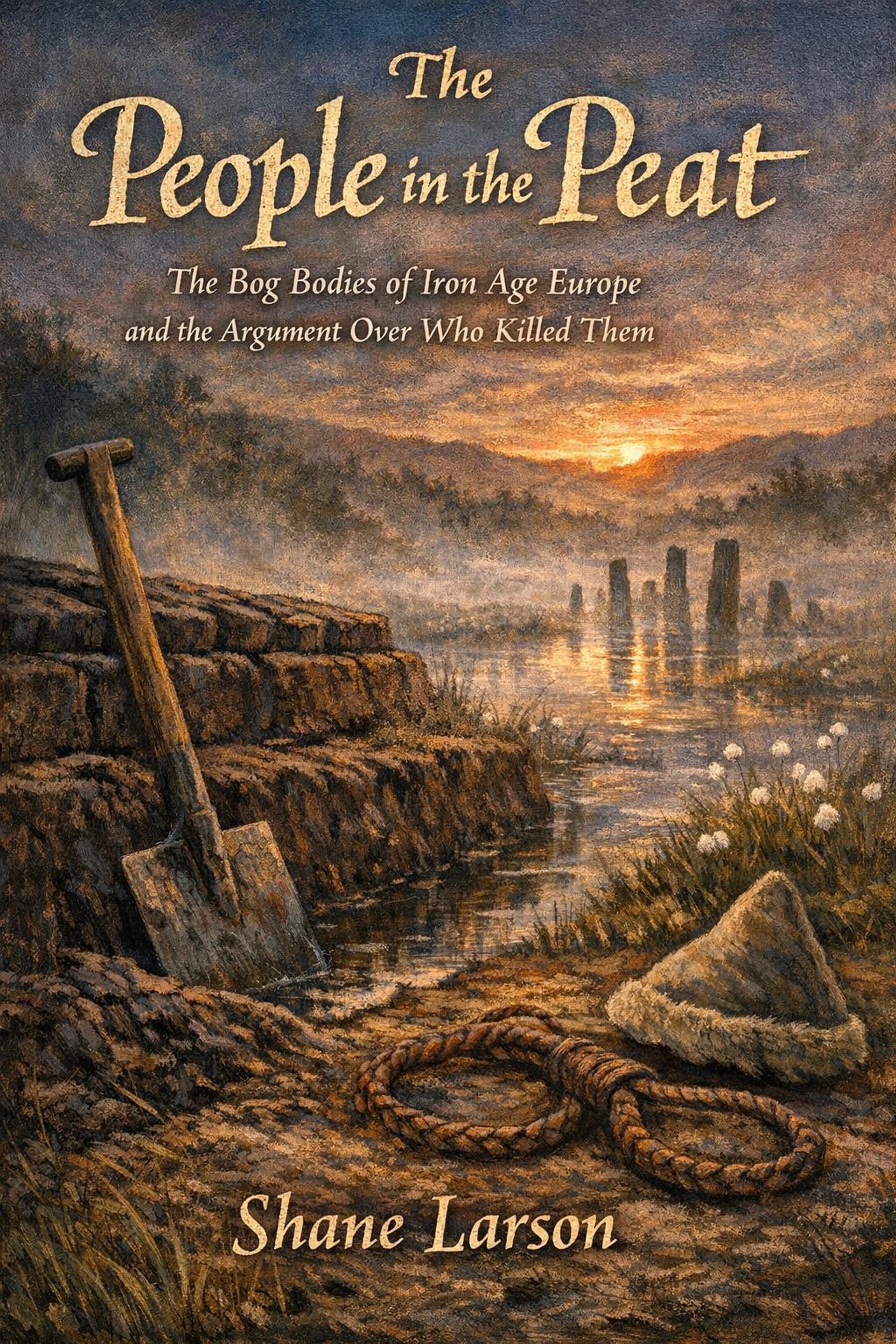
The People in the Peat
The Bog Bodies of Iron Age Europe and the Argument Over Who Killed Them
By Shane Larson
About This Book
On the first day of August 1984, at a peat works on the edge of Wilmslow in Cheshire, a workman picked what he took for a lump of wood off the conveyor and, by the usual account, threw it to a workmate as a joke. When it landed the peat fell away. It was part of a human leg.
The police came first, as they had the year before, when part of a skull from the same moss had led a local man to confess to murdering his wife. Then the county archaeologist walked the cut face of the bog and saw a flap of dark skin showing in the peat. The man it belonged to was lifted in a block and driven to the British Museum, where a team of specialists went to work on him. He was a young man, probably in his twenties. His beard had been trimmed with shears or scissors, his nails were smooth, and he wore nothing except a band of fox fur on one arm. He had been struck on the top of the head. There was a thin cord of sinew at his neck and a gash at his throat.
The specialists agreed on all of that. They did not agree on what it meant, and they still don't.
The Argument
The People in the Peat is about the bodies that the bogs of northern Europe have kept: Tollund Man and Grauballe Man in Denmark, the Windeby and Yde finds in Germany and the Netherlands, Lindow Man in England, Clonycavan and Old Croghan in Ireland, and two dozen others. Cold, acid, airless peat does what no grave does. It tans skin, holds hair and fingernails in place, and keeps a stomach's contents for two thousand years. It hands an archaeologist the kind of evidence a pathologist works with.
What it does not hand over is a motive. Since the 1950s three verdicts have competed. The dead were sacrifices, given to gods who were thought to live in water. They were offenders or outcasts, executed and refused a grave, which is how one passage in the Roman historian Tacitus has been read. Or some of them were victims of ordinary murder, robbery or accident, and the pattern is partly something we have imposed. An Irish theory adds a fourth: that the Irish bodies were kings who failed, killed and placed on the borders of their kingdoms.
The book takes the bodies one at a time, as case files, in the same order every time: the find, the scene, the examination, the dating, and only then the readings. Its one rule is that it says what a body shows before it says what anyone thinks it means. The people who carry the story are peat cutters, policemen, conservators and laboratory scientists. There are no invented scenes and no imagined last hours.
It is also a book about being wrong. Almost every famous story told about these bodies has been corrected by a later generation of method, and the corrections are less well known than the stories. They are all here.
Why I Wrote This
I went to this subject from Doggerland, which is about what the seabed and the peat can keep. I thought I knew the bog bodies. I had the standard picture in my head: a winter sacrifice, a ritual meal, a goddess.
Then I read the restudy of the Windeby body. For fifty years that was a girl punished for adultery, exactly as a Roman author describes. It was in the books and on the museum wall, and a well-known poem was written about her. When someone finally went back and looked, the girl was probably a boy and there was probably no crime. A text had written a story onto a body, and everybody had read the story instead of the body.
After that I wanted to go through all of them the same way and separate what was observed from what was supplied. Some of the old stories survive that treatment. Several don't. I found the ones that don't more interesting than the ones that do.
Frequently Asked Questions
Were the bog bodies human sacrifices?
Some probably were, and the book gives that case in full. But the same evidence often fits a judicial killing equally well, at least one celebrated case was probably not a killing at all, and a Europe-wide survey published in 2023 concluded that no single explanation covers the record. The book weighs each body separately and leaves several verdicts open.
How did Tollund Man die?
He was hanged. The plaited leather noose was still round his neck when he was found in 1950, and later forensic examination supported hanging over strangulation. Radiocarbon dating puts his death at about 400 BC. Who hanged him, and why his eyes were then closed and his body laid carefully in the bog, is the real question.
Does the book include photographs of the bodies?
No. The well-known photographs belong to the museums that hold the remains, and the book was written to work without them. An appendix lists every museum where the bodies can be seen and says what is original and what is reconstruction.
Is this book gruesome?
It describes injuries accurately, the way a pathology report would, once and without dwelling on them. Two of the dead were adolescents and they are treated with particular restraint. Readers who are comfortable with a museum display of human remains will be comfortable with the book.
Do I need to know anything about archaeology or the Iron Age?
No. Radiocarbon dating, CT scanning, isotope analysis and the rest are explained in plain terms where they first matter, and there is a glossary and a who's who at the back.
If You Liked This, You Might Like
- Doggerland — the drowned country under the North Sea, known from the same kind of waterlogged ground and told with the same attention to what the evidence can and cannot carry.
- Teutoburg Forest — the Germans Tacitus was writing about, seen through a battlefield that archaeology found eighteen centuries after the Romans lost it.
- Roman Britain — the province that Lindow Man may or may not have lived to see, depending on which laboratory's date is right.
Somebody closed Tollund Man's eyes before they put him in the water. This is an account of everything else that can be known about him and the others, and of where the knowing stops.
What You'll Learn
- **How peat preserves a body**, and why it keeps skin while dissolving the bone inside it. One find is nearly perfect and the next is a stain in the ground.
- **The finds before science**: a body declared to be a Viking queen and given a royal coffin, bodies reburied in churchyards or lost, and a celebrated catalogue of nearly two thousand finds that turned out to be largely unverifiable.
- **Tollund Man in full.** The noose, the cap, the closed eyes, the last meal as analysed in 1950 and again in 2021, and how much of what is on display is original.
- **Grauballe Man and the first public test of radiocarbon dating**, called in to settle a local claim that he was a peat cutter who had vanished in the 1880s.
- **The book and the poems that made the bodies famous**, and the argument over using the ancient dead to speak about modern violence.
- **Windeby**: the "adulteress" of the museum labels, and the restudy that found a sickly adolescent, probably male, who may not have been killed at all.
- **Two chapters on Lindow Man**: the find, the British Museum investigation, the "triple death", the pathologist who dissented, the laboratories that disagreed about his date, and the druid theory.
- **The Irish finds of 2003 and 2011** and the kingship theory, with its supports and its objections set side by side.
- **The verdicts weighed**: the case for sacrifice, the case for execution, and the case for nothing so tidy, including a close reading of what Tacitus does and does not say.
- **Three appendices**: a table of the principal bodies, a guide to the museums that hold them, and a plain-language guide to the methods.
New Ancient History releases and free chapters — no spam, unsubscribe anytime.
More in This Genre
View all →