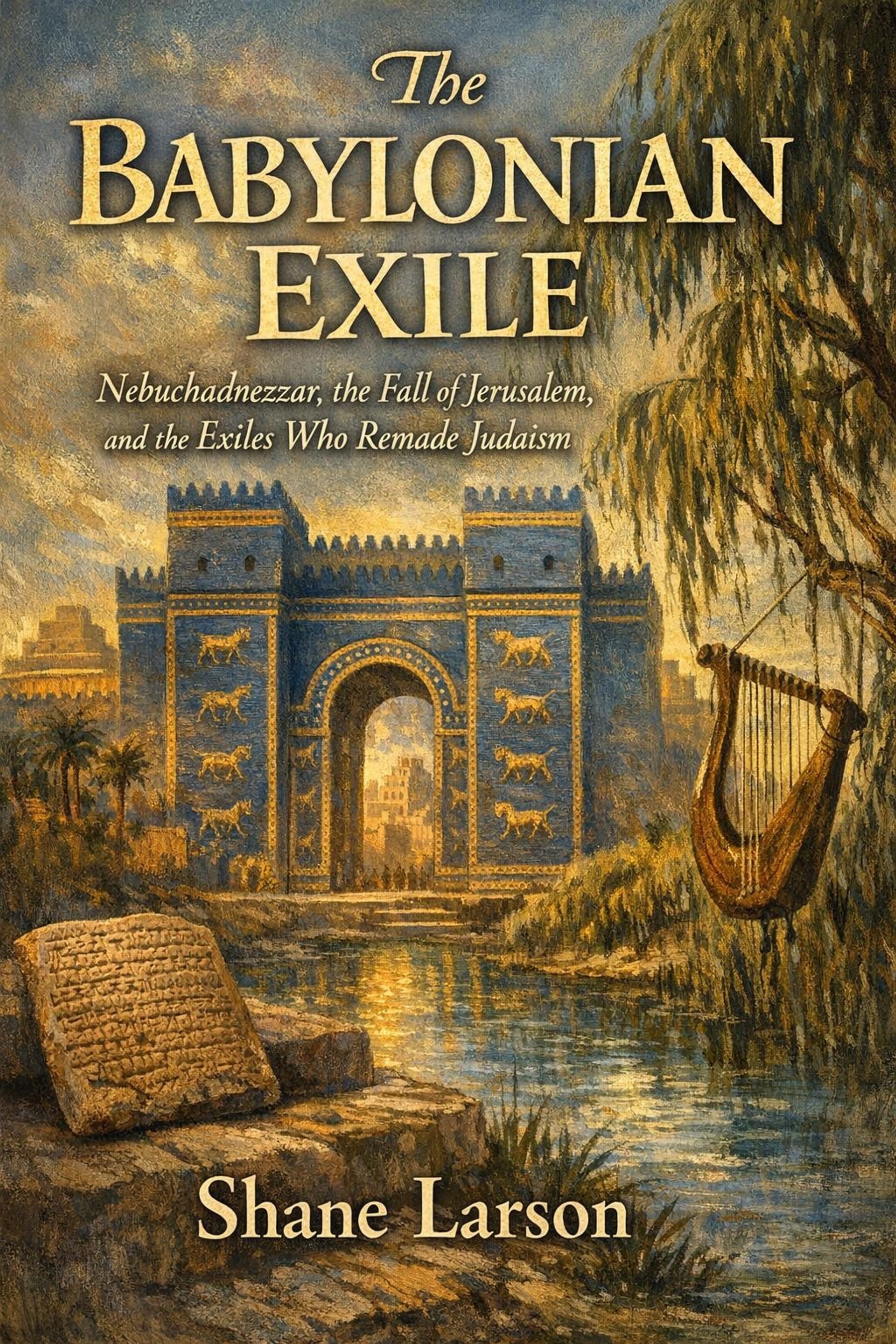
The Babylonian Exile
Nebuchadnezzar, the Fall of Jerusalem, and the Exiles Who Remade Judaism
By Shane Larson
About This Book
Sometime in the last months of the kingdom of Judah, a junior officer at an outpost in the hills wrote a report to his commander in ink on a broken piece of pottery. He confirmed that he had carried out his orders. Then he added that he and his men were watching for the fire-signals of Lachish, following the signs they had been given, because they could not see Azekah.
The potsherd was found in 1935 in the burned guardroom of the gate at Lachish, in the ash of the fire that ended the town. The book of Jeremiah, describing the same weeks, says that Lachish and Azekah were the only fortified cities of Judah still holding out. An excavated letter and a biblical verse had been written about the same two towns, and one of them had just gone dark.
What happened next is one of the best-known stories in the Bible and one of the least understood. How did a small hill kingdom, flattened by the largest army in the world and marched off to the far end of the Fertile Crescent, become the one deported people of the ancient Near East that did not disappear?
The Story
There were two sieges. In 597 BC Nebuchadnezzar of Babylon took Jerusalem after a short one, removed its eighteen-year-old king, and carried him east along with the court, the skilled workers, and a young priest named Ezekiel. A Babylonian chronicle tablet gives the day the city fell. Ten years later the replacement king gambled on Egyptian help and lost. This time the Babylonians stayed until the city starved, and when they got in they burned the temple, the palace and the houses and pulled down the walls. Archaeologists have dug through that layer in several parts of Jerusalem: scorched rooms, collapsed stonework, arrowheads, and dozens of clay seal impressions baked hard when the documents they were attached to went up in flames.
The familiar telling stops close to there, with Psalm 137 and the captives weeping beside the canals of Babylon. This book keeps going, because the evidence does. It follows the people who were never deported, and the short, violent career of the governor the Babylonians left in charge of them. It follows the refugees who ran to Egypt and took the prophet Jeremiah with them against his will, and the Judean soldiers who, a century later, were keeping their own temple on an island in the Nile. And it follows the deportees themselves into the Babylonian countryside, where a cache of cuneiform contracts shows what exile looked like once the weeping was done: farmland held in return for service, rent paid in barley and dates, loans, lawsuits, inheritances.
Then comes Cyrus of Persia, who took Babylon in 539 BC and allowed displaced peoples to return to their homes. Some Judeans went back and built a second, smaller temple. A great many did not, and the community they founded in Babylonia was still producing scholarship a thousand years later.
Running through all of it is an argument about survival. Judah lost its king, its territory and the only place it was permitted to offer sacrifice. What it carried out of Babylon was a way of being a people that needed none of those things.
Why I Wrote This
I knew this story the way most people do, as a psalm and a few Sunday-school scenes: the fiery furnace, the writing on the wall, the harps on the willows. What I did not know was that the last king of Judah's family shows up in a Babylonian storekeeper's records, or that there are rental agreements signed by the grandchildren of the people who watched the temple burn.
That second body of evidence is what made me want to write the book. A lament tells you what a catastrophe felt like. A lease tells you what people did the next year, and the year after that. I kept wanting to read the two together, and I could not find a book for general readers that did it, so I wrote one. I have tried to be straight about what is known and what is argued over, and to leave the questions of faith with the reader.
Frequently Asked Questions
Is there archaeological evidence for the Babylonian exile?
Yes, and a good deal of it. Babylonian chronicles record the capture of Jerusalem in 597 BC, palace ration lists name the exiled king of Judah, the burned layers in Jerusalem and Lachish match the biblical account of the second siege, and contracts from Babylonia show Judean families living there for generations. The book goes through each find and says who dug it up and when.
Does this book take a side on who wrote Isaiah or when Daniel was written?
No. On those questions, and on how much of the Hebrew Bible was composed or edited during the exile, it sets out the case made by critical scholars and the case made by Jewish and Christian tradition, with the evidence each relies on. It does not tell you which to believe.
Which Bible translation does the book quote?
Only the King James Version. Every other ancient source, including the cuneiform tablets and the Hebrew and Aramaic letters, is described in the author's own words.
What are the Al-Yahudu tablets?
They are roughly two hundred clay documents, dated between 572 and 477 BC, from a village in Babylonia whose name means something like "Judah-town". They record the ordinary business of Judean deportees and their descendants. They reached scholars through the antiquities market, so their findspot is unknown, and the book treats that as the serious problem it is.
If You Liked This, You Might Like
- Babylon — the city the exiles were taken to, from Hammurabi's law code to the astronomers whose arithmetic still runs our clocks.
- The Persian Empire — Cyrus and his successors from the Persian side, including the policies that sent displaced peoples home.
- Assyria — the empire whose sudden collapse opens this book, and the earlier deportations that destroyed the northern kingdom of Israel.
- Elijah — an earlier prophet at odds with an earlier king, for readers who want more of the history behind the biblical narrative.
A burned city and a stack of farm leases are both part of the record. Read together, they explain how a people outlived its own kingdom.
What You'll Learn
- The same siege in two archives. The Babylonian Chronicle and the Book of Kings independently place the first capture of Jerusalem in the same weeks of early 597 BC. The book sets the two accounts side by side and shows where they match and where their calendars pull apart.
- A king in the palace accounts. Storehouse tablets from Nebuchadnezzar's Babylon list oil issued to Jehoiachin of Judah and to his five sons, along with Philistine princes, Phoenician sailors and Greek carpenters. A full chapter works out what a royal hostage was for.
- The destruction layer. What was found in the burnt houses of the City of David and at the foot of the wall in the Jewish Quarter, who found it, and how it reads beside the book of Lamentations.
- Judahtown. About two hundred contracts from a village the Babylonians named for its Judean settlers, tracing one family through four generations. The tablets were never excavated and nobody knows exactly where they come from; the book says plainly what that costs.
- How empty was the land? Three scholars, three readings of the same archaeology, each given its strongest form. The reader gets the evidence for all of them.
- Two exiles compared. The Judeans in Egypt kept a temple and vanished from the record. The Judeans in Babylonia had none and endured. The contrast is the closest thing history offers to an experiment.
- The questions people argue about. Who wrote the second half of Isaiah, when Daniel was written, how much of the Bible took shape in Babylon, whether the fall came in 587 or 586. In each case the scholarly and the traditional positions are both laid out, and the book does not pick a winner.
- The Cyrus Cylinder, read closely. What the famous clay barrel actually says about returning peoples and their gods, and the fact that it never mentions Judah at all.
New Ancient History releases and free chapters — no spam, unsubscribe anytime.
More in This Genre
View all →