In 1345 Petrarch Found Cicero's Private Letters and Wrote Him an Angry Reply
November 22, 2026 · 6 min read
In June 1345 an Italian poet sat down in Verona and wrote a letter to a man who had been dead for almost fourteen centuries. He dated it carefully, gave his address as the right bank of the river Adige, and added that the year was counted from the birth of a God his correspondent had never known. Then he told Marcus Tullius Cicero, the greatest orator Rome produced, exactly how disappointed he was in him.
The poet was Francesco Petrarca, known in English as Petrarch. The letter still exists, the third in the last book of his collected correspondence. It is one of the stranger documents of the fourteenth century, and to understand why he wrote it you have to know what he had just been reading.
The Cicero Petrarch thought he knew
For most of the Middle Ages, Cicero was a voice without a life. Monks and schoolmen read his works on duty, friendship and old age, and some of his speeches. They knew him as "Tully", a kind of honorary sage: calm, lofty, a pagan who had come surprisingly close to wisdom. Petrarch had loved that Cicero since he was a boy. He tells a story elsewhere of his father throwing his books on the fire and relenting only for two, one of them a Cicero, when the boy wept.
By the 1340s Petrarch was the most famous man of letters in Europe and a tireless hunter of old manuscripts. He knew from references in other ancient writers that Cicero had left a large correspondence. Nobody he knew had seen it.
What was in the Verona library
The cathedral chapter at Verona had one of the oldest libraries in Italy. Some time in the spring of 1345 Petrarch was given access to a manuscript there containing Cicero's letters to his friend Atticus, with the smaller collections to his brother Quintus and to Brutus. It was in poor condition and hard to read. He copied it himself, he says, because he did not trust a scribe with it, and he was ill at the time.
What he copied were letters of a kind he had never seen from antiquity. They were not essays dressed as letters. They were the real thing: notes dashed off before a courier left, sometimes two in a day, full of money worries, building projects, gossip, Greek tags and nicknames, complaints about colleagues. And they covered the most dangerous twenty-five years in Roman history, from Cicero's rise to the months before his murder in 43 BC.
In them the sage disappears. The Cicero of the letters cannot stop boasting about his year as consul. Driven into exile in 58 BC, he collapses, blames his friends, and writes that he should have ended his life. When civil war breaks out between Caesar and Pompey he spends months unable to choose a side, and lays the indecision out for Atticus day by day. Under Caesar's dictatorship he flatters the dictator in public and despises him in private. After Caesar's murder he throws himself, in his sixties, into a fight with Mark Antony that anyone could see might kill him, and it did.
The letter of reproach
Petrarch's reply is short and upset. He says he has read the letters eagerly and has heard Cicero saying many things, lamenting many things, and changing his mind many times. He had long known what kind of teacher Cicero was to others. Now at last he has learned what kind of guide he was to himself.
Cicero
Then come the charges. Why so many quarrels and feuds that did nobody any good? Why abandon the quiet that suited his age, his calling and his fortune? What false glitter of glory dragged an old man into the wars of the young and led him to a death unworthy of a philosopher? He reproaches him for trusting the young Octavian, and for attacking Antony with such fury. How much better, he says, to have grown old peacefully in the country, thinking about eternal life, as Cicero himself had somewhere recommended. He signs off with an eternal farewell.
It is a letter written by a man who has just discovered that his hero was a politician.
Petrarch seems to have known he had been hard. He wrote a second letter to Cicero not long after, gentler in tone. In it he explains that it was the life he had criticised, not the mind or the eloquence, which he still held above all others. He also gives the dead man a report on which of his books had survived the centuries and which were lost, and this second letter is touching in a way the first is not.
Why the discovery mattered
Petrarch's complaint has been repeated ever since. The great nineteenth-century historian Theodor Mommsen despised Cicero as a weathercock, and he had the letters to quote. Every charge of vanity or cowardice ever made against him rests on evidence Cicero supplied himself, in documents that were never polished for strangers.
But the letters cut the other way too, and Petrarch's own career shows it. He was so struck by them that he began collecting and editing his own correspondence on the same model, which is why his letter to Cicero survives at all. The private letter as a literary form, the idea that an ordinary day's worries are worth keeping, comes back into European writing through that Verona manuscript. Half a century later Coluccio Salutati, the chancellor of Florence, went looking for a copy of Petrarch's find and was sent a different collection altogether, Cicero's letters to his friends and family, from a library at Vercelli. By 1400 the whole correspondence was back in circulation, more than nine hundred letters.
The original Verona manuscript later vanished. The text survives because copies had been made, which is how nearly everything from the ancient world survives.
What Petrarch missed
Reading the letters now, it is hard not to think Petrarch asked the wrong question. He wanted to know why a philosopher had not stayed out of politics. The letters show that Cicero never thought of himself as a philosopher who had strayed into public life. He was a public man who turned to philosophy when the Forum was closed to him, and went back the moment it reopened.
They also show something a polished memoir would have hidden. The man who dithered for months in 49 BC is the same man who, six years later, knew precisely what Antony was and said so fourteen times in public. The vanity and the courage are in the same handwriting. No one else from the ancient world can be seen that closely, and very few people from any period would come out of it better.
Petrarch closed his first letter by saying farewell forever. He wrote to Cicero again within months.
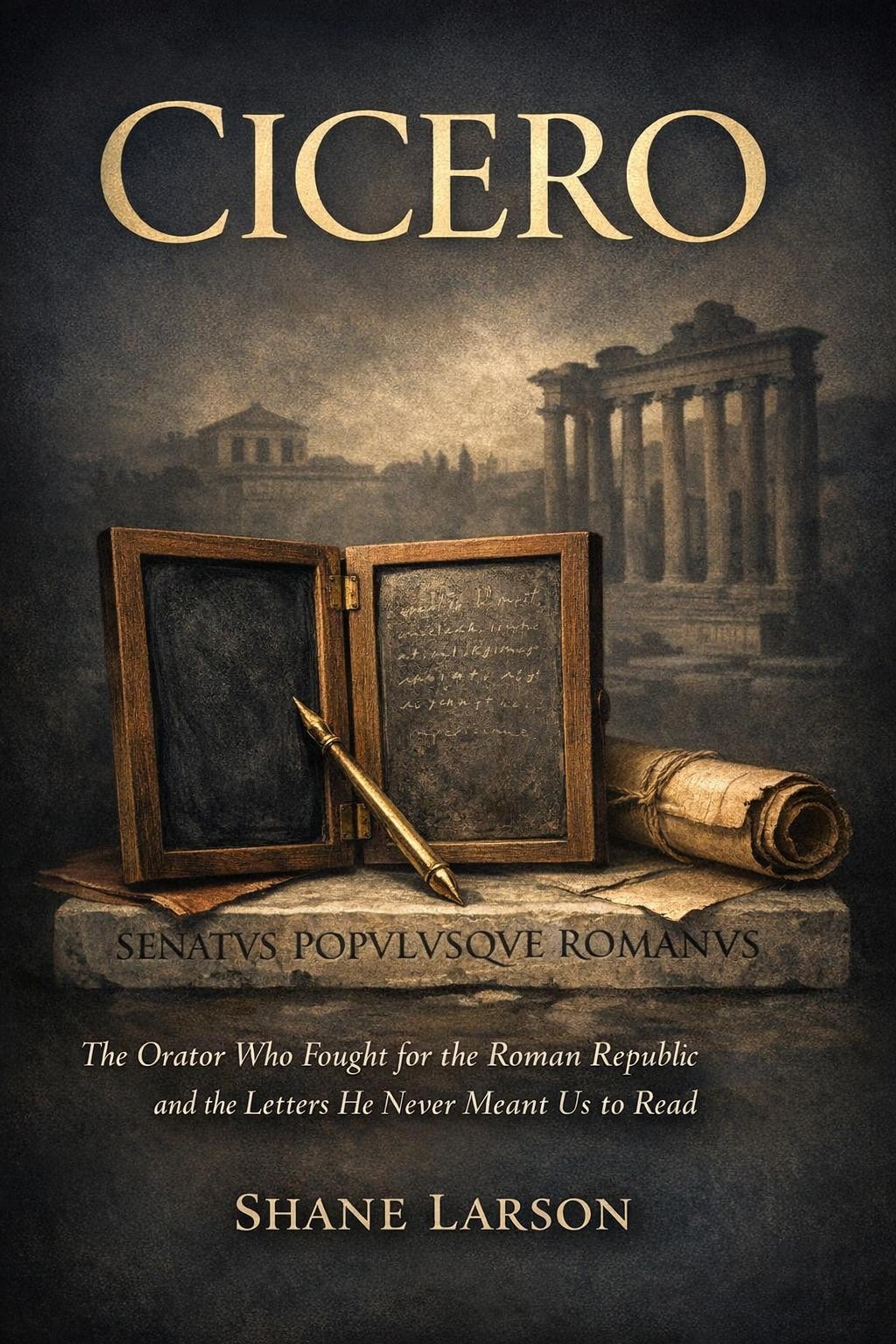
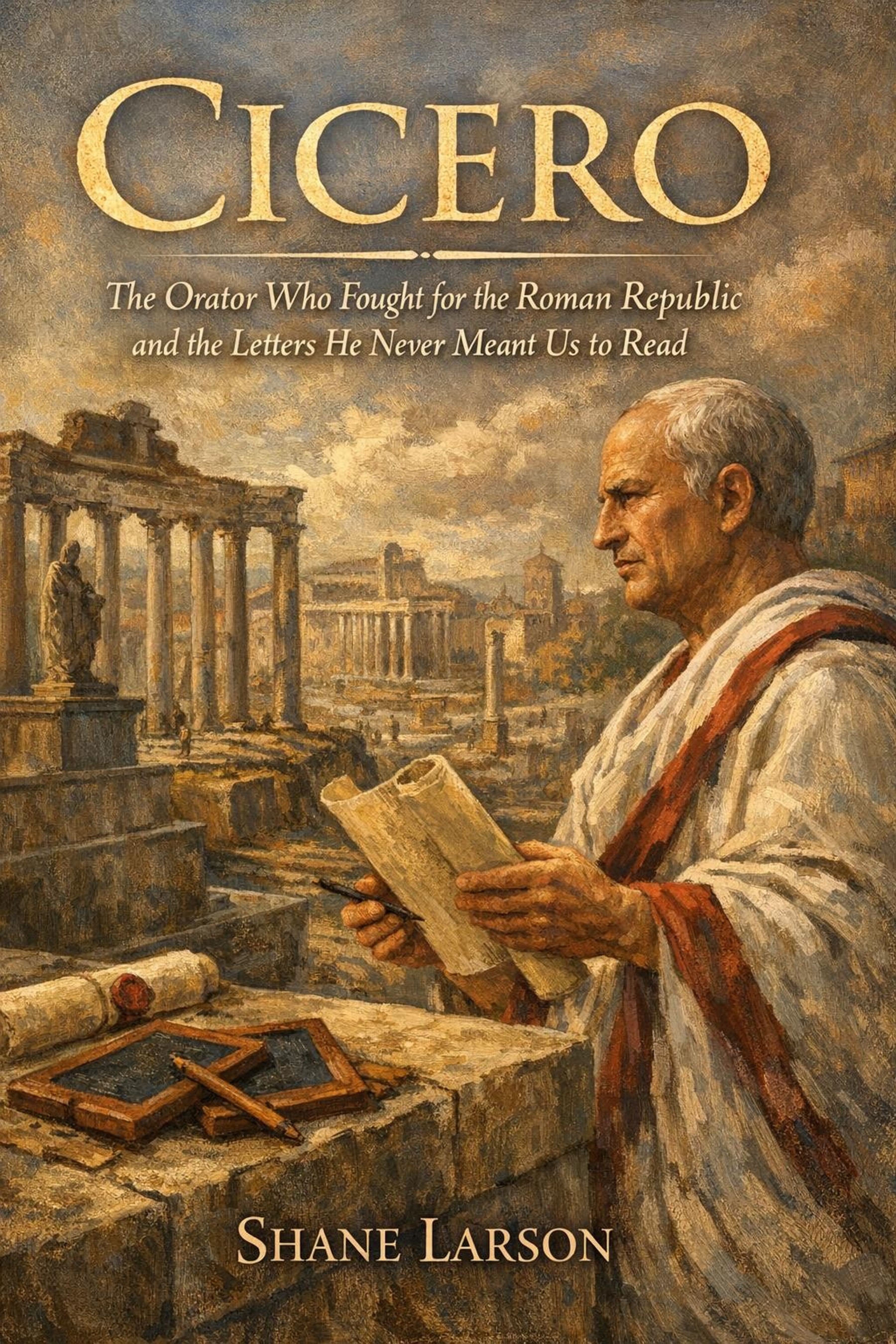
The letters, set beside the speeches Cicero published in the same weeks, are the spine of *Cicero: The Orator Who Fought for the Roman Republic and the Letters He Never Meant Us to Read*, which follows the man through both records from a hill town called Arpinum to the road where Antony's soldiers caught him.
Cicero
New posts and releases, straight to your inbox. No spam, unsubscribe anytime.