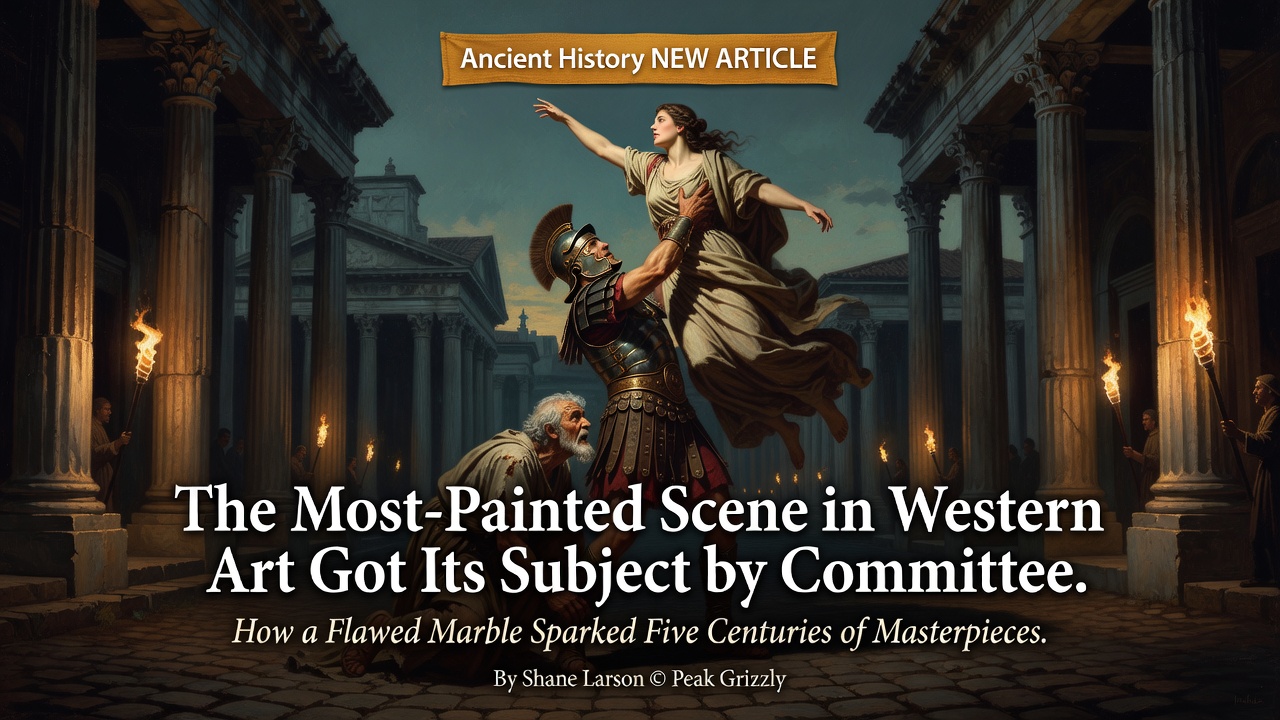
The Most-Painted Scene in Western Art Got Its Subject by Committee
August 16, 2026 · 7 min read
In 1583, Giambologna unveiled a marble group in Florence that would become one of the most celebrated sculptures of the late Renaissance: three figures — a crouching older man, a young man rising over him, a woman lifted into the air — spiraling out of a single block of stone. The technical achievement was the point. The block was flawed, the figures interlock, and there is no principal viewpoint; the sculpture has no front, so you have to walk around it. Sculptors had argued for a century about whether painting or sculpture was the higher art, and Giambologna's answer was a work that could not be reproduced in any single image.
Here is the strange part: when he finished it, it had no subject. The three figures were not anyone in particular. The title came afterward, chosen from a shortlist by the scholars advising the Medici court, and the choice they settled on was the seizure of the Sabine women — the episode from Rome's founding legend in which the wifeless first Romans abducted the daughters of their neighbors at a religious festival. The name stuck, the sculpture went into the Loggia dei Lanzi on the edge of the Piazza della Signoria, and it stands there today, one of the most photographed artworks in Italy, wearing a title it was assigned the way a foundling is assigned a name.
That would be a curiosity if it were an exception. It is closer to a summary. For roughly five hundred years, European art returned to the Sabine women over and over — Pietro da Cortona in the Baroque, Poussin twice in the 1630s, Rubens, Jacques-Louis David on a canvas fourteen feet wide, Degas copying Poussin as a student exercise, Picasso in 1962, and, improbably, an MGM musical in 1954. Museum wall labels tend to treat each of these as an isolated masterpiece. Line them up instead, in order, and they become something better: a five-century record of what each generation could bear to see in the same story.
A story with two halves
To understand why artists could not let this subject go, you need the part of the legend the paintings' titles usually skip.
The Roman tradition — written down centuries after the fact by Livy, Dionysius of Halicarnassus, Plutarch, and Ovid, who disagree on almost every detail — runs like this. Rome began as a sanctuary town of fugitives and landless men, with one fatal shortage: no wives, and neighbors who refused the legal right of intermarriage. So Romulus staged a festival, invited the surrounding towns with their families, and at a signal his men seized the unmarried women and carried them off. The families fled; a war followed.
But the war took years to arrive — the Sabines needed time to build a coalition — and the delay is what gives the story its second half. By the time the fathers and brothers finally marched on Rome, the abducted women had husbands, homes, and children on the Roman side and their entire birth families on the other. In the middle of the decisive battle, the tradition says, the women themselves walked out between the two armies, carrying their infants, and made the argument that no one else on the field could make: whichever side wins, we are widows or orphans. The fighting stopped. The two peoples merged into one city under two kings, and Rome named thirty of its earliest voting divisions after thirty of the women.
An atrocity, and then a reconciliation performed by its victims — the same women, in the same story, a few pages apart. That double structure is the engine under everything that follows, because it means the story can be told as either half, and which half a culture reaches for tells you what that culture needed.
Look at the titles: most of them say "intervention"
Here is the detail that rewards actually reading the labels in the museum. A remarkable number of the famous canvases are not depictions of the abduction at all. Rubens's treatment of the subject circulates under the title of the intervention — the women stopping the battle. So does the greatest of them all: Jacques-Louis David's enormous 1799 canvas in the Louvre, which puts Hersilia, the leader of the women, dead center in white, arms flung wide between two armed men about to kill each other, with babies literally on the ground between the soldiers' feet.
The Sabine Women
David's choice was not antiquarianism. He began the picture while imprisoned after the fall of Robespierre. He had voted for the execution of his king, served the Terror as its virtual minister of propaganda, and watched France tear itself apart. When he exhibited the finished painting — charging admission, a novelty that scandalized his colleagues — the public that filed past understood exactly what a picture of former enemies lowering their weapons over a woman's outstretched arms was proposing in 1799. It is a painting about amnesty, made by a man who needed one, offered to a country that did too.
Even the artists who did paint the seizure tended to flee from it into form. Poussin's two versions — one now in the Metropolitan Museum, one in the Louvre — organize the chaos into rigorous geometry, with Romulus presiding calmly from a portico like a conductor. Giambologna, as we have seen, was not painting the subject at all; the subject was appended to the virtuosity. Century after century, the pattern holds: the scene is irresistible, and almost nobody looks at it straight.
Then the twentieth century split it in half
The modern era pulled the story's two halves apart and sent them in opposite directions in the same decade.
In 1954, MGM released Seven Brides for Seven Brothers, a musical adapted from Stephen Vincent Benét's 1926 short story "The Sobbin' Women," which had transplanted the episode to the Oregon frontier. The film keeps the plot skeleton — brothers abduct the women they cannot court, a winter siege stands in for the war, a mass wedding resolves everything — and plays it as courtship comedy with a legendary barn-raising dance number. It is, by orders of magnitude, the most-watched version of the Sabine story ever made, and it is the reconciliation half with the crime dissolved into choreography.
Eight years later, Picasso went the other way. In late 1962 and early 1963 — the months around the Cuban Missile Crisis, when the end of the world was a live newspaper story — he produced a series of canvases and dozens of studies on the Sabine theme, working directly from David and Poussin. What he kept was the violence: rearing horses, a woman under the hooves, a mother crouched over a dead child, the vocabulary of Guernica redeployed. What he cut was the intervention. There is no peace anywhere in Picasso's versions. At the moment humanity seemed likeliest to destroy itself, the twentieth century's most famous artist reached for a two-thousand-year-old Roman legend and deleted its ending.
A barn dance and an apocalypse, from the same source, within a decade. That is not a story being remembered. That is a story being used — and it had been used that way all along. Renaissance Florence wanted the civic virtuosity; the Baroque wanted ordered violence; David's France wanted amnesty; the Cold War wanted a scream. Every age painted its own moment and called it Rome.
Why this story, and not another
Western art does not lack for dramatic classical episodes, so why did this one become the perennial? The answer, I think, is precisely that its two halves refuse to reconcile. A story that was only an abduction would be unbearable as public art; a story that was only a reconciliation would be inert. The Sabine episode is both at once, permanently, and the tension never discharges — which means every generation can find its own crisis somewhere along the arc from crime to peace, and no version is ever the last word. The subject stays open the way a wound stays open.
It also means the paintings are historical evidence twice over: once about Rome, and once about the people at the easel.
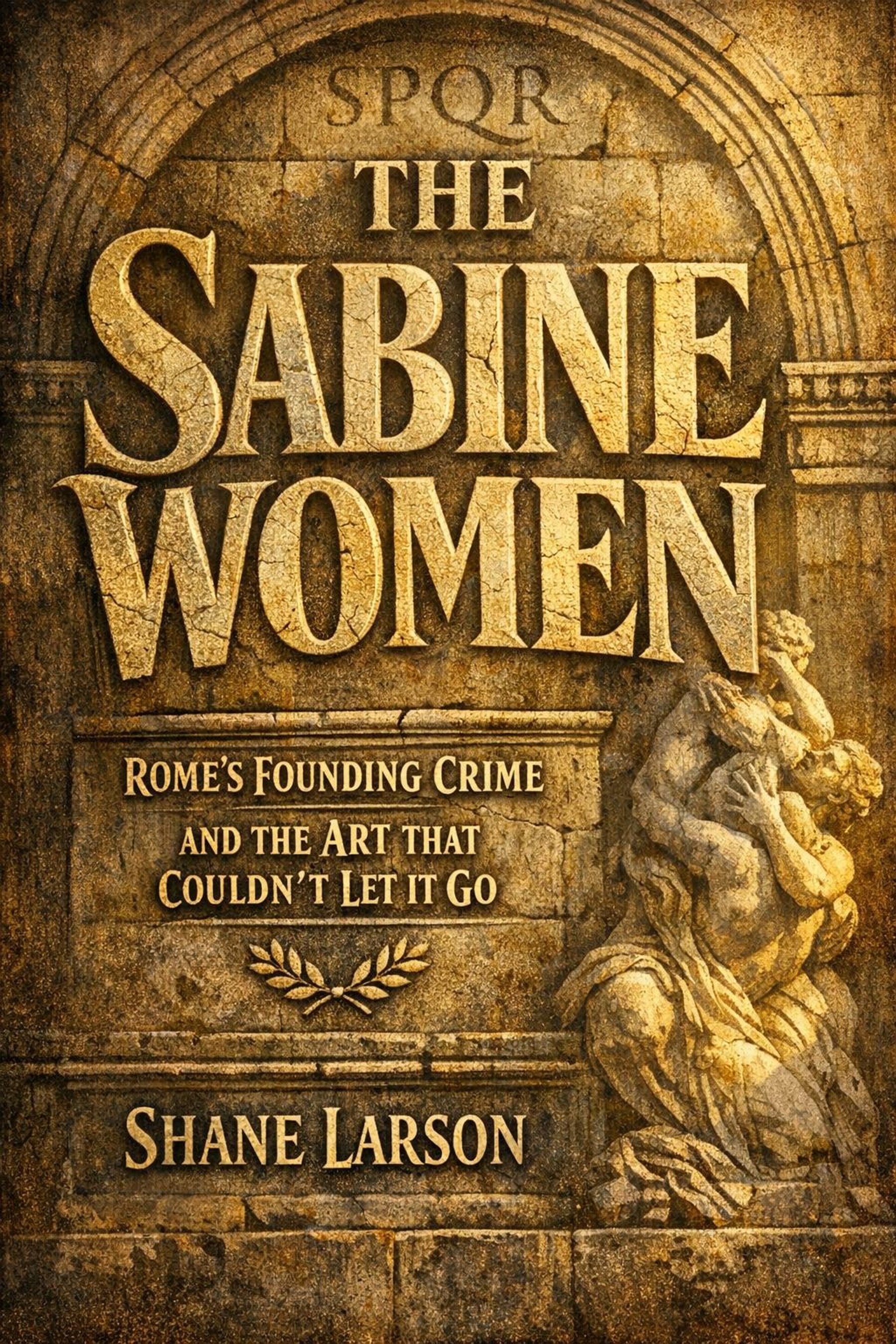
If this way of reading the art interests you, my book The Sabine Women: Rome's Founding Crime and the Art That Couldn't Let It Go follows the whole arc — first taking the episode apart as history, through the contradictory ancient sources, the contested Latin word behind the conventional English title, and the strange fact that Rome built the abduction into its own wedding customs, and then tracing the story through Giambologna, Poussin, Rubens, David, Picasso, and Hollywood. It treats every retelling as evidence about the people doing the retelling, and it is honest about the one question none of them ever settled: whether the intervention redeems the abduction, or convicts it.
The Sabine Women: Rome's Founding Crime and the Art That Couldn't Let It Go is available now on Amazon Kindle.
The Sabine Women
New posts and releases, straight to your inbox. No spam, unsubscribe anytime.