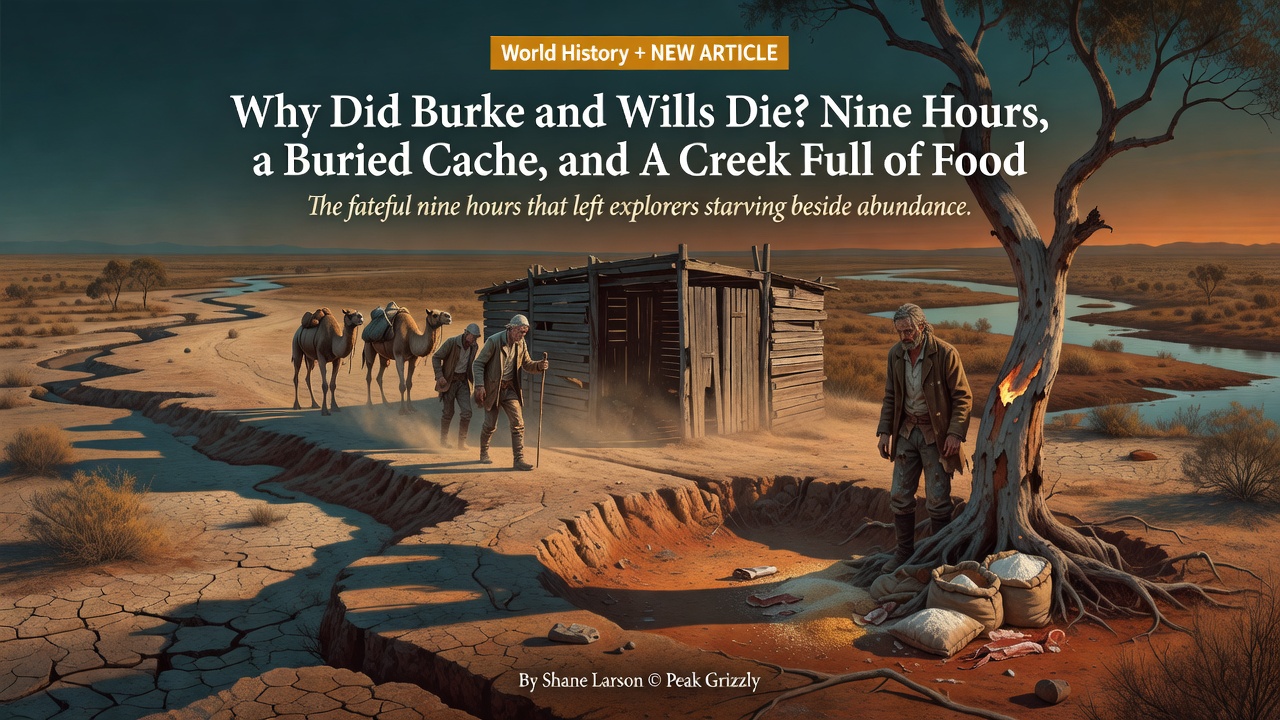
Why Did Burke and Wills Die? Nine Hours, a Buried Cache, and a Creek Full of Food
November 14, 2026 · 7 min read
On the evening of Sunday 21 April 1861 three men and two camels came up the bank of Cooper Creek, in the dry interior of Australia, toward a small stockade. They had left it four months earlier to walk to the north coast of the continent and back. They expected to find four companions, food and rest. They found nobody. On a coolibah tree by the camp someone had cut a fresh blaze with a word in it: DIG.
Under the tree was a cache of flour, rice, oatmeal, sugar and dried meat, and a note. The party that had been waiting for them had left that morning, about nine hours before.
That near-miss is the most famous moment in Australian exploration. It is usually told as the reason Robert O'Hara Burke and William John Wills died. It was not the reason, or not on its own. They lived for another ten weeks, on a creek with fish in it, among people who fed them. Understanding why they still died means looking at what happened before that evening and what they did after it.
An expedition that kept dividing
The Victorian Exploring Expedition left Melbourne on 20 August 1860. It was the most expensive exploring party an Australian colony had sent out: nineteen men, about two dozen camels imported from India, horses, wagons and some twenty tons of stores. Its job was to cross the continent from south to north, a journey no colonist had made.
A committee of the Royal Society of Victoria chose the leader. They picked Burke, a police superintendent of about forty, an Irishman who had served in the Austrian cavalry. He was brave and well liked. He had no experience of exploring, and he did not keep a journal. His surveyor, Wills, was twenty-six, trained at the Melbourne observatory, and recorded everything.
The column took about two months to reach Menindee, the last settlement, on the Darling River. Burke had already quarreled with his second-in-command, who resigned there. Impatient with the pace, and aware that a rival explorer from South Australia was in the field, Burke divided his party. He took eight men ahead to Cooper Creek, 400 miles on, and told a local station manager, William Wright, to follow with the bulk of the supplies.
At the Cooper he divided it again. On 16 December 1860 he set out for the Gulf of Carpentaria with Wills, John King and Charles Gray, six camels, a horse and food for about twelve weeks. William Brahe was left in charge of the depot with three men. His orders were spoken, not written. By his own later evidence, he was to wait three months, or as long as his provisions lasted.
To the Gulf and back
The four reached the tidal channels of the Gulf in February 1861. They could not get through the mangroves to see open water, but the creek they stood beside was salt and rose and fell with the tide. They had used about two-thirds of their food on the way out.
The walk back was made on short rations through the wet season. They killed and ate their animals one after another. Gray fell ill, was caught taking extra flour, and was beaten by Burke for it. He died on 17 April. The other three spent a day burying him. Four days later they reached the depot.
Why Brahe left
Brahe had waited four months and five days, a full month beyond his instructions. Wright's supply party, expected since the new year, had never appeared. One of his men was badly injured and could not walk, and the others were showing what Brahe took for scurvy. He had enough food to get his men back to the Darling if he left some behind and went at once. He believed Burke had either come out by another route or was dead.
So on the morning of 21 April he buried a cache, strewed horse dung over the ground to hide it, cut the blaze, and rode out. He camped that night about fourteen miles away.
Wright, meanwhile, had not left the Darling until late January. He had been waiting for confirmation of his appointment from Melbourne, for money, and for fit animals. When he finally started, in the worst heat of the year, his party broke down with sickness. Three of his men died within a week of each other in late April.
Nine Hours Late
The decision at the tree
Burke, Wills and King now had a few weeks of food and two exhausted camels. They could follow Brahe's tracks. Or they could head south-west for a police outpost near a hill called Mount Hopeless, about 150 miles off.
Brahe's note said his men and animals were in good order. That was not quite true, but it convinced Burke that three men on foot would never catch them. He chose Mount Hopeless. Before leaving, the three put a letter in the cache and smoothed the ground over, so that it would look undisturbed. They did not change the marks on the tree.
On 8 May, Brahe and Wright rode back to the depot to check one last time. They saw smooth ground and an unchanged tree. They stayed about fifteen minutes and left. Burke's party was within a day or two's ride.
The attempt on Mount Hopeless failed for lack of water. The camels died. The three men fell back to the creek.
The people who lived there
Cooper Creek was not empty country. It was the home of the Yandruwandha people, who lived at its permanent waterholes on fish, mussels, birds and flour ground from the seed-cases of nardoo, a small fern that grows on the flood plains. The explorers' own journals record that the Yandruwandha gave them fish and nardoo cakes, again and again, through May.
Wills was grateful and thought they should try to live with their hosts. Burke did not trust them. In early June, by King's account, Burke fired his revolver over the head of a man he thought was stealing, and later knocked fish out of the hands of men who had brought it. The Yandruwandha moved away.
Left to themselves, the three gathered nardoo and pounded it into flour. They ate pounds of it a day and grew weaker. Wills noted, puzzled, that he was starving on a full stomach.
What killed them
The leading explanation is that nardoo contains an enzyme, thiaminase, which destroys vitamin B1. Without that vitamin the body develops beriberi: weakness in the legs, wasting, heart failure. The Yandruwandha ground nardoo with water and baked it, and ate it alongside fish. The explorers ground it dry and ate little else. A 1994 study argued that the difference in preparation mattered.
Not every researcher accepts this. The men had been overworked and underfed for months before they ate any nardoo. It was midwinter, with freezing nights, and they were in rags. Scurvy is possible. A diagnosis made from a journal 130 years later can only go so far.
Burke and Wills died at the end of June 1861, a few miles apart.
The one who lived
John King, twenty-two, was now alone. He did what Wills had suggested. He followed the Yandruwandha's tracks, found their camp, and stayed. They fed him, built him a shelter and took him with them when they moved. When a relief party under Alfred Howitt reached the Cooper on 15 September, they found King sitting in a Yandruwandha camp, thin and barely able to speak, and alive.
A Royal Commission in Melbourne later divided the blame among Burke, Wright, Brahe and the committee. It asked very little about the Yandruwandha.
The nine hours were real. But the expedition had been spending its margins since the day it left Melbourne, and after 21 April it spent more: a wrong choice of route, a tree left unmarked, a quarter of an hour on 8 May, a pistol fired to warn off the people supplying the fish. The men died in a place that was feeding several hundred other people. The one who survived was the one who went and lived with them.
Nine Hours Late: Burke and Wills, the Dig Tree, and the Yandruwandha People Who Kept John King Alive tells the whole story, decision by decision, from the committee room to the creek. For another expedition story told from the side of the people who knew the country, see A Ton of Goods.
Nine Hours Late
New posts and releases, straight to your inbox. No spam, unsubscribe anytime.