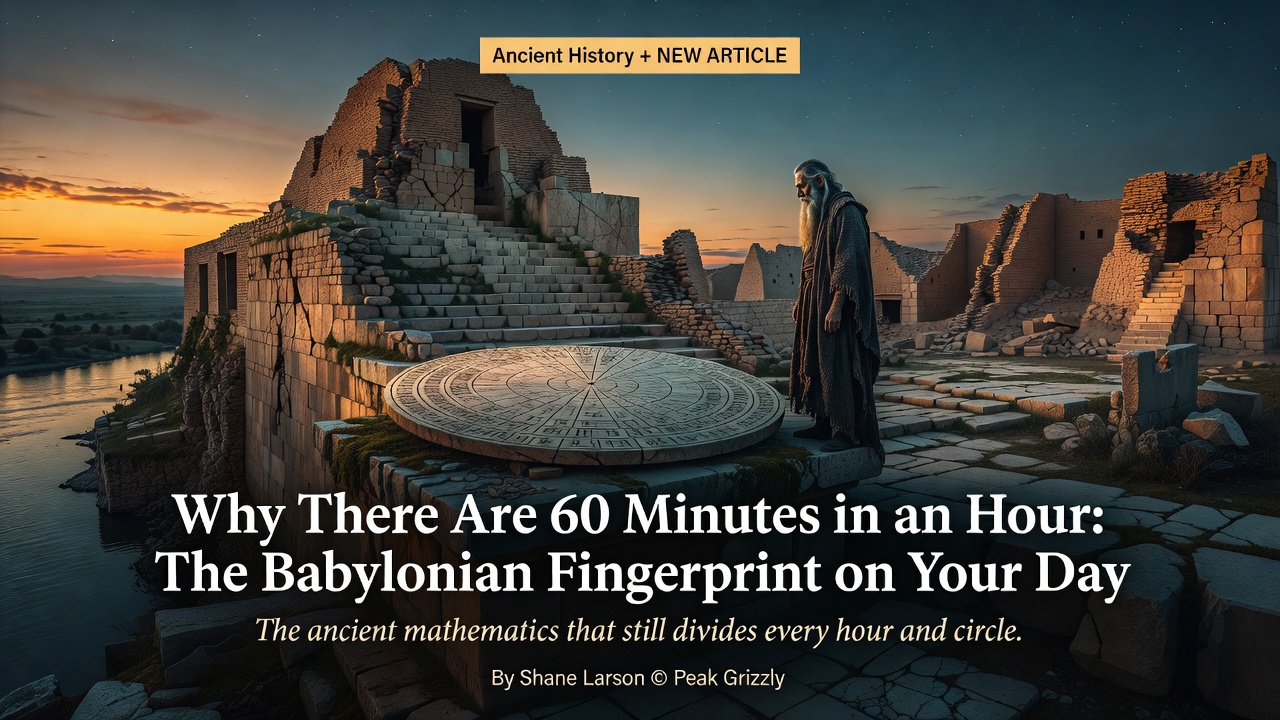
Why There Are 60 Minutes in an Hour: The Babylonian Fingerprint on Your Day
June 15, 2026 · 7 min read
Why There Are 60 Minutes in an Hour: The Babylonian Fingerprint on Your Day
Glance at a clock. Sixty seconds make a minute, sixty minutes make an hour. Look at a compass or a protractor: a full circle is 360 degrees. Check your phone's GPS, and your position is fixed by latitude and longitude measured in degrees, minutes, and seconds. These divisions feel automatic, as if the universe itself handed them down, yet they rest on a choice made long before clocks or satellites existed. We could just as easily have built a world of 100-minute hours and 400-degree circles — and in fact, during the French Revolution, reformers tried exactly that, pushing a decimal-based system that would have split the day into ten hours and the circle into four hundred parts. They failed. The system that won, the one you used to plan your morning, was set in wet clay on the banks of the Euphrates around four thousand years ago.
That is the strange, quiet truth about Babylon. We remember the city for the wrong reasons entirely — and forget it for the things that actually shaped our daily lives.
The wrong kind of famous
Say the word "Babylon" and watch what happens. People picture the Hanging Gardens. The Tower of Babel. Decadent kings, drunken feasts, writing appearing on a wall, a city so sinful that scripture made its name a synonym for corruption — the "whore of Babylon" of the Book of Revelation. The image is vivid because the stories were written by people who had every reason to exaggerate: rivals, exiles, and later moralists who needed Babylon to stand for everything excessive and doomed.
It's a spectacular reputation. It's also almost entirely beside the point.
The Hanging Gardens may never have existed in Babylon at all; the best modern scholarship suggests the famous terraced gardens were actually built in Nineveh, an Assyrian city more than three hundred miles away, and got attached to Babylon's brand by later confusion. The Tower of Babel was a real building — a ziggurat called Etemenanki, dedicated to the god Marduk — but it wasn't a monument to human arrogance struck down by heaven. It was a temple, the spiritual heart of an enormous, functioning city whose priests climbed its levels to chart the movements of planets. The legends, in other words, are mostly the work of outsiders: Greek travelers swapping tall tales, Hebrew scribes turning a conquering empire into a moral symbol, later generations layering wonder upon wonder until the real place vanished underneath. What got buried was something far more impressive than any myth: the patient, unglamorous work of administrators and observers who turned numbers into tools that still run our schedules.
A choice made in clay
The base-60 system — sexagesimal, if you want the technical word — didn't fall from the sky. It grew out of the very practical needs of a society that ran on writing and record-keeping. Scribes in southern Mesopotamia had already been keeping ledgers for centuries when they settled on sixty as their working number, and they chose it because it solved everyday problems that decimal counting never quite could.
Sixty is an unusually convenient number. It divides cleanly by 2, 3, 4, 5, 6, 10, 12, 15, 20, and 30. For merchants splitting shipments, surveyors parceling out fields, and officials calculating rations and interest, that flexibility was gold. A number you can divide into thirds and quarters and fifths without messy fractions is a number that makes commerce and administration easier. A merchant could divide sixty bushels of grain among three partners or five crews without leftover fractions that required further negotiation. Babylonian scribes built an entire mathematics on this foundation, and they were astonishingly good at it. Surviving clay tablets show them solving quadratic equations, calculating square roots, and working with what we'd now call Pythagorean triples more than a thousand years before Pythagoras was born. They had no decimal point and no symbol for zero for much of their history — and they still ran rings around their contemporaries, producing tables that let them multiply and divide large numbers with surprising speed.
Babylon
When they turned that mathematical machinery toward the sky, something unprecedented happened.
The first scientists were night-shift clerks
For century after century, anonymous Babylonian observers stood on temple platforms and wrote down what they saw overhead. The rising and setting of Venus. The timing of eclipses. The slow wandering of the planets against the fixed stars. They recorded it all on tablets, night after night, year after year, generation after generation. The work was repetitive and often done by junior priests whose names we will never know, yet the accumulated data became something new in human history.
This sounds modest. It was revolutionary. What they were building, without quite knowing it, was the first long-term scientific database — a continuous record of celestial events stretching across hundreds of years. And once you have centuries of data, patterns emerge. The Babylonians learned to predict eclipses rather than merely fear them, identifying the eighteen-year cycle that still bears the name Saros. They worked out the cycles of the planets with remarkable accuracy. They divided the path of the sun through the sky into twelve segments — the origin of the zodiac you still see in horoscopes — because twelve fit neatly inside their sixty-based counting and matched the rough number of lunar cycles in a year. This is the deep root of the 360-degree circle. The sun appears to travel a full loop through the heavens over roughly 360 days, and the Babylonian habit of counting in sixties made 360 a natural way to carve up that circle. From the sky, the number came down to earth, and it never left.
When Greek astronomers like Hipparchus and Ptolemy got to work centuries later, they didn't start from scratch. They inherited Babylonian records, Babylonian methods, and Babylonian numbers. The 60-based system passed into Greek science, then into the Islamic astronomers who preserved and advanced it, then into medieval Europe, and finally into the watch on your wrist. A line of transmission runs unbroken from a clay tablet to your phone's lock screen.
Why this matters more than the myths
There's a pattern here worth pausing on. The Babylonians didn't leave us pyramids or marble temples that survived intact for tourists to photograph. They wrote on clay, and clay cities melt back into mud. What they left instead was infrastructure for the mind — systems of counting, measuring, recording, and predicting that were so useful they outlived the civilization that produced them. Their decision to favor sixty over ten or twelve was never presented as a grand philosophical statement; it simply worked better for the daily business of an empire that needed reliable taxes, predictable calendars, and accurate land measurements.
The same is true of their other great invention. Hammurabi's famous law code, carved on a black stone pillar around 1750 BC, wasn't really about the specific penalties it listed. Its revolution was the principle behind it: that the rules should be written down, displayed in public, and binding even on the king. That idea — that law is a permanent, visible thing rather than the whim of whoever holds power — is arguably Babylon's greatest gift, and it's invisible precisely because we now take it utterly for granted.
That's the irony at the heart of Babylon's story. The things it got wrong reputations for — gardens, towers, decadence — were spectacular and forgettable. The things it actually achieved — written law, predictive astronomy, the architecture of time itself — were so foundational that we stopped noticing them. They became simply the water we swim in.
So the next time you split an hour into quarters, or fix a meeting for 3:15, or read a compass bearing in degrees, you're using a piece of technology invented by scribes who have been dead for four thousand years. Their city is gone. Their numbers run the world.
If this glimpse of the real Babylon — the city of scribes, stargazers, and lawgivers behind the legends — caught your interest, my new book Babylon tells the full story, from Hammurabi's stele to Nebuchadnezzar's blue-glazed gates to the Greek thinkers who carried Babylonian ideas westward. It's available now.
Babylon
New posts and releases, straight to your inbox. No spam, unsubscribe anytime.