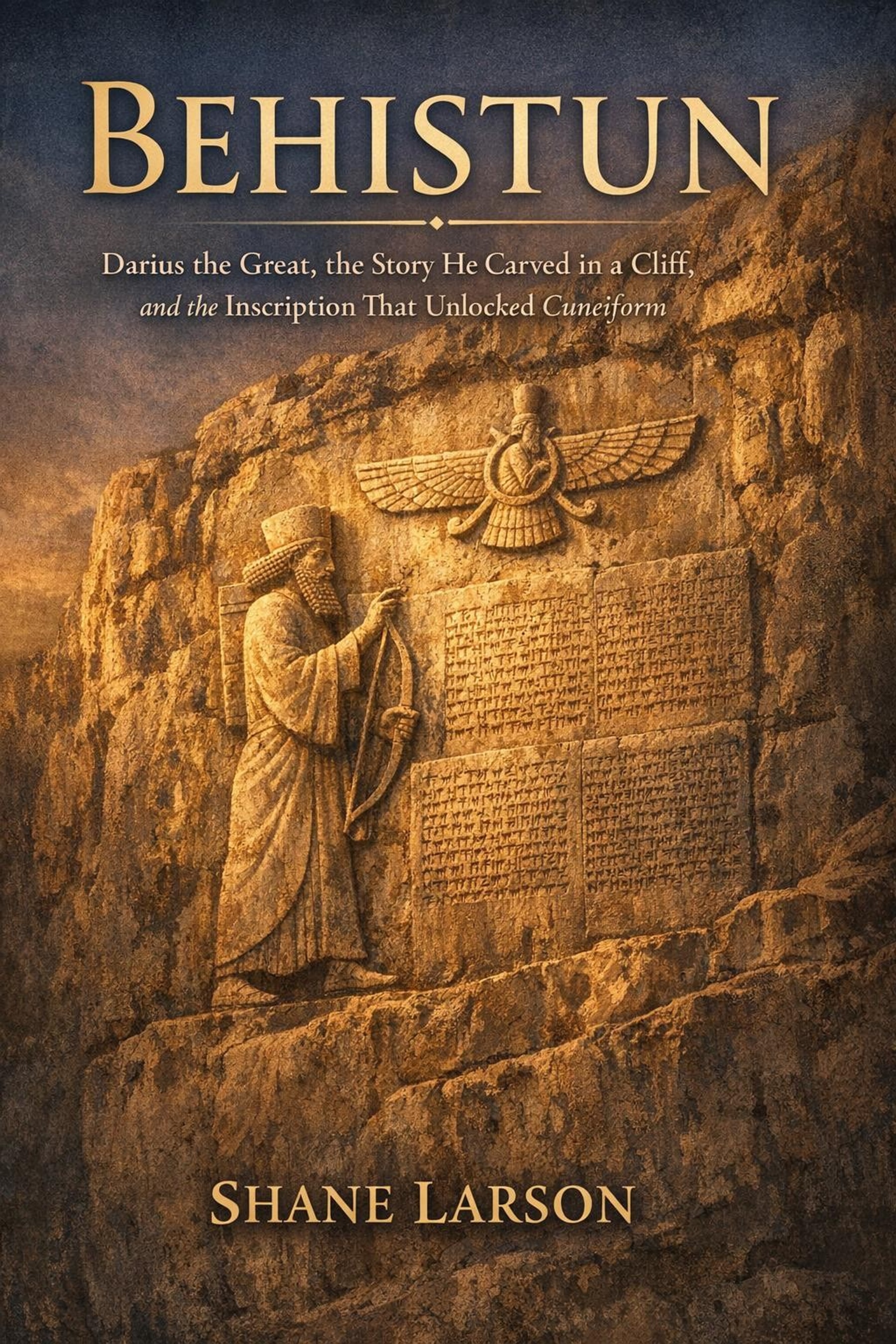
Behistun
Darius the Great, the Story He Carved in a Cliff, and the Inscription That Unlocked Cuneiform
By Shane Larson
About This Book
Sometime around 420 BC, a scribe in a garrison town on the Nile sat down with a roll of papyrus and copied out, in Aramaic, a text that was already a century old. The town was Elephantine, at the southern edge of Egypt. The text was a Persian king's account of how he had come to the throne. The original was cut into a mountainside more than a thousand miles away, in a script the scribe had probably never seen.
That papyrus changes how the Behistun inscription looks. The cliff carving sits so high above the old road from Babylon to the Persian highlands that a traveller could make out the figures and none of the words. For a long time that seemed like a puzzle. It stops being one when you find the copies: a stone version set up in Babylon, a papyrus version still being recopied in Egypt four generations later. The cliff was never the publication. It was the seal on a story that Darius the Great sent to every corner of his empire.
The Story Darius Told, and the One He May Have Buried
The story goes like this. King Cambyses secretly had his brother Bardiya killed. A priest named Gaumata then claimed to be the dead prince and took the throne. Nobody dared to object until Darius, with six companions and the favour of the god Ahuramazda, killed the pretender in a fortress in Media on 29 September 522 BC and restored the kingdom to its proper family.
Herodotus tells roughly the same tale two generations later, with better anecdotes. A long line of modern historians reads it the other way around. On their reading the man who died in that fortress was Bardiya himself, a son of Cyrus and a popular king, and Darius was a junior noble with a thin claim and a very good cover story. The inscription supplies some of the evidence against its own author. In the year after the killing, by his own count, Darius fought nineteen battles and captured nine kings. One of them raised an army in Persia itself by claiming, again, to be Bardiya.
Behistun: Darius the Great, the Story He Carved in a Cliff, and the Inscription That Unlocked Cuneiform follows that story to the end of his reign, and then follows the cliff for another twenty-three centuries. Once nobody could read the wedges, the monument collected new explanations. A Greek doctor gave it to the legendary queen Semiramis. Persian poets made the mountain the work of Farhad, a sculptor cutting stone for love. A British traveller in 1818 decided the roped prisoners were the lost tribes of Israel.
Then the words came back. A schoolteacher in Gottingen guessed three royal names on a bet. A soldier of the East India Company spent years on ladders copying the rock. An Irish country rector worked out, from his study, how the hardest of the three scripts actually functioned. By 1857 Akkadian cuneiform could be read, and with it the records of Babylon and Assyria.
Why I Wrote This
I kept running into Behistun in other books. It turns up for a page in every history of Persia, and for a chapter in every account of how cuneiform was cracked, and the two halves never seem to meet. The Persian histories treat it as a source. The decipherment books treat it as a puzzle with a ladder leaning against it.
What caught me was that it is the same object doing two opposite jobs. Darius had it carved so that one version of 522 BC would outlast every other. It did, for a very long time. Then the same carving became the tool that let people read thousands of documents he never controlled, including the Babylonian tablets that show a King Bardiya being recognised in the months he was supposedly an impostor.
I do not think the question of who died in that fortress can be closed, and the book does not pretend to close it. I wanted to lay out what the evidence will bear.
Frequently Asked Questions
Was Gaumata a real impostor, or did Darius kill the real Bardiya?
Nobody knows, and this book does not claim to. Darius's inscription is the only Persian account, and it was written by the man with the most to gain. The book gives both readings a full hearing, shows which pieces of evidence support each, and says plainly where the record runs out.
Do I need to read The Persian Empire before this book?
No. This is a standalone history. The Persian Empire is the broad survey from Cyrus to Alexander; this one stays close to a single king, a single year of crisis and a single monument, and it explains everything it needs as it goes.
Is Behistun really the Rosetta Stone of cuneiform?
The comparison is fair up to a point. Like the Rosetta Stone it carries one text in three versions, and reading the easiest one opened the way to the others. The difference is that nobody could read any of the three at the start, so the first step was a great deal harder.
Does the book include a translation of the Behistun inscription?
It includes a complete paraphrase, section by section, with the standard section numbers. Modern translations are under copyright, so the text is given in the book's own words throughout, and Herodotus and the other ancient writers are handled the same way.
How much of the book is about Darius and how much is about the decipherment?
Roughly two thirds ancient, one third modern. Nine chapters cover the coup, the revolts, the carving and the reign. One covers the centuries of legend, and three cover the decipherment from the 1760s to 1857.
Is this an academic book?
It is narrative history for general readers, written from the scholarship. There are no footnotes, no untranslated languages and no assumed background, but scholarly disagreements are named and explained where they matter.
If You Liked This, You Might Like
- The Persian Empire — the survey this book is a close-up of, carrying the story on from Darius's heirs to Alexander.
- Linear B — another unreadable script and another outsider who cracked it, a century after Rawlinson's ladders.
- Elam — the ancient kingdom whose language fills one of the three texts on the cliff, and which rose against Darius three times.
- Gilgamesh — the epic that came back to light in 1872 only because the work begun at Behistun had made its tablets readable.
A king made sure his account was the only one that survived. This is what it says, what it leaves out, and how reading it gave everyone he silenced a voice again.
What You'll Learn
- Nineteen battles in a single year. The revolts of 522 and 521 BC, region by region, with the rebel kings named and the inscription's arithmetic checked.
- Two brothers, two accounts. The cliff and Herodotus are set side by side on the death of Bardiya, and the case that Gaumata never existed gets the same space as the case that he did.
- A monument revised in progress. The relief was recut while it was being made: a ninth prisoner was squeezed in after a later campaign, and an entire text was moved to make room.
- A script that may have been invented for the job. Darius seems to say he had a new kind of writing made. The book sets out the three ways scholars read that sentence.
- Clay receipts from Persepolis. Thousands of ration tablets show the empire from the inside, including royal women running their own estates, which is not the picture Greek writers give.
- Semiramis, Farhad and the Ten Tribes. What the cliff meant to the people who looked at it during the long centuries when it could not be read.
- The boy on the rope. The Babylonian text sat on an overhang Henry Rawlinson judged unreachable. A Kurdish boy crossed it with pegs and ropes and took the paper casts. His name was never recorded.
- Four sealed envelopes. The 1857 test in which four scholars translated the same unseen text separately, and what the comparison proved.
- The whole inscription in plain words. An appendix paraphrases the text section by section, numbered so any passage can be found in a scholarly edition.
New Ancient History releases and free chapters — no spam, unsubscribe anytime.
More in This Genre
View all →