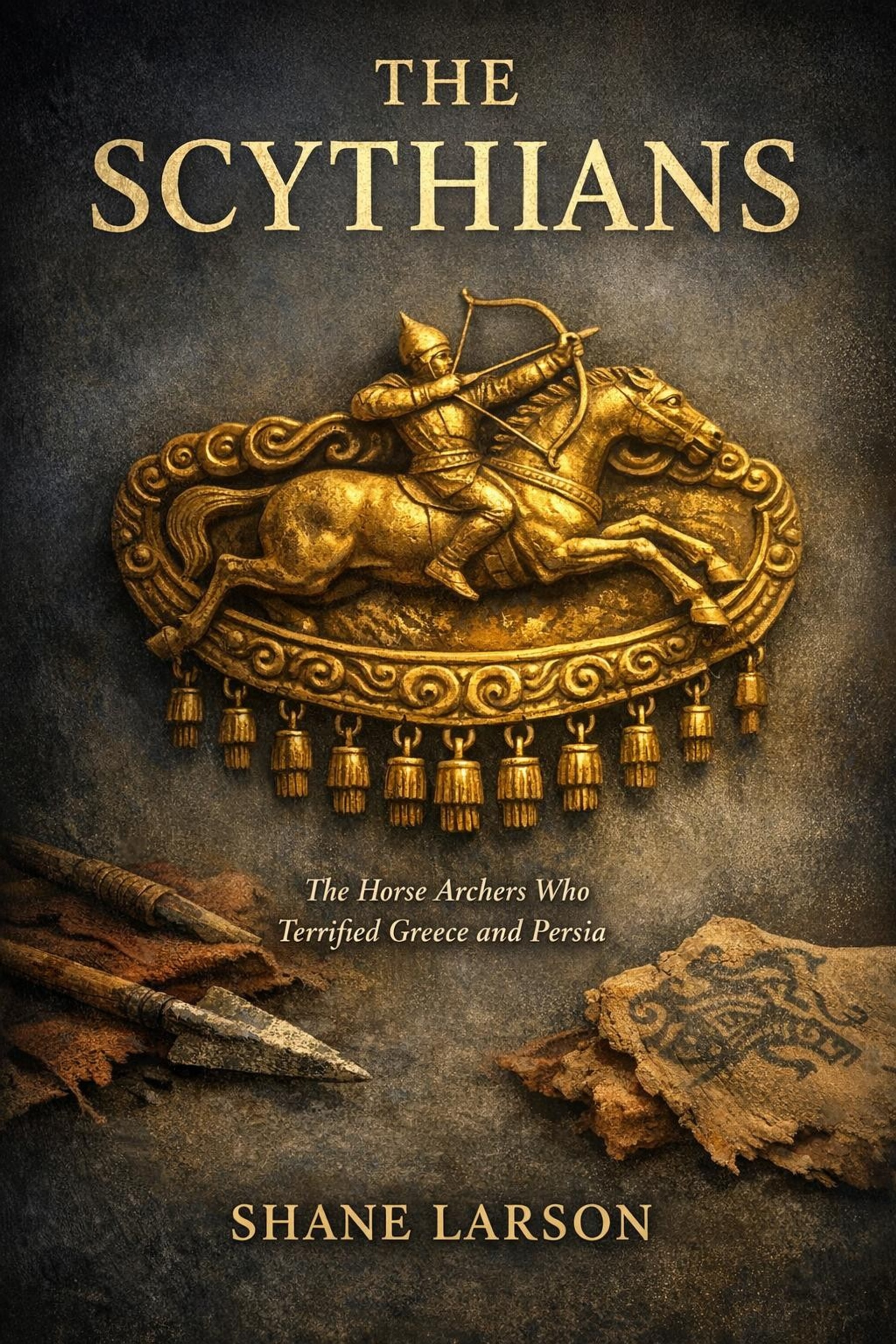
The Scythians
The Horse Archers Who Terrified Greece and Persia
By Shane Larson
About This Book
Sometime in antiquity, robbers cut a shaft down through a burial mound in the Altai Mountains and broke into the timber chamber underneath. They took the gold and left everything else. Water followed them down the shaft, pooled in the chamber, and froze — and because the mound's cap of stones shaded the ground beneath it, the ice never thawed again. The thieves had accidentally built a freezer, and it ran for over two thousand years.
When Soviet archaeologists opened the Pazyryk tombs in the twentieth century, thawing the ice bucket by bucket, they lifted out things that survive nowhere else in the ancient world. A knotted wool pile carpet. Felt wall hangings. A complete four-wheeled wagon. Saddles with their stuffing intact. Horses wearing masks and antlered headdresses. And human bodies with their tattoos still legible — deer and big cats in the same animal style found in gold five thousand kilometres to the west.
The people in those tombs kept no writing and built no cities. The Greeks called them Scythians and used them as their standard example of everything wild and unassimilable. Yet thanks to the ice and two centuries of excavation, we know their daily texture better than that of some literate empires.
The Argument
The Scythians are the first people on record to defeat a world empire by refusing to be found. When Persia marched an enormous army into the grassland north of the Black Sea around 513 BC, the Scythians withdrew ahead of it, burned the pasture, stopped the wells, and sent their herds over the horizon. There was no battle, because there was nothing to fight over — no city to besiege, no harvest to burn, no treasury to seize. The invasion starved on its own progress and went home. That was not a trick. It was a way of war that grew out of how the steppe works — grass, herds, horses, and the composite bow — and it kept beating settled armies, from the Parthians against Rome to the Mongols against nearly everyone, for two thousand years. That campaign opens the book; the doctrine chapter closes it.
Between those bookends runs the book's second thread, and its particular pleasure. Herodotus devoted much of his fourth book to Scythian customs, and for centuries his most vivid claims read as ethnographic slander: kings buried with strangled servants and heaped horses, enemies' skulls gilded into drinking cups, mourners howling with pleasure in felt tents full of hemp smoke. Then the excavations began, and claim after claim came up out of the ground almost exactly as reported — the retainer burials, the horse pits, and at Pazyryk the smoking equipment itself, down to the charred seeds. The book gives you the ancient report first, lets it sound as implausible as it sounded for centuries, and then opens the tomb. Not everything survives the audit — an appendix keeps score — but the pattern runs opposite to what scholars long assumed.
Why I Wrote This
Two things pulled me into this subject and would not let go. The first is the audit. Herodotus is the ancient writer everyone learns to distrust — the teller of tall tales — and the Scythians are the rare case where his wildest material can actually be checked, because the ground has been so generous. Watching a twenty-four-century-old travel writer's most ridiculed claims get confirmed by a spade is a genuine and repeatable pleasure, and I wanted to build a whole book on that rhythm. The second is the paradox of the evidence. A people with no writing should be a rumour at the edge of other civilisations' records. Instead we have their carpets, their saddle stuffing, their tattoos, the seeds they burned in grief. There are literate ancient states about whose ordinary life we know far less. That inversion seemed worth a book on its own.
Frequently Asked Questions
Were the Amazons real?
Not as a nation of warrior women — no evidence supports that. What the graves do show is that in some steppe cemeteries roughly a fifth of the armed burials are osteologically female, some with worn weapons and combat injuries. The Greek Amazon stories are almost certainly legend grown around that real observation — and the finding is more interesting than the myth.
What are the Pazyryk tombs and why are they frozen?
They are burial mounds in the Altai Mountains of southern Siberia, from roughly the fourth and third centuries BC. Ancient robbers breached the chambers, water followed them in and froze, and the stone caps insulated the ice permanently. The result: the ancient world's best-preserved organic material — textiles, wood, leather, and tattooed human skin.
Did the Scythians really smoke cannabis?
Yes. Herodotus described small felt tents, heated stones and hemp seed thrown on them, and excavators found exactly that equipment, seeds included, in a Pazyryk tomb. The book treats it as it appears in context: a mourning rite, part of Scythian religion, not a recreational habit.
Are the Scythians the ancestors of any modern country?
Several modern movements claim so, and the honest answer is no. Iranian-speaking steppe ancestry is real, very old, and spread across an enormous area — which is precisely why it maps onto no modern nation. The one genuine linguistic survival is Ossetian, in the Caucasus, and that is a fact about language, not a national pedigree. Descent claims beyond the evidence are political, not historical.
Do I need to have read anything else first?
No. It assumes no prior knowledge of the steppe, Persia, or Herodotus, and every technical term — kurgan, gorytos, akinakes — is explained when it first appears. Other titles in this catalog connect, but nothing depends on them.
If You Liked This, You Might Like
- The Persian Empire: The World's First Superstate — the other side of the 513 BC campaign: the empire that could conquer everything except grass.
- Attila: The Scourge of God — the steppe doctrine this book establishes, arriving at Rome's gates nine centuries later.
- The Mongol Storm: How Genghis Khan's Grandsons Connected the World — the same way of war run at continental scale, and the end of the story the Scythians begin.
- The Golden Age of Athens: How One City Invented the Western World — the city whose police force was Scythian archers, and whose writers built the barbarian stereotype this book tests against the ground.
Some peoples are remembered because they wrote; the Scythians are remembered because the ground kept what they were. This is the story of the horse archers who beat an empire by walking away from it — and of the ice, the gold and the graves that proved their strangest chronicler right.
What You'll Learn
- The campaign of 513 BC: the bridge of boats on the Danube, an army chasing an enemy that moved like weather, and the night flight that nearly ended with the bridge cut behind it.
- The steppe as a machine — why a five-thousand-kilometre corridor of grass keeps producing the same kind of society, with mobility an economic fact before it was a military doctrine.
- The horse and the composite bow, and what a lifetime in the saddle does to a human skeleton.
- The forgotten Near Eastern century — the Assyrian records of the *Ishkuzai*, a proposed dynastic marriage, and Scythian armies among Assyria, Media and Urartu.
- The gold of the great kurgans, with the Tolstaya Mogila pectoral — a Scythian world in miniature, worked by a Greek hand — read register by register.
- The frozen tombs of Pazyryk, from Chinese silk to a chieftain's tattoos, plus the uncomfortable present tense: the permafrost that kept them is failing.
- A royal funeral, reported and excavated — Herodotus's most notorious passage set beside the retainer burials and horse pits that confirmed it.
- A religion with no temples — a sword planted in a mountain of brushwood, diviners who paid for failure with their lives, and the hemp-smoke mourning rite.
- The women in the graves — the armed female burials, the combat trauma and worn weapons, and where the evidence for the Amazon tradition actually stops.
- The doctrine after the Scythians — Carrhae, the Han tribute system, the Huns, the Mongols, and the two answers settled empires eventually found: money and gunpowder.
New Ancient History releases and free chapters — no spam, unsubscribe anytime.