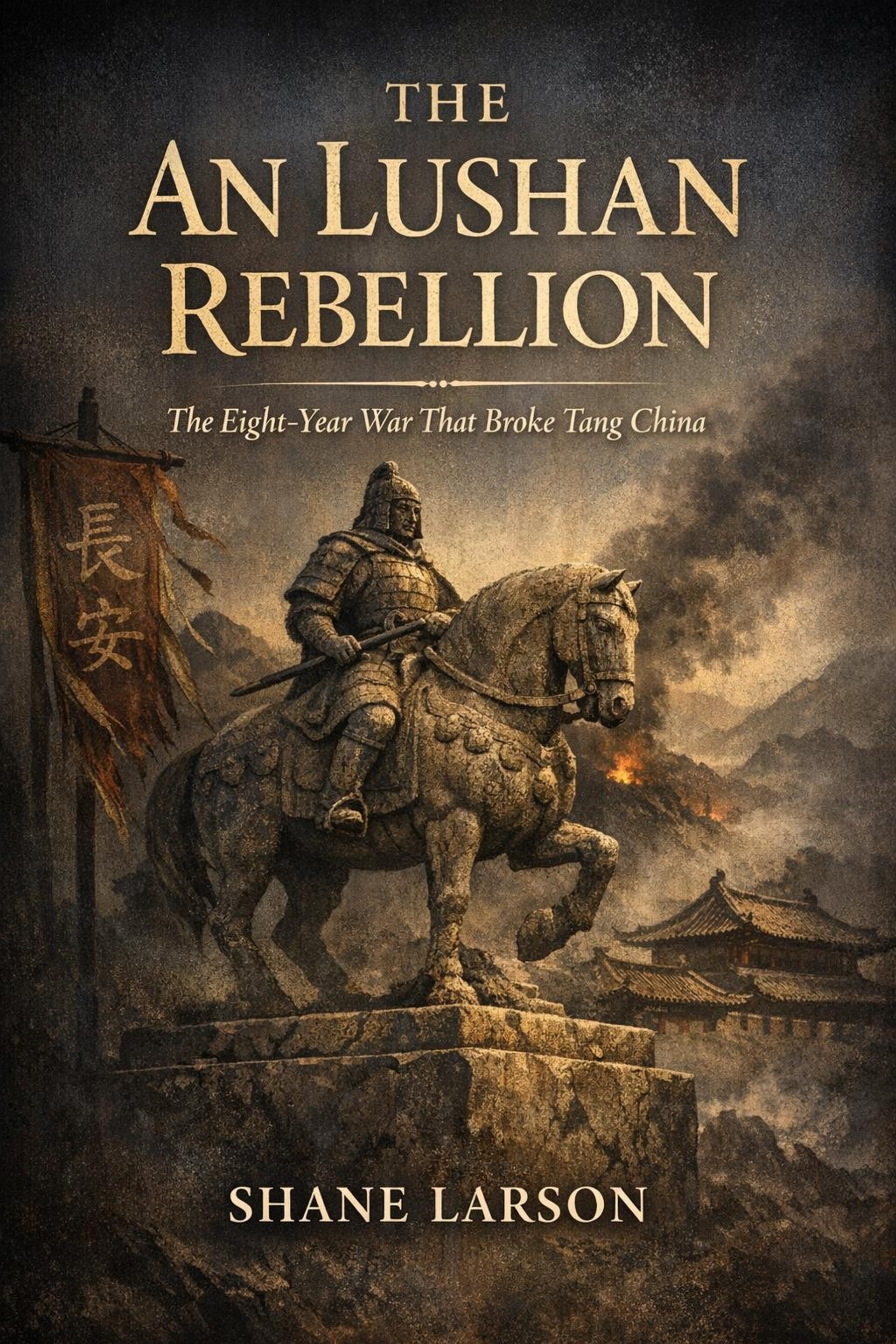
The An Lushan Rebellion
The Eight-Year War That Broke Tang China
By Shane Larson
About This Book
In 763, the year the war ended, the Tang court considered abandoning Chang'an for Luoyang, and the general Guo Ziyi wrote to tell the emperor why he must not. The eastern capital, he said in substance, had been burned and plundered twice over. Fewer than a thousand households were left in its whole district, and a traveller riding east across the plain could go for hundreds of miles without seeing smoke rise from a single kitchen fire, through country gone back to thorn scrub and wild animals.
It was a general's argument, and its numbers are rhetoric. But he knew the ground, and eight years earlier that plain had held something like a quarter of the registered population of the Tang. Where those people went, and how many died, is a question this book takes a whole chapter to answer, and the honest answer is not a number.
The War the Golden Age Built
The An Lushan Rebellion: The Eight-Year War That Broke Tang China follows the war from the system that made it possible to the legend that grew over it. It opens in 712 with Wu Zetian's grandson seizing a throne. As the Emperor Xuanzong he presided over the Tang's high summer: a capital of a million people with Sogdian merchants in its markets, and an army pushed to the Pamirs. Over forty years the Tang replaced its militia farmers with professional soldiers, gathered them into ten great frontier commands, and handed those commands, by deliberate policy, to generals from outside the Chinese elite. By 755 one of them held three at once and something like a third of the empire's fighting men.
An Lushan was that general: the son of a Sogdian father and a Turkic mother, an interpreter in the border markets of the northeast who twenty years later was the most trusted soldier in the empire, formally adopted as the son of the emperor's favourite consort though he was some fifteen years her senior. The book treats his rise as a product of the court's openness, and weighs the famous anecdotes, the belly, the dancing, the bath, against the sources that first carry them.
Then the war: the march from Fanyang in December 755, Luoyang gone in five weeks, the disaster at the Tongguan pass and the flight west to the post station at Mawei. The dynasty survived because a garrison on the canal route held long enough to keep the south, because it hired Uyghur cavalry it could not afford, and because the rebellion kept killing its own leaders, An Lushan by his son, Shi Siming by his. It won in 763 by pardoning the surviving rebel generals into governors of the provinces they had taken. The last part of the book is what the war left: a state that could no longer count its own people, and a slow closing of the open empire that ends, ninety years on, with every foreign religion in China ordered out of its robes.
Why I Wrote This
I finished Wu Zetian with a question I had not expected to care about. She dies in 705 with the dynasty she remade intact, and fifty years later the whole thing is on fire, started by a man her grandson trusted above everyone. Then I went looking for a book on the war and found it was a chapter in every survey of the Tang and the subject of none, which seemed wrong for an event that sits near the top of every list of the deadliest things humans have done. That number was the other hook: I had seen it for years and never checked it, and when I did I found a tax register, a state that stopped being able to count, and a genuine argument among people who had read the sources. The book is my attempt to tell the war in order and give the number the chapter it deserves.
Frequently Asked Questions
Do I need to read Wu Zetian before this book?
No. The two books share a dynasty and a family, and this one is written as the sequel, but it stands on its own. Chapter One compresses the coups of 705 to 713 into a few pages and points to Wu Zetian for the full story. The narrative proper begins in 712 and runs about 79,000 words in fourteen chapters with three appendices.
Did the An Lushan Rebellion really kill 36 million people?
Nobody knows, and the book says so. The figure is the difference between two census returns, 52.9 million registered people in 755 and 16.9 million in 764, and most historians of the Tang read that gap as the collapse of the state's ability to count rather than as a body count. The war certainly killed people in the millions. Chapter Twelve sets out the argument and what can and cannot be said.
Who was An Lushan, and was he really a foreigner?
He was born, by the traditional date, in 703 in a frontier town in the far northeast to a Sogdian father and a Turkic mother, and he was an interpreter in the border markets before he was a soldier. The Tang sources call him a barbarian; the book reports that rhetoric as rhetoric. He was also a product of the Tang court that promoted him for twenty years, which the book argues matters more than his parentage.
Does the book quote Du Fu and the other Tang poets?
No. Almost every English version of Du Fu, Li Bai, Wang Wei and Bai Juyi in circulation is a modern translation under copyright, so the book describes what each poem does, in its own words, and tells you where to find it. Chapter Eleven treats them as the war's best witnesses to ordinary lives.
Does it cover the story that Yang Guifei escaped to Japan?
Yes, in the final chapter, which separates the Mawei of the two earliest sources from Bai Juyi's poem, the Yuan and Qing plays, the Peking opera role, and the Japanese tradition that she survived and was smuggled across the sea. It takes the legend seriously as history of its own, and keeps it off the afternoon of July 756.
If You Liked This, You Might Like
- Wu Zetian — the grandmother who built the dynasty this book watches break; her story ends in 705 and this one picks up the fight over her inheritance.
- The Silk Road — the Sogdian trading world that produced An Lushan, and the battle of Talas, which this book takes in a paragraph and that one tells in full.
- The Taiping Rebellion — China's other great civil war, eleven centuries later, with far better records and a death toll still disputed by tens of millions.
- The Xiongnu — the first version of the steppe-frontier problem the Tang inherited.
The soldiers at Mawei blamed the Yang family, the poets blamed love, and the histories blamed the barbarian. This book is about the system none of them could see.
A standalone on the China shelf, following Wu Zetian.
What You'll Learn
- Mawei Station, July 756, as the two sources closest to the archive give it: a hungry guard, a chancellor's head on a spear, a demand, and an emperor who agreed to it.
- The frontier machine: how the military governors came to hold most of the empire's soldiers, and why promoting non-Han generals made sense at the time.
- The Sogdian question, and why Sogdian families across northern China began changing their surnames after 763.
- The poets as witnesses: Du Fu held in the occupied capital and escaping in hempen sandals; Wang Wei's four lines of verse produced as evidence in a treason trial; Yan Zhenqing's draft requiem for his murdered nephew.
- The census: what a Tang household register was for, why 52.9 million was already an undercount, and why the registers fell off a cliff the moment the state lost its provinces rather than as the dead mounted.
- The afterlife: Bai Juyi's poem of 806 and the love story it made of a political killing, and the Japanese shrine that says she never died.
- Three appendices: a month-by-month timeline of 755 to 757, a who's who of both courts, and the Tang census returns in one table with the competing readings.
New Medieval History releases and free chapters — no spam, unsubscribe anytime.
More in This Genre
View all →