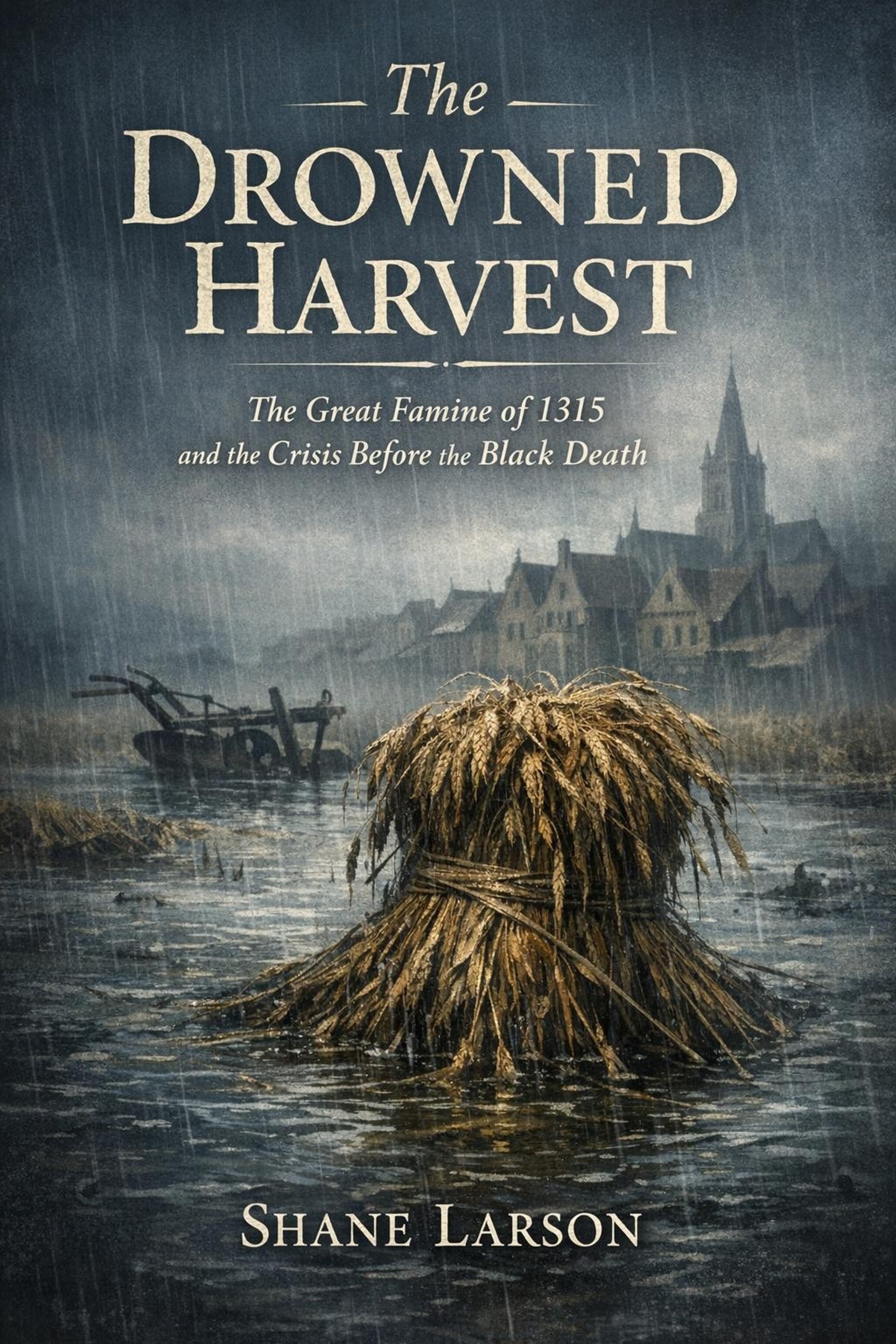
The Drowned Harvest
The Great Famine of 1315 and the Crisis Before the Black Death
By Shane Larson
About This Book
The Black Death killed somewhere between a third and a half of Europe, and everyone has heard of it. The famine a generation earlier killed perhaps one person in ten across the whole of the north, and almost nobody has.
Part of that is proportion. The bigger reason is a trick of memory. The plague did not just exceed the Great Famine of 1315; it overwrote it. The men who should have been its historians either died in 1348 or wrote in its shadow. The famine never got an iconography or even a settled name, and when it finally acquired one in English, Ireland already owned it. Search for "the Great Famine" today and you get the potato.
So the three wet years that broke medieval Europe survive mostly as a paragraph of background at the start of books about the plague. The paragraph is true. What it leaves out is that the trouble had a shape, a set of victims and a set of beneficiaries, and that the people it weakened were, on the evidence of their own bones, the people the plague found easiest to kill. The Drowned Harvest: The Great Famine of 1315 and the Crisis Before the Black Death is the long version of that paragraph.
The Europe the rain fell on was the fullest, richest, most organised Europe there had yet been, with coin, credit, cloth cities that ate grain they did not grow, and reeves who accounted for every bushel sown and reaped. It is the best-documented catastrophe in Europe before the modern period, and that is the paradox the book turns on. Markets, money and bureaucracy went on doing what they were built to do, and none of them could make grain that had never been harvested. They moved what grain there was towards whoever could pay, and the people who could not pay were the majority.
The book follows the chain link by link: two failed harvests and a third poor one; wet pastures that killed the sheep; a Scottish army fighting through the hunger in Ireland while the north of England was raided and ungoverned; a cattle plague from 1319 that killed the oxen and the milk cows; a frightened France that found shepherds, lepers and Jews to blame; and then thirty years in which a population that had grown for three centuries stopped growing and never started again. At every step it says whether a claim rests on the hard numbers of account rolls, price series, burial payments and gaol records, or on the horror of chroniclers who knew how a famine was supposed to be described. Both are used; they are never confused.
Why I Wrote This
When I was writing The Black Death I gave the famine the paragraph everybody gives it, and I was uneasy about it even then. The sources kept gesturing at something enormous thirty years earlier and moving on, because the plague was the subject. Afterwards I went looking for the book on the famine itself and found a 1930 article, a 1996 monograph, and nothing between those and the plague shelf that a person could read on a train.
What held me was the paradox. This was not a primitive Europe starving for want of organisation; it was the most commercial, most literate Europe there had yet been, and the organisation recorded everything and relieved nothing. The reeve who wrote down a yield of under two to one at Michaelmas 1316 produced the most exact famine record before modern times, and the entry fed no one. Then the bone evidence from East Smithfield turned the famine from background into mechanism, and the book had its shape.
Frequently Asked Questions
Do I need to read The Black Death before The Drowned Harvest?
No. The two were written as a pair, but each stands alone. This one ends in 1347 with the galleys not yet at Messina, which is where The Black Death opens.
Is this a narrative history or an academic study of the Great Famine of 1315?
A narrative for a general reader, with the evidence left visible. Every chapter opens on a documented place or record, names the witness and says whether a figure comes from an account roll or a monk's set-piece. No invented peasants, no reconstructed dialogue.
Is it true that Hansel and Gretel is a memory of the famine of 1315?
The claim is common online, and one chapter examines it. There is no documentary support for it: the tale type is widely distributed and the Grimms collected it five centuries later. The chapter asks why the claim spreads anyway, and how to read the horror stories medieval chroniclers told.
What caused the rains of 1315 to 1317? Was it a volcano or the Little Ice Age?
Nobody knows for certain, and the book says so. Chapter 11 weighs the end of the Medieval Climate Anomaly, the Wolf solar minimum of roughly 1280 to 1350, the Kaharoa eruption in New Zealand around 1314, and shifts in North Atlantic circulation, and is honest that a cooling century is easier to explain than two wet summers.
Does the book cover Ireland and Scotland, or only England and Flanders?
Both. The Bruce invasion of Ireland gets a chapter of its own, told largely from the Irish annals, and the Scottish raids on northern England and Edward II's campaign of 1322 get another. Italy enters at the end with the Florentine famine of 1346 to 1347.
If You Liked This, You Might Like
- The Black Death — the sequel in all but name: it begins at Messina in 1347, exactly where this book stops, with the famine generation as the population the plague fell on.
- The Hundred Years' War — the war Edward III began in 1337 with a kingdom that had never restocked its herds, borrowing from the Florentine banks whose collapse closes this book's final part.
- The Hanseatic League — the Baltic grain that came west through Lübeck and Danzig in 1316 is one of the earliest episodes of the Hanse trade moving food across a continent, and failing to move enough.
- The Year Without a Summer — five centuries later a volcano did to 1816 what the rain did to 1315; together the two books show how much a famine depends on the economy it lands in.
The reeves wrote the numbers and the monks wrote the horror. What neither knew was that a third record was being laid down in the teeth of hungry children, to be read out of a London plague pit six and a half centuries later.
What You'll Learn
- Winchester and Bolton. The bishopric of Winchester's accounts show what a harvest returned on the seed sown, and Bolton Priory's rolls follow a rich Yorkshire house as its yields fall, its canons borrow to buy oats, and the Scots arrive.
- Ypres, summer 1316. The town's payments for collecting 2,794 bodies from its streets between May and October are the famine's single hardest number, and the book explains what that figure counts and what it leaves out.
- Who ate. Prices rose to three or four times their ordinary level while wages stayed put, and Edward II's attempt to fix prices by ordinance emptied the markets and was withdrawn within a year. What the gaol rolls say about food theft, and why grain ships from the Mediterranean and the Baltic could not close a gap the size of two harvests.
- The Bruce invasion and the north. Edward Bruce's landing near Larne in May 1315 and his death at Faughart in 1318; Berwick lost, Boroughbridge, and an English army starving in a scorched Scotland in 1322.
- The great bovine pestilence. Why the cattle plague may have done more lasting damage than the grain failures: an ox is not a crop, and a herd takes a generation to breed back.
- The Pastoureaux and the lepers' plot. The massacres of 1320 and the well-poisoning panic of 1321, told as atrocities and read as a rehearsal for 1348.
- Why it rained. The end of the Medieval Climate Anomaly, the Wolf solar minimum, the proposed Kaharoa eruption of around 1314, and the gap between a centennial trend and two particular summers.
- The famine generation. What the skeletons from London's East Smithfield plague cemetery record in bone and tooth enamel, and the argument, with its objections, that childhood hunger in 1316 set who died in 1349.
New Medieval History releases and free chapters — no spam, unsubscribe anytime.
More in This Genre
View all →