Alfred the Great Never Burned the Cakes. So Where Did the Story Come From?
November 17, 2026 · 7 min read
Everyone knows one thing about Alfred the Great, and it is this. Driven from his throne by the Danes, the king hides in a peasant's hut in the Somerset marshes. The woman of the house, not knowing who he is, sets him to watch her loaves baking on the hearth. He broods over his lost kingdom, the loaves burn, and she scolds the king of Wessex for being too idle to turn a cake. It is a good story, and it is not in a single source written within a century of Alfred's death.
That is worth stating plainly, because the gap is unusual. For most of what Alfred did, the evidence is close to the events. The Anglo-Saxon Chronicle was probably compiled at or near his own court in the early 890s. His biographer, Asser, a Welsh monk in the royal household, wrote his Latin Life of King Alfred in 893 while the king was alive and could read it. Alfred's own prefaces, laws and will survive in Old English. Between them these witnesses cover his childhood, his illness, his battles, his buildings and his books. None of them mentions a hut, a hearth, a scolding woman or a cake.
What the ninth century actually says about the marsh
The Chronicle's entry for 878 is short and does not flinch. Just after Twelfth Night a Danish army under Guthrum rode into the royal estate at Chippenham, in north Wiltshire, in the dead of winter when nobody campaigned. They occupied the land of the West Saxons and settled in it. Many people were driven overseas; most of the rest submitted; and the king, with a small band, made his way through the woodland into the marsh country.
Then, at Easter, Alfred and his few men built a fortification at Athelney, an island in the wetland where the rivers Tone and Parrett meet, and fought from it with the men of the nearest part of Somerset. In the seventh week after Easter he rode to a meeting place called Egbert's Stone, east of Selwood, where the men of Somerset, Wiltshire and part of Hampshire came to him. Two days later he beat Guthrum's army at a place the Chronicle calls Ethandun, almost certainly Edington in Wiltshire, pursued the survivors to their fortress, besieged them for a fortnight, and took their surrender. Three weeks after that Guthrum was baptised at Aller, a few miles from Athelney, with Alfred standing as his godfather.
Asser, writing fifteen years later, adds colour but no cakes. He has the king leading a restless, hunted existence in the Somerset wetlands, surviving on what his men could seize in raids, from the Danes and from the English who had gone over to them. That is the whole contemporary record of the four months in hiding: a fort, a few raids, a man with almost nothing left. The marsh is real. The hut is not there yet.
The first appearance: a saint's life, a century or more later
The cakes arrive in a text about somebody else. St Neot was a hermit in Cornwall, and at some point in the late tenth or the eleventh century, so roughly a hundred years or more after Alfred died in 899, a monk wrote a Latin life of him. Medieval saints' lives needed a famous sinner for the saint to correct, and the writer had one to hand. In his telling, Neot is a kinsman of Alfred who rebukes the young king for his pride and foretells the disaster to come. When it comes, Alfred, humbled, takes shelter with a swineherd whose wife sets him to mind her loaves; he lets them burn; she berates him; and the king accepts the scolding as a penance. Later the saint's spirit appears to him and promises victory. The whole episode exists to make a point about Neot's power and Alfred's humility.
Notice what kind of story that is. It is not a memory of 878 handed down through the Somerset villages. It is a literary form, the mighty brought low and taught by the humble, that monastic writers used about many rulers. The same decades produced a rival version from the north: the community of St Cuthbert, then at Chester-le-Street and later at Durham, told how their own saint had appeared to Alfred in the marsh and promised him his kingdom back, in return for which his dynasty owed Cuthbert's church a debt of gratitude. Two religious houses, two saints, one marsh. Each wanted a piece of the king's recovery, and each wrote a story that gave them one.
The twelfth century added another. William of Malmesbury has Alfred disguise himself as a harper and walk into Guthrum's camp to listen to the Danes' plans. That one has no ninth-century support either, and it has the same shape as the cakes: a king in disguise among people who do not know him. By 1150 the four months at Athelney had acquired a hut, a hearth, two saints and a harp, and not one of those details had been written down by anyone alive in 878.
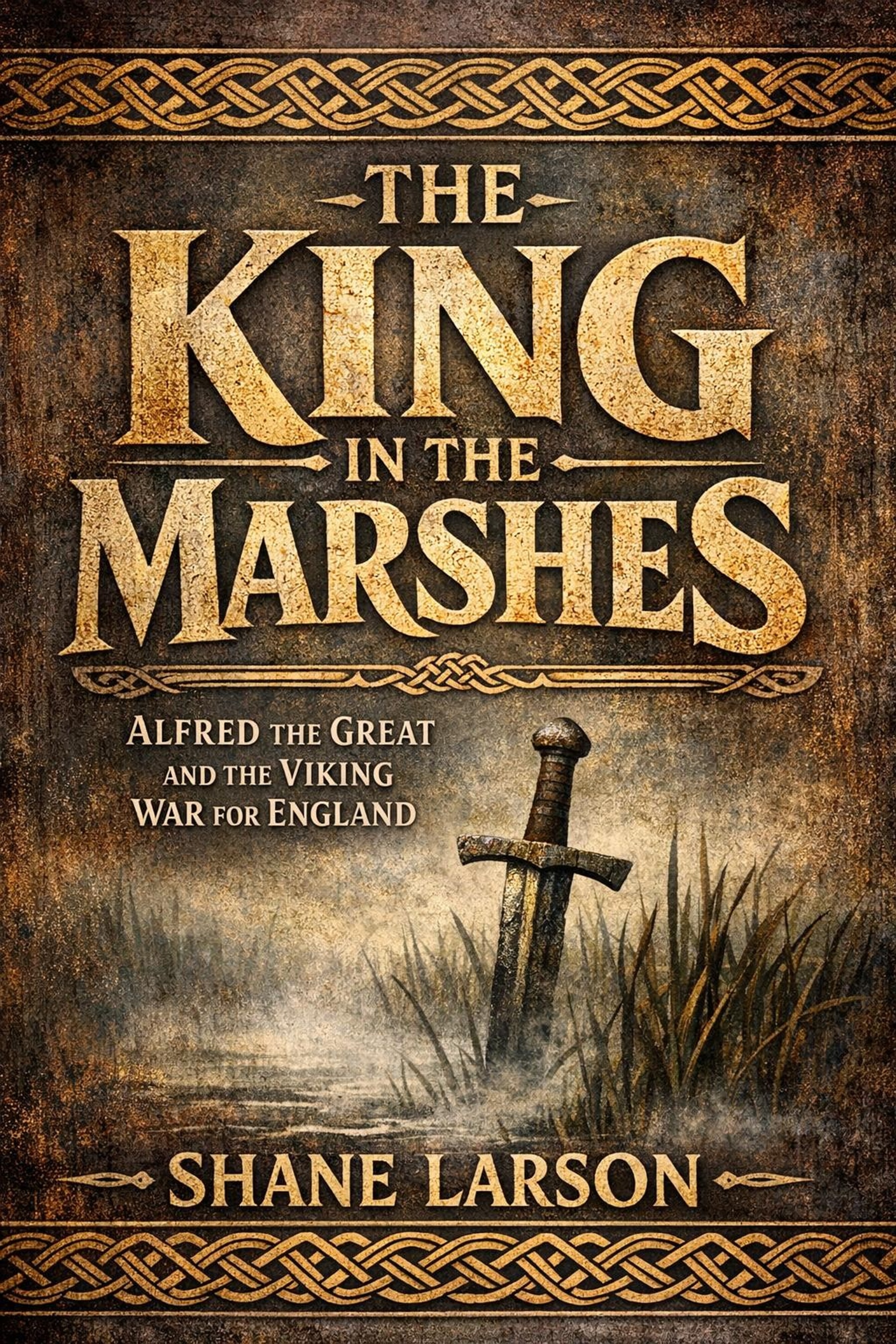
The King in the Marshes
How the cakes got into Alfred's biography
If the story lived only in a Cornish saint's life, it might have stayed a curiosity. What made it the most famous fact about Alfred was an editorial decision in 1574.
That year Archbishop Matthew Parker printed the first edition of Asser's Life, working from the single medieval manuscript then in existence. Parker and the antiquaries around him were recovering the Old English past for a reason: an English church that had broken with Rome wanted an English history older than Rome's authority, and Alfred, who had translated Latin books into his people's tongue and issued laws with a prologue from Moses, was exactly the king they needed. But Parker did not print Asser's text alone. He folded into it passages from a later compilation known as the Annals of St Neots, which had itself borrowed the cake story from the saint's life. In the printed book the hut and the loaves sat between Asser's sentences with nothing to mark where one writer stopped and another began.
For three centuries, as a result, every reader of Asser believed Alfred's own friend had told the story of the cakes, and it was quoted and taught as a contemporary account. It took later editors to separate Parker's insertions from the genuine text, and by the time they had, the story had been English common knowledge for longer than Alfred's kingdom had existed. The medieval manuscript itself burned in the Cotton Library fire of 1731, so the editors did their untangling from Parker's edition and from transcripts, which is one reason the question of exactly what Asser wrote has stayed open.
Why the story stuck
A legend survives when it does a job, and this one did several. For the monks it taught humility. For the Tudor antiquaries it humanised a king they were making into a founder of English law and letters. For the eighteenth century, which gave Alfred a masque at Cliveden in 1740 whose finale was "Rule, Britannia!", the hut was the plot: a shepherd and his wife shelter the unknown king, and the kingdom is won from their cottage. For the Victorians, who put up a seventeen-foot bronze of him in Winchester in 1901 to mark a millennium they had dated two years late, the cakes were the lesson every schoolchild could carry: a great man brought low, patient under rebuke, who rose again.
Each age kept the marsh and furnished it to taste. It tells you a great deal about the people who told it, and almost nothing about January to May 878.
What is left when the cakes are taken away
More than you might think. Strip out the hut, the hearth and the saints and the ninth-century record still holds the hardest fact in the story. In the first weeks of 878 the last English king still on a throne had lost it. Northumbria, East Anglia and half of Mercia were already under Danish rule. If Alfred had been caught on a wet track in Somerset that spring, or had taken ship for Francia as others did, there would have been no English kingdom left on the island for anyone to recover.
He was not caught and he did not leave. He built a fort, fought a small war from it, rode out in May to a stone where an army was waiting for him, and won. Then he spent twenty years making sure it could not happen the same way twice: fortified towns a day's march apart, an army that served in shifts, ships, a law code, London, and a programme of books in English begun after he learned to read Latin in his late thirties. None of that needed a swineherd's wife to make it remarkable.
The cakes are a good story. The marsh is a better one, and it has the advantage of being true.
*The King in the Marshes: Alfred the Great and the Viking War for England* is a narrative life of Alfred of Wessex told from inside the kingdom the Viking armies nearly finished. Every famous story about him, the cakes, the harper, the anointing in Rome, the raven banner, the navy, is introduced with the earliest text that tells it and that text's date, and then weighed. The war is a third of the book. The rest is what Alfred built so it could not happen again, and the twelve centuries of people who rebuilt him in their own image.
The King in the Marshes
New posts and releases, straight to your inbox. No spam, unsubscribe anytime.