Why Is It Called the Wars of the Roses? The Name Nobody Who Fought in It Ever Heard
November 16, 2026 · 8 min read
Ask anyone what the Wars of the Roses were and you will get the same picture: two noble houses, Lancaster and York, each with a rose for a badge, red and white, fighting for the crown of England until a marriage joined the two flowers into one and ended it. It is one of the tidiest stories in English history. It is also, in nearly every particular, a story assembled after the war was over, by people who needed it to have a shape. The name is the last piece of it to arrive, and the easiest place to start pulling.
Nobody at the time called it anything
The war ran, by the usual reckoning, from a street fight at St Albans on 22 May 1455 to a pitched battle at East Stoke in Nottinghamshire on 16 June 1487. The people who lived through those thirty-two years did not call them the Wars of the Roses. They did not call them anything. The phrase does not occur in any fifteenth-century document, chronicle or letter, and the reason is simple: nobody experienced the period as a single war. They experienced a run of political crises around a king who could not govern, a handful of short and very bloody battles, a change of king, a second, a third, and in between long stretches of nervous ordinary life in which the courts sat, the wool went to Calais, and the gentry sued their neighbours. A man standing in the snow at Towton in 1461 did not know he was in the sixth year of anything.
The habit of treating the whole period as one conflict with one cause is itself a later invention, and the name followed the habit.
Hume, Scott, and the Victorians
The first step toward a name was taken in the eighteenth century. David Hume, in the volumes of his History of England covering the period, published in the early 1760s, wrote of the quarrel between the two roses: a figure of speech, not a title, but the two flowers were now standing in for the two houses in a serious history. The decisive step belongs to a novelist. In Anne of Geierstein, published in 1829 and set partly among Lancastrian exiles on the Continent, Walter Scott wrote of "the wars of the White and Red Roses." Scott was the most widely read author in the English-speaking world, and his phrasing travelled. In the decades after 1829 it shed the colours, acquired capital letters, settled into the plural, and became the heading under which schoolchildren learned the period. By the end of Victoria's reign it was simply what the war was called, and it had been for so long that nobody thought to ask who had named it.
So the name is about two hundred years old, attached to a war five hundred and seventy years old, and it was given by a Scottish novelist. That is not a scandal. Historians name things in retrospect all the time; nobody in 1337 knew they were starting the Hundred Years' War either. But the roses name is different in one respect. It does not just label the war. It tells you what the war was about, and that part is where the real rewriting lies.
The garden that never was
The image most people carry of the war's beginning is a garden. In the first part of Shakespeare's Henry VI, written in the early 1590s, a group of lawyers and noblemen arguing a point of law in the Temple Garden in London are asked to declare themselves by plucking a rose from the bushes: white for Richard Plantagenet, soon to be Duke of York, red for the Duke of Somerset. Each man picks, the sides form, and the stage fills with the two colours that will spend the next three plays killing each other.
It is a superb piece of theatre, and it did not happen. No chronicle records it, no letter mentions it, and no historian before Shakespeare knew of it. He needed a way to put the origins of a civil war on a stage in a single picture, and he wrote one. The scene has since been painted onto the walls of the Palace of Westminster, in Henry Payne's mural for the East Corridor, finished in 1910, so that the one episode in the whole war known never to have happened is the one now hanging in Parliament.
Half the roses were real
The white rose was genuine. It was one of several badges of the house of York, inherited through the Mortimer line, and Richard, Duke of York, and his sons used it, alongside the falcon and fetterlock and, after a strange morning in February 1461 when three suns appeared in the sky over Mortimer's Cross, Edward IV's sun in splendour. A reader of the chronicles meets the white rose often enough to believe in it.
The Wars of the Roses
The red rose is a thinner story. There is scattered evidence that the Lancastrian kings used roses occasionally, among many other devices. There is no evidence that a red rose was the badge Lancastrian armies fought under, and none that anyone between 1455 and 1485 thought of the conflict as a contest between two flowers. Henry VI's badges were the antelope and the swan. The men who followed him into battle more often wore the private liveries of the lords who had raised them: Warwick's bear and ragged staff, the Percy crescent, the Earl of Oxford's star with streams, the badge that in the fog at Barnet in 1471 was mistaken for Edward's sun and got Oxford's men attacked by their own side. Those were the colours of the war. A red rose was not among them in any way that mattered.
The king who needed a red rose
The red rose came into its own only after the fighting. Henry Tudor took the crown at Bosworth in August 1485 with the weakest blood claim of any contender in the whole war: a descent from John of Gaunt through a line legitimated by Act of Parliament with a clause that barred it from the throne. His best title was a battle. His next best was his marriage, on 18 January 1486, to Elizabeth of York, the eldest daughter of Edward IV, which brought the Yorkist claim into his family. He was careful to be crowned first, so nobody could say he reigned by her right. Then he needed an emblem that said the quarrel was settled and he had settled it.
The Tudor rose, white set inside red, was the answer. It presented the marriage as the joining of two houses, which required that each house have a rose to join. York did. Lancaster was supplied with one, retrospectively, and the red rose of Lancaster has been carved over English doorways ever since. Henry did not rely on it alone; the red dragon of Cadwaladr, the Beaufort portcullis and the greyhound did as much work on the walls of his buildings. But the rose is the one that lasted, because it carried an argument. It said: there were two sides, and now there is one, and the one is me.
From badge to history book
The badge needed a history to go with it, and the Tudor court saw to that. Polydore Vergil, an Italian scholar asked by Henry VII to write a history of England, finished a draft by 1513 and printed it in 1534, with Henry as the instrument of providence. Thomas More drafted a life of Richard III in the 1510s. And in 1548 the lawyer Edward Hall published a chronicle whose title announced the entire thesis before the first page: The Union of the Two Noble and Illustre Families of Lancaster and York. Hall's argument is that England was punished for the deposition of Richard II in 1399 with a century of division until a providential marriage healed it. Shakespeare read Hall, through Holinshed, and put the argument on stage in eight plays, garden and all. The Victorians added the name. The picture was complete.
Every piece of that picture arrived after 1485, and every piece arrived for a reason. Which is not to say the war was invented. Three kings died violently in thirty years, a fourth was deposed, and the mass grave opened at Towton in 1996 holds at least thirty-seven men whose skulls carry the marks of being struck again and again after they had stopped fighting. The violence was real. The roses were added afterwards, to explain it in a way that flattered the man who had come out on top.
What to call it instead
Some historians have tried alternatives. The Cousins' War has a certain currency, but it is a modern coinage too and no more contemporary than the roses. The honest answer is that there is no period name to recover, because the period did not have one, and the Wars of the Roses will go on being used because everyone knows what it means. The useful thing is not to replace the name but to hold it at arm's length: to remember, each time it comes up, that it carries a Tudor argument inside it, and that the men who marched to Towton under the swan and the antelope and the ragged staff would not have recognised a single word of it.
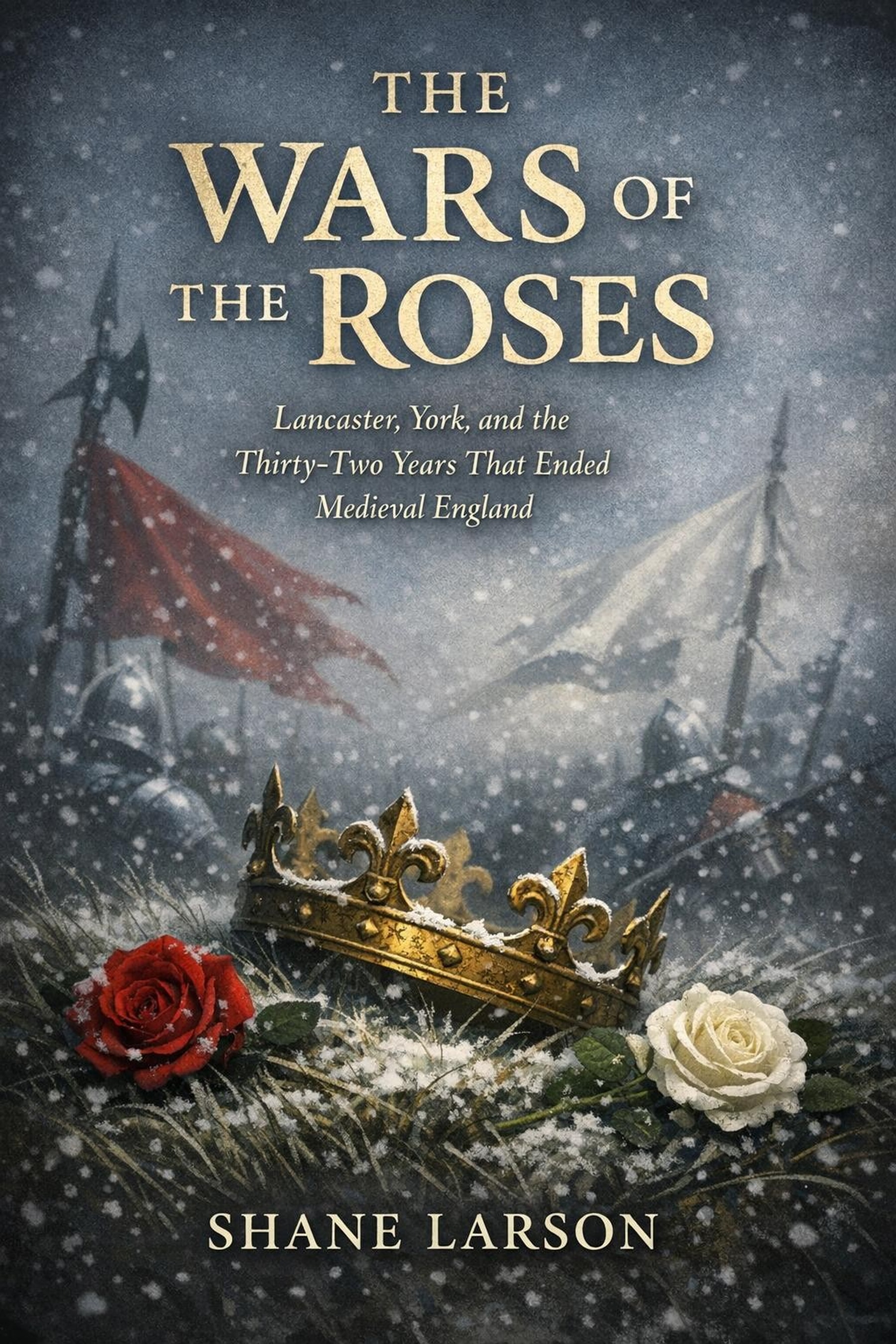
*The Wars of the Roses: Lancaster, York, and the Thirty-Two Years That Ended Medieval England* is a standalone history on the English shelf, picking up where *The Hundred Years' War* ends. It opens by separating the Tudor story from the fifteenth-century record, the roses, the garden and the name, and then tells the whole war from St Albans to Stoke Field, with each battle anchored to a named source and each legend given its provenance.
The Wars of the Roses
New posts and releases, straight to your inbox. No spam, unsubscribe anytime.