Did the An Lushan Rebellion Really Kill 36 Million People? What the Tang Census Actually Counts
November 12, 2026 · 8 min read
Somewhere near the top of every ranked list of the deadliest events in human history sits a war most of the people reading the list have never heard of. The An Lushan Rebellion, 755 to 763, is credited in those lists with thirty-six million dead, which in a world of perhaps two hundred million people would be one human being in six. Adjusted for population, that puts it ahead of the Mongol conquests, ahead of the Second World War, ahead of everything.
The figure is real, in the sense that it comes from genuine Tang government records and nobody made it up. What it counts is another matter, and the people who have spent their lives reading those records stopped taking it as a death toll long before it became famous. Here is where the number comes from, what it actually measures, and why the honest answer to the question in the headline is less satisfying than the number and a good deal more interesting.
Two lines in a tax register
In the 790s an elderly finance official named Du You, serving as military governor at Yangzhou, finished a two-hundred-chapter history of Chinese government called the Tongdian. In its chapters on population he copied out the figures from the imperial registers. For 755, the last year of peace before An Lushan marched, the Tang recorded about 8.9 million households and 52.9 million people. For 764, the year after the war ended, it recorded about 2.9 million households and 16.9 million people.
Subtract one from the other and you have thirty-six million. That is the entire derivation. There is no Tang source that counts the dead of the war, no contemporary estimate, no mass-grave archaeology; there are two entries in a register nine years apart. Everything depends on what the register was counting, and what happened to the people who compiled it.
What a Tang register was for
The Tang state did not count its people to know how many there were. It counted them to tax them, conscript them and allot them land. The household register, compiled by each county every three years, existed to record who owed what, and Du You's own breakdown of the 755 figure shows the logic: of 52.9 million people, only about 8.2 million were taxpaying adult men. The rest were listed because they belonged to taxable households.
The system also leaked constantly, even in peace. A household that moved to escape a bad harvest or a debt vanished from the state's sight unless it registered again where it settled; a family that attached itself as tenants to a great estate passed from the state's books into the landlord's. The leak could be measured. Between 721 and 724 the court sent commissioners into the provinces to find unregistered households, and they turned up something over 800,000 of them, in peacetime, with the roads open and the clerks at their desks. The 52.9 million of 755 is therefore a lower bound: the real population was larger, perhaps considerably larger, and nobody knows by how much.
What the war did to the count
Now consider what happened to that machinery between 755 and 764.
The rebellion began in Hebei, the most populous region of the north, and for most of the war the rebels held large parts of Hebei, Henan and Hedong. Registers in rebel-held prefectures were not sent to Chang'an and may not have been compiled at all. When the war ended in 763 the surrendering rebel generals were confirmed in their provinces, and those provinces went on governing themselves and sending nothing to the capital for the rest of the dynasty. Their households never appear in the imperial returns again, and Hebei alone had held, on the usual estimate, something like a quarter of the registered households of 755. At the same time the Tibetans took the whole Hexi corridor and the Longyou region from a frontier stripped of its armies; those prefectures dropped out too. The 16.9 million of 764 is a count of a much smaller country.
The timing gives the game away. Figures compiled in 760, with the war still being fought, already show about 17 million people, almost exactly the 764 level, and the record notes that a large number of prefectures had sent in no returns. The register does not decline slowly as the dead mount. It falls off a cliff the moment the state loses its provinces and then sits at that level for years.
Within the territory the court still controlled, the war produced refugees on a vast scale, most of them southward across the Huai and the Yangzi, where the fighting never reached. A refugee family arriving without papers did not join the register automatically, and a state that had just lost most of its northern revenue had little capacity to find them. Inside the north, a household that had lived through years of conscription had the strongest possible motive to vanish from the lists. And the system itself was dying. The court raised money through a salt monopoly from 758, which needed no census, and in 780 it abolished the old head taxes altogether and assessed households on their property where they actually lived. The post-war registers record the remnant of a tax system being abandoned, not a population.
The An Lushan Rebellion
How the number got famous
For most of the twentieth century this was simply the view of people who worked on the Tang. The figure of thirty-six million was known, and it was known to be an artefact. It escaped the field in 2011. That year Matthew White, an American librarian who had spent years compiling death tolls for wars and catastrophes, published his ranked list as a book, and the same year Steven Pinker drew on White's compilations for a table in a widely read argument that violence has declined across human history. Pinker added a step of his own: to compare events across very different eras, he scaled each toll to the world population of its time. Scaled that way, the Tang census gap went to the top of the table.
Both writers attached warnings about the reliability of ancient figures, and White's own working number was about thirteen million, well below the full gap. But the table was the part that travelled, and it travelled into a thousand online lists without the caveats. Neither man invented the figure, and a compiler of several hundred events cannot be a specialist in all of them. The problem was that a number the specialists had long since stopped taking literally had nobody standing guard over it once it left the field.
What can honestly be said
None of this means the war was not a catastrophe. The histories record the sack of the Hebei cities, the destruction of the Tang army at Tongguan, the starving of the garrison at Suiyang, Luoyang handed to Uyghur cavalry for plunder in 757 and again in 762, famine across the Guanzhong and Henan, and an epidemic in the lower Yangzi. In every premodern war for which there is good evidence, most of the dead died of hunger and disease among a population driven from its fields, and the Yellow River plain was fought over for eight years. The dead were counted in millions. It would be astonishing if they were not.
But the census cannot tell you how many millions, in either direction. Because 52.9 million was itself an undercount, the true pre-war population was larger, which means more people exposed to the war, not fewer. The argument that the register gap overstates the toll is not an argument that the toll was small. It is an argument that the register is the wrong instrument.
There is a precedent, and it is the clinching one. The Eastern Han registered something over fifty million people in the middle of the second century; after the civil wars that ended the dynasty, the reunifying Jin registered about sixteen million in 280. The shape is almost identical to the Tang collapse, and it was once read the same way, as the death of two thirds of China. Historians now read it mainly as a state losing its registers and its tax base, with the population passing into the hands of landlords and warlords who had every reason to keep it off the books. And there is the recovery: the Hebei provinces that sent no returns remained among the most populous and formidable regions of China for the next 150 years, and when a stable state could count again, under the Song, it registered sixteen or seventeen million households, far beyond the Tang peak. A real loss of two thirds in the 750s would need a rate of recovery for which there is no evidence anywhere.
So the honest answer is this. The An Lushan Rebellion killed people in the millions. Thirty-six million is not a measurement of them; it is the difference between what a state could count at the height of its reach and what it could count after losing a third of its territory and most of its grip. In 755 the Tang could find and tax about 52.9 million of its people, and by 764 it could find 16.9 million, and it never found the rest again. That is what the gap measures. The habit worth taking away, for this number and for every round figure in premodern history, is to ask who counted, what they were counting, and why.
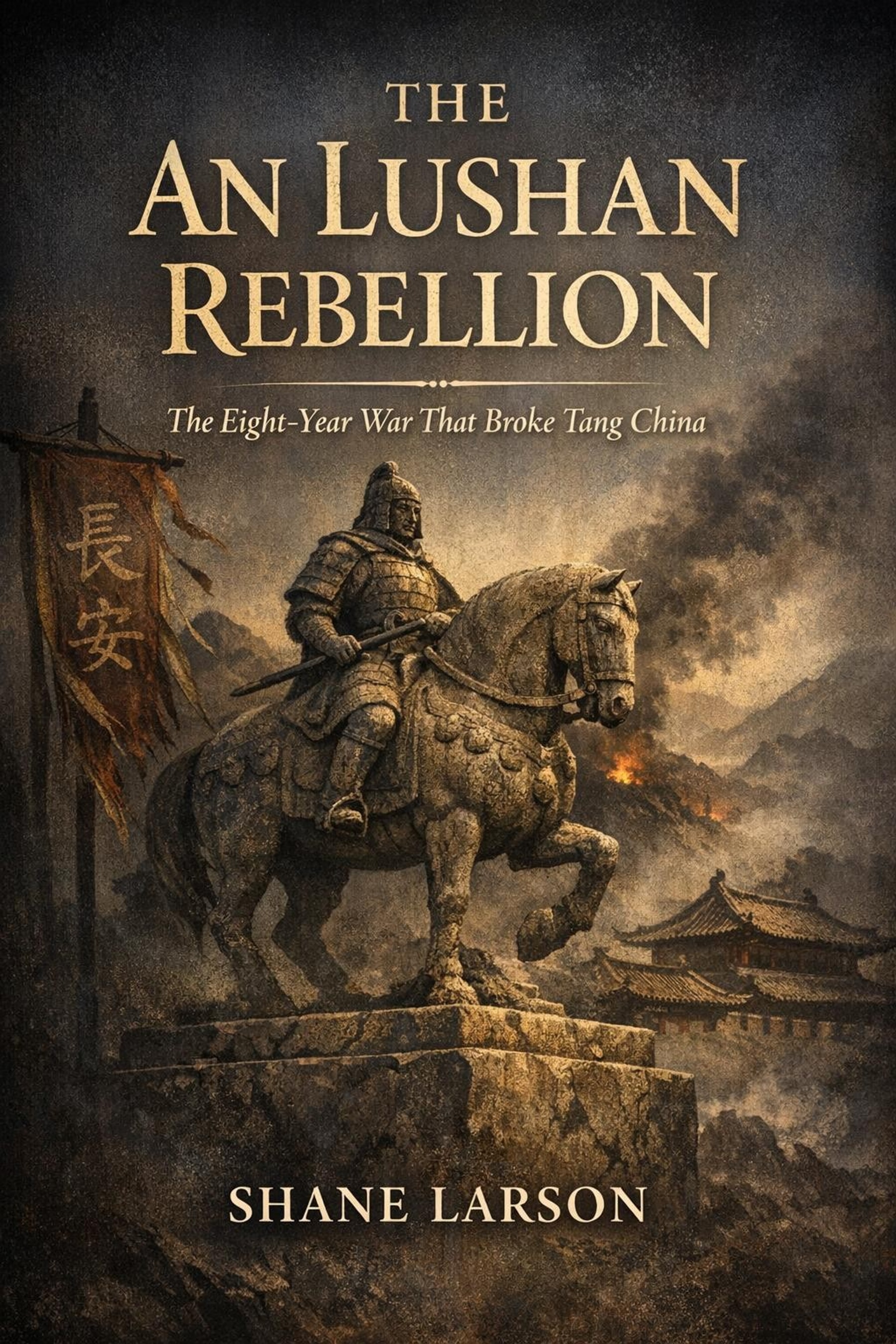
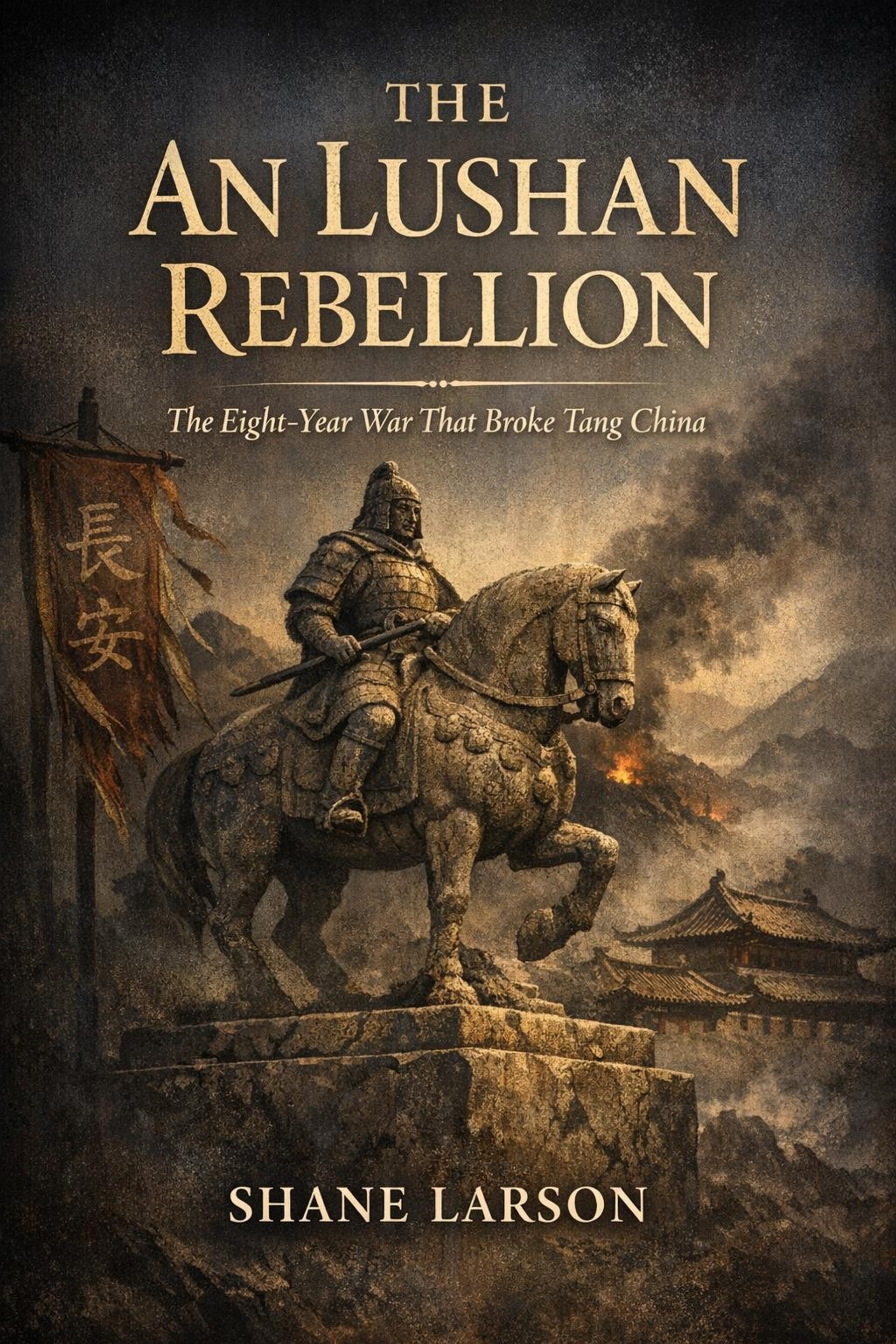
The An Lushan Rebellion: The Eight-Year War That Broke Tang China is a narrative history of the war from the frontier system that built the rebel to the poem that turned his victim into a heroine, with the census argument set out in full in its own chapter and the Tang returns before, during and after the war in one table in an appendix. The source is named in every scene, and the book says where the sources fall silent.
The An Lushan Rebellion
New posts and releases, straight to your inbox. No spam, unsubscribe anytime.