The Oldest Geared Machine in the World Predicted Eclipses. It Also Kept Track of the Olympic Games.
October 26, 2026 · 8 min read
In 2008 a team working on a lump of corroded bronze in the National Archaeological Museum in Athens announced a small dial nobody had expected. The object it belonged to had been known for a century. It had already been shown to track the sun, the moon, a nineteen-year calendar and a cycle that predicts eclipses. The new dial was simpler than any of those. It turned once every four years, and the names engraved around it were Olympia, Nemea, Isthmia, Pythia, and a festival at Dodona that most people have never heard of.
The most sophisticated machine to survive from the ancient world, it turned out, also told its owner when the games were on.
I spent a book on that object, and the games dial is the part I keep coming back to, because it says something about the machine that the eclipse gearing cannot. The eclipse cycle tells you how good Greek astronomy was. The games dial tells you who the machine was for.
What came out of the sea
Start with where it was found, because the finding is a story in itself and most accounts hurry past it.
In the spring of 1900 a boat of sponge divers from the island of Symi was on its way to the sponge grounds off North Africa when the weather turned. They put in behind Antikythera, a rock in the channel between Crete and the Peloponnese, and while they waited one of them went down to look for sponges. He came back up and reported corpses and horses on the seabed. They were statues, bronze and marble, the cargo of a ship that had gone down around 70 to 60 BC with a load of Greek art almost certainly bound for Roman buyers.
The Greek government hired the same divers to excavate it, and between November 1900 and September 1901 they did, in brass helmets and canvas suits, at fifty metres and more, with a navy ship standing by. Nobody had excavated an ancient shipwreck before. Nobody understood decompression sickness either. One diver died and two were paralysed. What they raised filled the museum in Athens: a bronze youth, a bronze head of a bearded philosopher, marble figures eaten to the bone on the side that had faced the water, glass, amphorae, the bronze fittings of furniture. And a few lumps of corroded bronze with wood stuck to them, set aside.
In May 1902 one of those lumps, drying on a shelf, cracked open, and the archaeologist Valerios Stais saw a gearwheel in the crack. A gearwheel with small triangular teeth, in a ship that sank in the first century BC, fourteen hundred years before gearing of that kind was supposed to exist. He wrote it up and was not widely believed. One early suggestion was that the thing was too advanced to belong to the wreck and must have fallen in later.
The eclipse dial
It took the rest of the century, and finally a microfocus CT scanner trucked to Athens in 2005, to read what the fragments held. There are 82 of them now, and about thirty gears survive in whole or in part. The back of the machine carried two spiral dials. One tracked a calendar of 235 lunar months, which is nineteen years, the cycle after which the phases of the moon fall on the same dates again. The other tracked a cycle of 223 months, a little over eighteen years, after which eclipses repeat.
That second cycle is Babylonian. Priests in Mesopotamia had written down where the moon was, night after night, for centuries, and had worked out from the records that if there was an eclipse in a given month there would very probably be another 223 months later. The Greeks took that number, and the machine turns it into bronze: a pointer moving round a spiral of 223 divisions, with tiny engraved glyphs in the months where an eclipse was due, marked for sun or moon and, in many cases, for the hour of the day. A smaller dial beside it adds the correction, because 223 months is not a whole number of days and the eclipse drifts by about eight hours each cycle. Turn the handle to a month, and the machine tells you whether to expect an eclipse, of what, and roughly when.
It is worth being precise about what that means and what it does not. The mechanism does not calculate in the way a computer does. Its gears do not add or multiply; they turn at rates fixed by their tooth counts, and the rates stand in for the periods of the heavens. It performs one set of operations, chosen when the teeth were cut, and its teeth were cut by hand and are measurably uneven. Over a few years of use the pointers would have drifted against the sky. The honest description is a hand-made analogue calculator, built by people who knew exactly what the sky did and had the patience to file it into bronze. That is a large enough claim. It does not need the aliens, and the people who offer the aliens have never looked at the gear teeth.
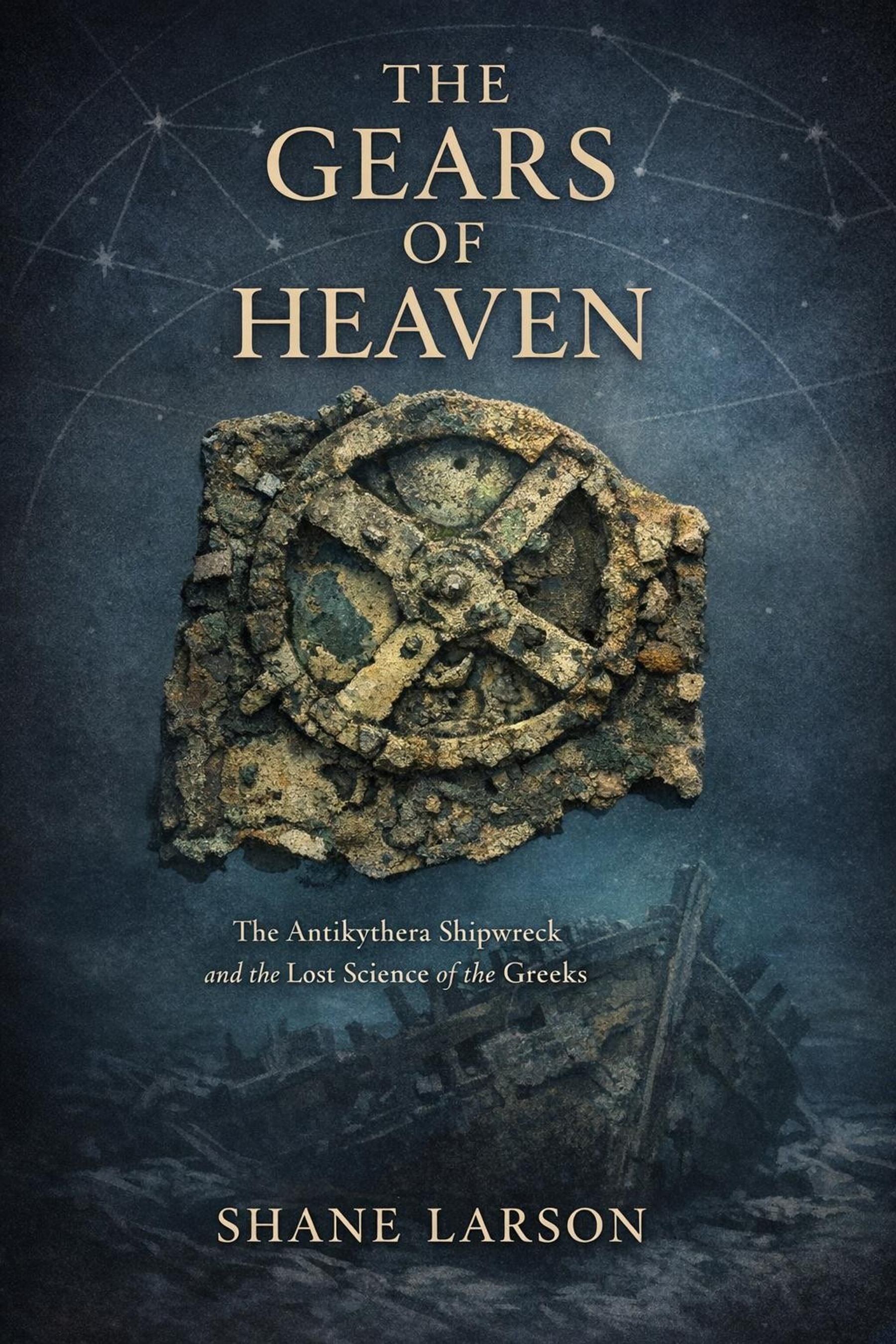
The Gears of Heaven
The dial nobody expected
Now the small dial. The 2008 scans found, on the back of the machine, a four-year dial divided into quarters, with the name of a festival in each. Olympia and Pythia, the great games held every four years, appear once. Isthmia and Nemea, held every two, appear twice. The fifth name, Naa, is the festival of Zeus at Dodona in the mountains of north-western Greece. A sixth, read later and less securely, is probably the Halieia on Rhodes.
Think about what that dial is doing in a machine of this kind. Everything else on it is astronomy: the sun, the moon, the calendar the moon generates, the eclipses the moon and sun produce together. The games dial is not astronomy. The games were held on a fixed cycle because people decided they would be, and the cycle mattered because Greeks counted their years by it. An educated Greek of the second century BC dated events by Olympiads. Asked when something happened, he would answer with the number of the Olympiad and the year within it, the way we answer with a number of years since a fixed point. The games dial is a civil calendar, the one a reader of the machine would actually use to say where he was in time.
So the machine was not built as a demonstration of astronomy. It was built for a person, to be used, and the person who used it needed to translate between the heavens and the calendar he lived by. The engraved text on the plates and doors, of which some 3,400 characters have been read, confirms that: it is not a dedication or a boast but a description of what the dials show, in the voice of someone explaining an instrument to a user who did not build it. Instructions are what you engrave on a thing that changes hands. A man who makes one machine for himself does not write the manual on it.
Dodona and Rhodes are clues too. Nobody puts a minor mountain festival on a dial beside Olympia unless it matters to the customer, and the arguments about where the machine was made turn on exactly such details, along with the Corinthian month names on the calendar dial. The candidates run from Rhodes, where Hipparchus worked, to the Corinthian colonies in the west, Syracuse among them. No one has settled it, and the book sets out each case rather than picking a winner.
One survivor
Here is the thing the games dial, and the instructions, and the eclipse gearing all point to. The mechanism does not look like a first attempt. A first attempt at anything is over-built where the maker was unsure and crude where he had not found the trick. This is pared down, compact, and does seven or eight things in a box a hand could span, with a settled vocabulary for its parts and a manual for the owner. It reads as the state of an art, not the beginning of one.
Cicero, writing in the middle of the first century BC, describes bronze spheres that showed the motions of the sun, moon and planets: one built by Archimedes and carried off from Syracuse in 212 BC, and one built in his own lifetime on Rhodes. Before 1902 those passages were read as rhetoric. After 1902 they read as the description of a genre, and the thing in the museum in Athens is that genre's only surviving member. Nothing like it turns up again for a thousand years. Either the Greeks built one astonishing machine and stopped, or they built many and we lost every one of them but this, because bronze is valuable and gets melted and the knowledge lived in a few workshops that died.
The second answer is the more likely one, and the more disturbing, and it is the question the book is really about. The eclipse dial shows how good the Greeks were. The games dial shows they were building these things for people to carry and use. The thousand years of silence afterward show how much of that world is simply gone.
*The Gears of Heaven: The Antikythera Shipwreck and the Lost Science of the Greeks* is available now in ebook and paperback. It tells the story of the wreck, the machine and the science that built it, with the evidence showing throughout, and it sits on the shelf beside *The Library of Alexandria*, *Hypatia of Alexandria* and *The House of Wisdom* for anyone who wants to follow where that science went.
The Gears of Heaven
New posts and releases, straight to your inbox. No spam, unsubscribe anytime.