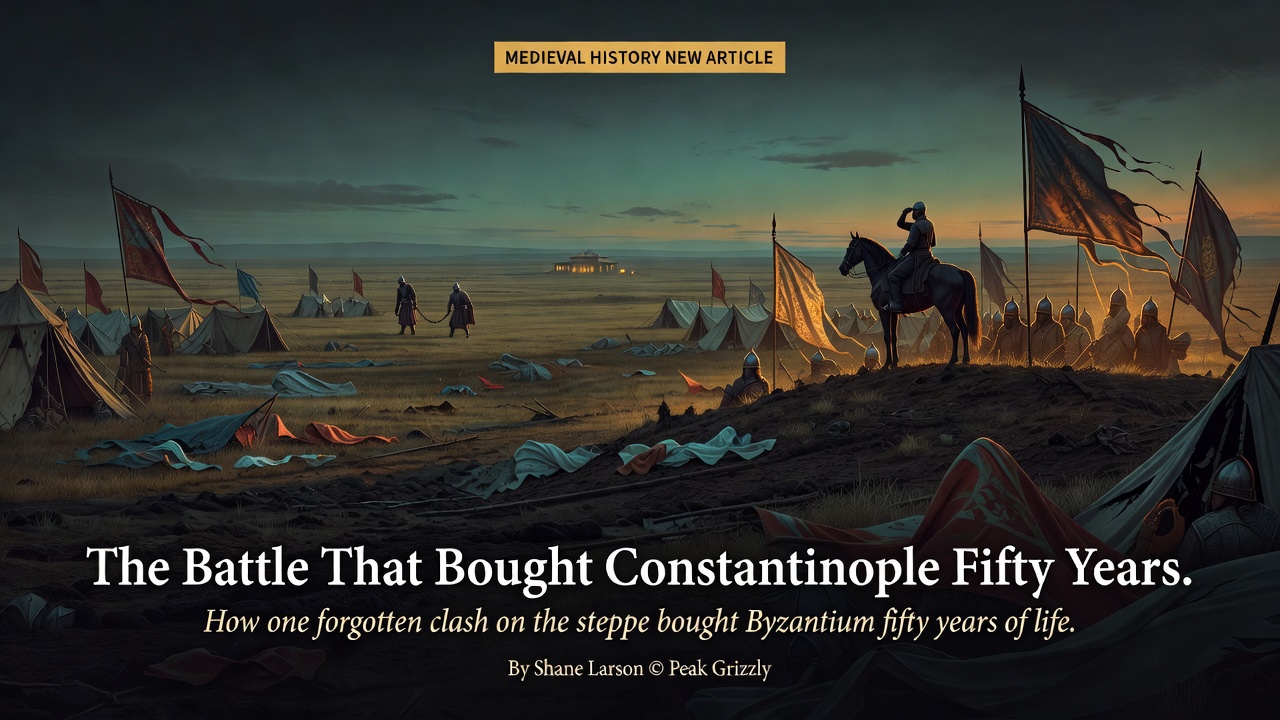
The Battle That Bought Constantinople Fifty Years
October 2, 2026 · 5 min read
Everyone knows Constantinople fell in 1453. Almost nobody asks why it didn't fall in 1402.
It should have. By the summer of that year, the city had been under Ottoman blockade for eight years. Sultan Bayezid — called Yildirim, the Thunderbolt, for the speed with which he moved armies — had already destroyed the last great crusade the West would ever assemble, at Nicopolis on the Danube in 1396, and the lesson had landed: no one was coming. The Byzantine emperor, Manuel II, wasn't even in his capital. He was touring the courts of western Europe, dining with kings in Paris and London, politely asking for armies that everyone at the table knew would never march. Constantinople's fall had stopped being a question of whether. It was a question of which campaigning season.
Then, on July 28, 1402, on a plain in central Anatolia near a fortress the Ottomans owned, the Thunderbolt's army was destroyed in a single day — and not by any power in Europe. The army that did it had marched from Samarkand, in what is now Uzbekistan, under a commander in his mid-sixties who walked with a limp from arrow wounds taken as a young raider. Europe would come to call him Tamerlane, a corruption of the Persian Timur-i Lang: Timur the Lame.
How to beat an army that doesn't lose
The battle of Ankara was decided before it was fought, which was typical of the man who won it.
Timur had spent more than thirty years campaigning almost continuously — Persia, the Golden Horde's steppe, Delhi, Damascus, Baghdad — and his method was never simply to out-fight an enemy. It was to make the enemy fight on the wrong day, in the wrong place, in the wrong condition. In the summer of 1402 he did all three. While Bayezid waited for him along the obvious invasion route, Timur swung wide, came in behind the Ottoman position, and seized their base at Ankara — putting the Ottoman army, not his own, in the position of the invader marching to relieve a siege. Bayezid's troops arrived after a forced march in the July heat and found the water sources controlled, fouled, or diverted. The most feared army in Europe began the most important battle of its existence dying of thirst.
Then the battle started, and it got worse. A large part of Bayezid's force consisted of cavalry from the Anatolian Turkmen emirates he had recently conquered and absorbed. Their former princes were standing in Timur's camp — deliberately collected, hosted, and displayed for exactly this moment. Whole contingents defected mid-battle, riding across to join the men they had followed a decade earlier. By evening the Ottoman army had ceased to exist as a fighting force, and Bayezid — the sultan who had crushed the crusade at Nicopolis, the man Europe had learned to describe as unstoppable — was a prisoner. He died in captivity within months. The legend of the iron cage came later, and the sober sources don't support it; the captivity itself was humiliation enough.
Timur
The decade the Ottoman Empire didn't exist
What followed was, for the Ottomans, close to erasure. Bayezid's sons fell into a civil war that historians call the Ottoman Interregnum — roughly a decade in which the empire was a set of warring fragments rather than a state. The Anatolian emirates Bayezid had swallowed were deliberately restored by Timur, resetting the Ottoman position in Asia Minor by a generation. The blockade of Constantinople simply stopped. The starving city on the Bosporus watched its besieger's empire dissolve, and some of the congratulatory letters that went east to the conqueror came from Christian courts that had been praying for exactly this and would spend the next fifty years pretending they hadn't needed it.
Constantinople did fall, eventually — in 1453, to Bayezid's great-grandson Mehmed II, with siege artillery that hadn't existed in 1402. But the fifty-one years in between were not nothing. They were half a century of the city continuing to exist, of scholars and manuscripts moving west ahead of the inevitable, of the last act of the Roman world playing out at its own pace. All of it was purchased on a single day in Anatolia, by a man fighting for reasons that had nothing whatever to do with saving Christendom — Timur seems to have regarded Bayezid mainly as a rival who had grown insolent, and their pre-war correspondence is a masterpiece of escalating insult on both sides.
Why nobody remembers the most consequential battle of the century
Here is the strange part: by any reasonable measure — scale, consequence, drama — Ankara belongs on the shortlist of the most consequential battles of the entire medieval period. It captured a reigning sultan on the field, a thing that essentially never happened. It suspended one of history's great empires for a decade. It moved the fall of Rome's last capital by fifty years.
And it is barely remembered, because its winner is barely remembered. Timur sits in a historical blind spot. He was not a Mongol, though he built his career inside the wreckage of the Mongol world and married into Genghis Khan's lineage to borrow its authority. He founded no lasting empire — his state began disintegrating within months of his death in 1405, on the road to invade Ming China at the age of sixty-eight, in January, on purpose. The conquerors we remember are the ones whose empires survived long enough to write the sequel. Timur's sequel was written instead in stone: the craftsmen of every city he conquered — the masons of Delhi, the glassworkers of Damascus, the tilemakers of Persia — were marched to Samarkand, where they built the turquoise-domed skyline that still stands today. The most destructive man of the fourteenth century built the most beautiful city of it, and those were not two different stories. They were one policy, seen from its two ends.
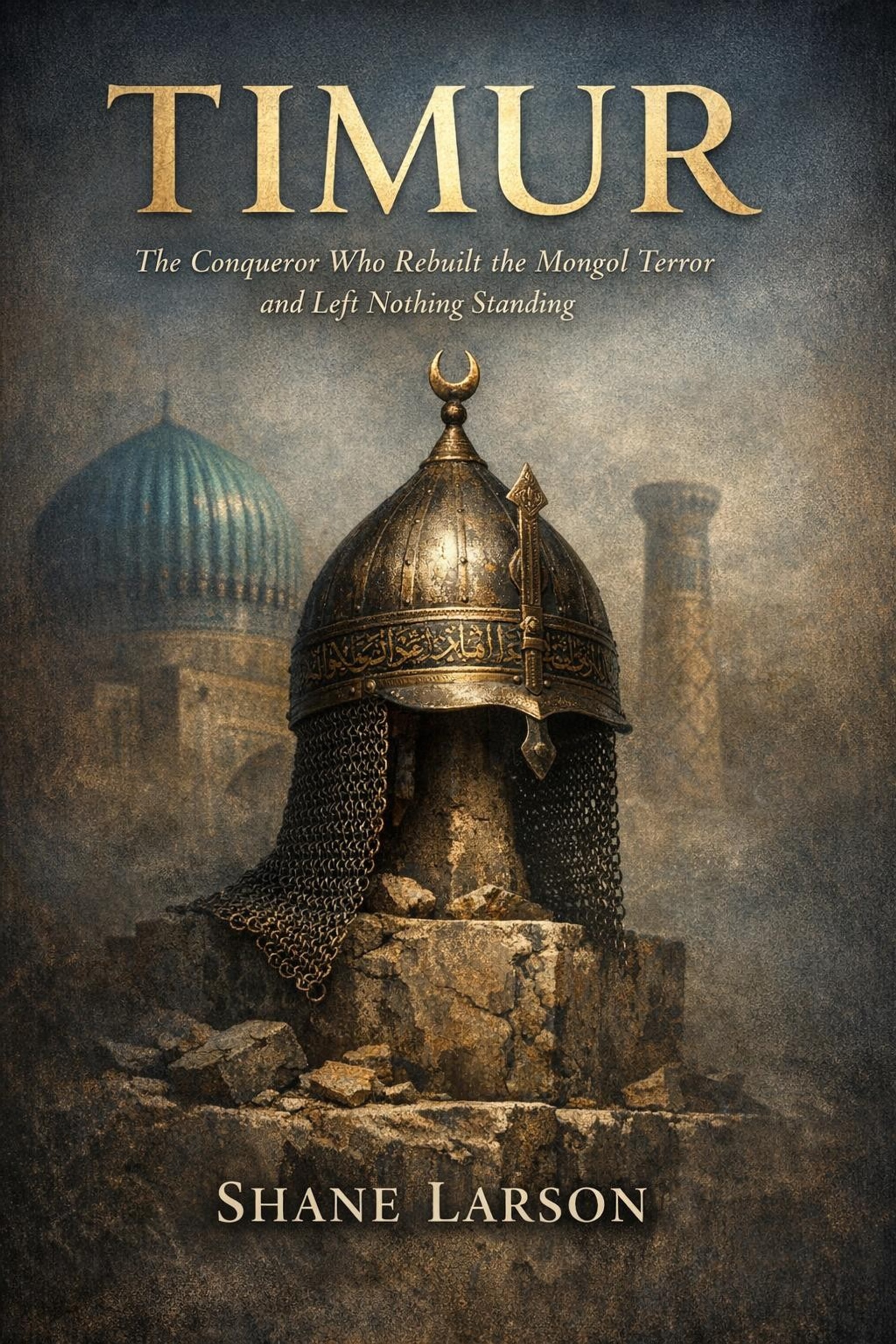
That contradiction — the towers of skulls and the tiled madrasas, the terror and the patronage, the empire that vanished and the city that didn't — is the subject of my book *Timur: The Conqueror Who Rebuilt the Mongol Terror and Left Nothing Standing*. It follows the whole arc: the rise from tribal raider, the campaigns that broke the Golden Horde and sacked Delhi and Baghdad, the extraordinary weeks when the historian Ibn Khaldun was lowered over the walls of Damascus by rope to negotiate with him, and the afterglow — an observatory in Samarkand, painting workshops in Herat, and a descendant named Babur who took the family business to India and founded the Mughal Empire. If you've ever wondered what the steppe did for an encore after the Mongols, this is the story.
Timur
New posts and releases, straight to your inbox. No spam, unsubscribe anytime.