The Most Important Moment in Reading Cuneiform Was a Boy on a Rope. Nobody Wrote Down His Name.
November 19, 2026 · 6 min read
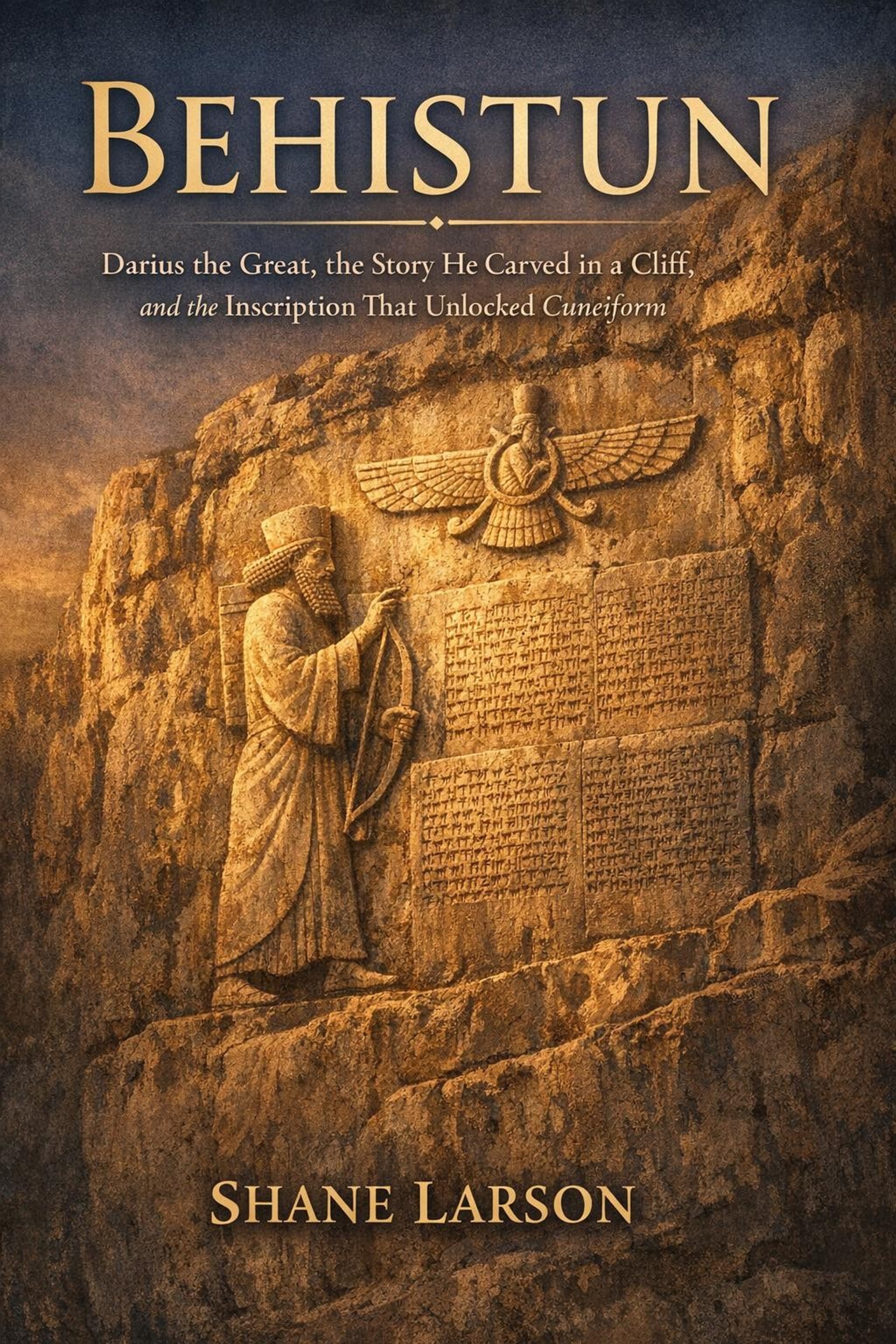
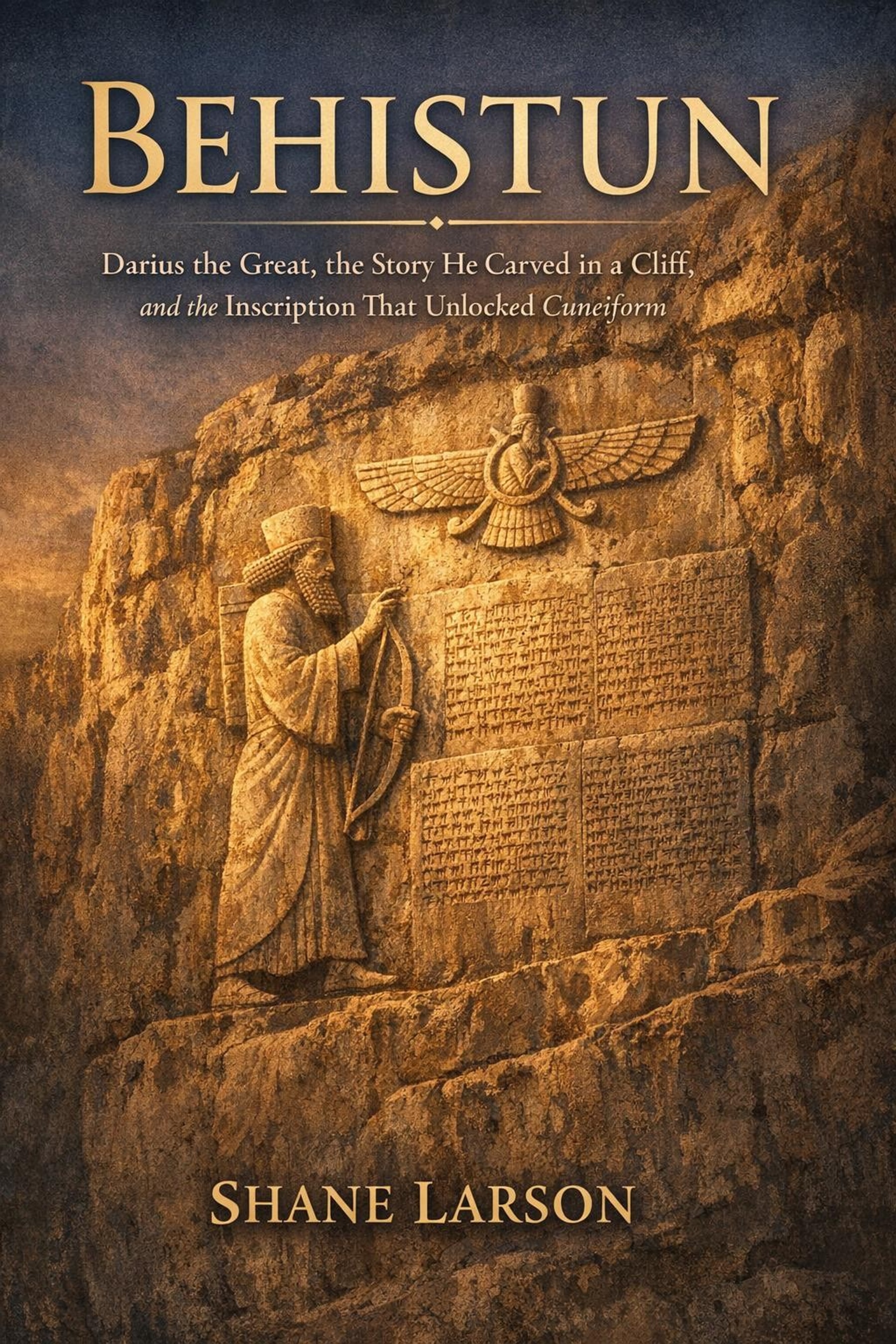
About nineteen miles east of Kermanshah, in the mountains of western Iran, a limestone cliff rises beside what was once the main road from Babylon up to the Persian plateau. More than sixty metres above the ground there is a carved panel: a king with a bow, his foot on a man lying on his back, a line of prisoners roped at the neck, and around them more than a thousand lines of wedge-shaped writing in three languages.
The king is Darius the Great. He had the panel cut around 520 BC, and it is his account of how he came to power. For most of the time since, nobody could read it. The story of how it came to be read usually has one hero, a British officer named Henry Rawlinson. It should have at least three, and one of them is a boy whose name we do not have.
Three texts and a problem of reach
The monument at Behistun says the same thing three times: in Old Persian, in Elamite, and in the Babylonian dialect of Akkadian. That is what made it valuable. Old Persian was written in a simple script of a few dozen signs, and by the 1830s scholars in Europe had worked out most of them from short inscriptions at Persepolis. Akkadian was the prize. It was the language of Babylon and Assyria, written with hundreds of signs, and nobody had the first idea how it worked. A long text in a script you can read, sitting beside the same text in a script you cannot, is the best help a decipherer can hope for.
The difficulty was getting at it. Darius's masons had cut back the ledge they worked from, leaving a shelf that in places is less than half a metre wide. Rawlinson, posted to Kermanshah in 1835 to train the Shah's troops, spent his spare days on that shelf. By his own account he stood a ladder on it, nearly upright because there was no room to slope it, and copied the Old Persian columns with a notebook in one hand while holding on with the other. War in Afghanistan took him away for years. He came back in 1844, finished the Old Persian and copied the Elamite.
That left the Babylonian. It is cut on a separate face of rock that juts out above and to the left of the relief. Rawlinson looked at it from every side and decided he could not get there. The local climbers he asked, men who grazed goats on that mountain, told him the same.
What the boy did
In 1847 he tried again, and this time, he wrote, a "wild Kurdish boy" who had come from some distance away offered to attempt it.
Rawlinson's description of the climb is short and worth following closely. The boy first squeezed himself up a cleft in the rock to the left of the projecting face. From the top of the cleft he drove a wooden peg into the stone, tied a rope to it, and tried to swing across to a second cleft on the far side. The overhang defeated that. So he crossed the smooth face itself, hanging on with fingers and toes over a drop that would have killed him. On the far side he drove a second peg, fixed the rope, and with a short ladder slung between the two lines made a kind of hanging seat, like a painter's cradle.
Sitting in that, working under Rawlinson's direction, he took squeezes of the whole Babylonian text. A squeeze is a simple thing: damp paper is beaten into the carved surface with a brush, left to dry, and peeled away with every wedge standing in relief.
Behistun
Those sheets of paper were the first usable copy of the longest Akkadian text then known whose meaning could be checked line by line against a readable version. Rawlinson published the Babylonian text and his reading of it in 1851. He did not record the boy's name, then or later.
The clergyman in County Down
The squeezes were necessary. They were not sufficient. Having the Babylonian text and understanding its script were different problems, and the second was largely solved by someone who never saw the rock.
Edward Hincks was the rector of Killyleagh, a village in the north of Ireland. He had no access to the East, a small income and a gift for writing systems. Working from published copies, he saw what Rawlinson at first did not: that the Akkadian signs were not letters. They stood for syllables, a consonant with a vowel, and some stood for whole words. Stranger still, a single sign could have several different sounds depending on where it appeared. That last idea seemed so unlikely that critics took it as proof the whole decipherment was fantasy. A script in which the same mark could be read four ways looked like a script in which you could read anything you liked.
Hincks was right, and Rawlinson, with the Behistun text in front of him, came round to the same conclusion. The two men never much liked each other, and Rawlinson, who had the fame, the position and the squeezes, did not go out of his way to share the credit.
Four envelopes
The doubt was settled in 1857 by an experiment. William Henry Fox Talbot, better known as a pioneer of photography, had taken up Assyrian as well. He proposed a test to the Royal Asiatic Society in London. A long inscription of the Assyrian king Tiglath-Pileser I had recently been found and had never been published. Rawlinson, Hincks, Talbot and a fourth scholar, Jules Oppert, would each translate it alone and send in the result under seal.
A committee opened the envelopes that May. The four versions were not identical, but Rawlinson's and Hincks's ran close together passage after passage, and the other two were near enough. Four men working apart do not invent the same account of a king's campaigns by accident. Akkadian was being read.
What followed came quickly. Tens of thousands of tablets were already coming out of the mounds of Assyria. In 1872 a museum assistant named George Smith, sorting fragments from the library at Nineveh, read on one of them a story of a great flood, a boat and a bird sent out to find land. It was part of the Epic of Gilgamesh.
What the cliff was for
There is an irony in all this that Darius would not have enjoyed. He had his version of events carved where it could not be defaced or corrected, and he sent copies across the empire so that it would be the only version. For twenty-three centuries it more or less was. Then the same carving became the tool for reading everything else, including Babylonian contracts dated to the reign of a King Bardiya, the man Darius insists was an impostor.
Whether he was is still argued. That argument, the year of civil war that followed, the making of the monument and the long strange history of what people thought it was when nobody could read it are the subject of *Behistun: Darius the Great, the Story He Carved in a Cliff, and the Inscription That Unlocked Cuneiform*. The boy on the rope is in it, with as much of his due as the record now allows.
Behistun
New posts and releases, straight to your inbox. No spam, unsubscribe anytime.