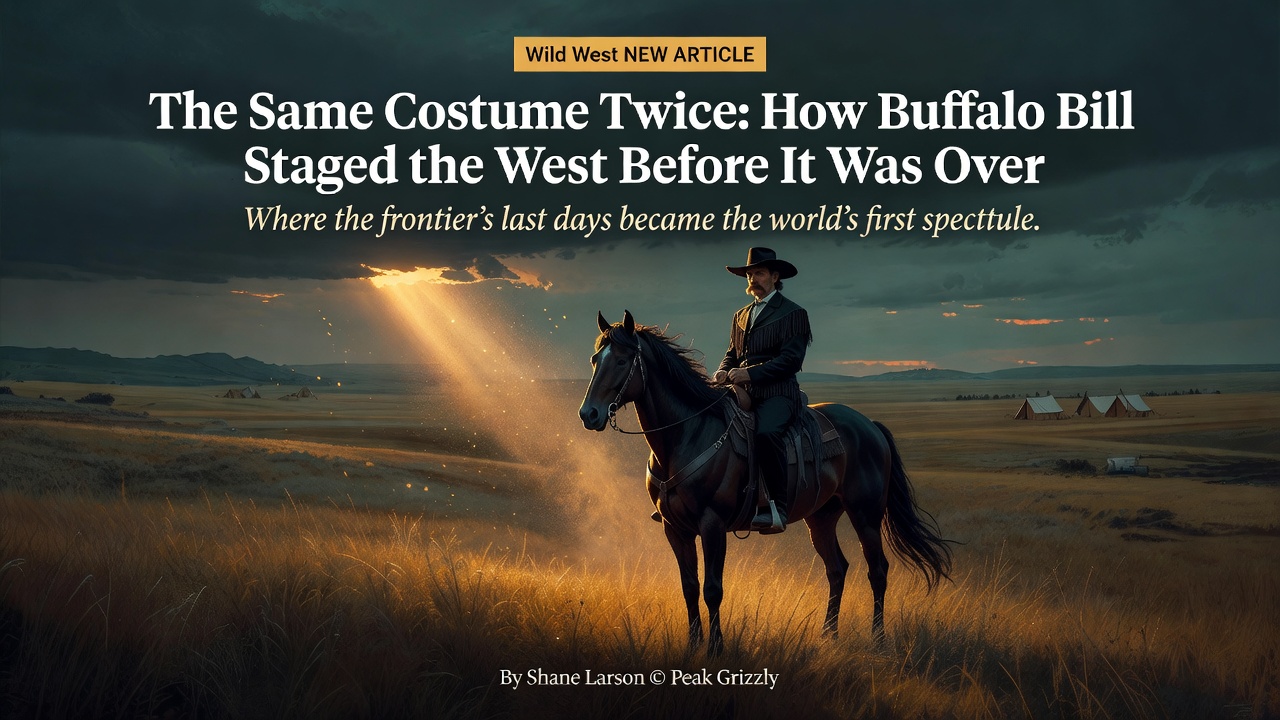
The Same Costume Twice: How Buffalo Bill Staged the West Before It Was Over
August 20, 2026 · 7 min read
On July 17, 1876, three weeks after the Little Bighorn, William F. Cody rode with the Fifth Cavalry at Warbonnet Creek in northwestern Nebraska and killed a Cheyenne warrior named Yellow Hair. The skirmish was small and the killing was real: Cody shot him, took his scalp, and by several accounts held it up and called it the first scalp for Custer. What makes the morning strange is not the violence, which was ordinary for that war. It is the wardrobe. Cody was dressed in a stage costume — black velvet, silver buttons, scarlet trim, a vaquero outfit cut for the theater — because he had come to the campaign straight from a theatrical season, and he seems to have understood, before anything happened, that whatever happened was going to be performed.
It was. Within weeks he was on a stage in Rochester, New York, playing the scene in a melodrama built around it, wearing the same clothes he had worn at the creek. The scalp went on display. No other figure in American history compressed the distance between an event and its dramatization so close to zero, with himself cast in both versions. The frontier had not closed. He was reenacting it while it was still running.
That compression is the key to Cody, and to most of what the world thinks it knows about the American West. The buckskin scout, the stagecoach chase, the attack on the settler's cabin, the cavalry arriving at a gallop, the sharpshooter, the whole visual grammar that Hollywood inherited and never questioned — nearly all of it was assembled by one man, for paying audiences, between 1883 and 1913, while the history it depicted was in living memory and some of it was still going on.
Not a Circus, and Never Called a Show
The thing Cody launched in Omaha in 1883 had no "show" in its name, and that omission was a business decision, not modesty. It was billed as Buffalo Bill's Wild West — an exhibition, an educational display, history presented by the people who had lived it. The claim was the product. The Deadwood stagecoach in the arena was the actual Deadwood coach. The cowboys were working cowboys, the buffalo were real buffalo, and many of the Lakota riders had fought in the campaigns the program depicted. Audiences were not asked to suspend disbelief; they were told there was nothing to disbelieve.
That claim was largely true and profoundly misleading at the same time, and the gap between those two facts is where the West got invented. The events were real; the arrangement was not. The program ran the frontier as a sequence — the Pony Express rider, the emigrant train, the stagecoach attack, the burning cabin, the buffalo hunt, the rescue — a loop of peril and deliverance in which settlement was always innocent, attack always came from the other side, and the cavalry always arrived. Real people, real horses, real gunfire, arranged into a story considerably more coherent and considerably less troubling than the record. It was the most effective history lesson ever staged, and it was wrong in exactly the ways that stuck.
Sitting Bull Plays Himself
In 1885 Cody recruited the most notorious Native man in America. Sitting Bull, nine years past the Little Bighorn and living under agency control at Standing Rock, signed on for one season at fifty dollars a week, with the right to sell his own photographs and autographs. He did not reenact anything. He rode once around the arena at a walk, and that was the act: being Sitting Bull, in public, for money.
American crowds hissed him as the killer of Custer — a charge that was false in the particulars and useful on the billboards. He endured it, banked the photograph money, and gave a remarkable amount of it away, much of it to the newsboys and beggars who worked the streets outside the showgrounds. He is recorded as being genuinely puzzled that a country capable of building such cities let its children go hungry in them. He formed a real friendship with Annie Oakley, the show's star shooter, and gave her the name she carried for the rest of her career. Then he went home. Whatever the season was — employment, exhibition, captivity with a salary — it was not simple, and the people involved knew it was not simple at the time.
Buffalo Bill Cody
Workers Who Signed Contracts to Play Themselves
Sitting Bull was the famous case, but the show employed hundreds of Lakota men and women, recruited season after season at Pine Ridge and Rosebud, under written contracts, for wages, with transport and board. They performed the attacks on the stagecoach and the cabin. They played, in effect, themselves — or rather the version of themselves the program required.
The federal Indian Office objected, repeatedly and in writing. The objection is revealing: not that the show demeaned its performers, but that it undermined assimilation — that men who were supposed to be farming allotments and shedding their language were instead traveling the world being conspicuously, professionally Lakota. The performers' own recorded views cut differently. The show paid cash when the agencies offered dependency. It meant travel, audiences, and a public identity at the precise moment federal policy was working to erase that identity at home. Black Elk, who toured Europe with the show as a young man, left an account of the experience that is neither an endorsement nor a lament — it is the testimony of a working man far from home, observing strange cities with clear eyes. The honest way to treat the Show Indians is the way the record treats them: as workers who weighed bad options and made decisions, not as props and not as dupes.
Chicago, 1893
The World's Columbian Exposition refused to give Cody a concession inside the fairgrounds. He leased land beside the entrance instead, set up his arena, and spent the summer intercepting the crowds. The 1893 stand became the most profitable season the Wild West ever had, and by some measures Cody's operation drew as well as the official attractions it sat outside of.
A few hundred yards away, on July 12, a young historian named Frederick Jackson Turner stood up before the American Historical Association, meeting at the fair, and read a paper arguing that the line of settlement had disappeared from the census map — that, as he put it, "the frontier has gone, and with its going has closed the first period of American history." It is the most influential essay an American historian has produced, and it was delivered within earshot of a man staging the frontier twice a day at a profit.
The two events explain each other. Turner announced that the frontier was finished; Cody demonstrated what it would become. The same summer, in the same city, America was handed both the death certificate and the afterlife — and the afterlife was the version with reserved seating.
The Grammar That Stuck
When the show business Cody built finally failed him — and it did; he lost the fortune, lost control of the exhibition, and died in Denver in 1917 nearly broke — the program did not die with him. It moved, with remarkable directness, into film. Early westerns borrowed his performers, his staging, his set pieces, and his story shape. The stagecoach chase, the cabin under attack, the cavalry rescue, the showdown exhibition of marksmanship: the Hollywood western is substantially Cody's arena with a camera in front of it, and the arena's omissions came along too. The treaties, the agencies, the disease, the ordinary labor, the Black and Mexican cowboys who worked the actual cattle trade — none of it had ever been in the program, so none of it made the pictures.
Cody himself resists the verdicts people want to hand him. He killed buffalo by the thousands on contract and later lobbied for preserving the herds. He staged the defeat of Native people nightly and argued in print that they had been wronged and should be dealt with justly. He paid Annie Oakley like the star she was and backed women's suffrage from a platform decorated with frontier nostalgia. None of these cancel each other. They are all true at once, which is less comfortable and more interesting.
This article sketches the case; the book makes it in full — the verifiable record behind each of Cody's claims, the season-by-season construction of the exhibition, the performers' own accounts, and the act-by-act lineage from his arena to the movie western. It is the story of how the most successful history of the American West came to be written by a showman, in a ring, for money — while the West itself was still happening.
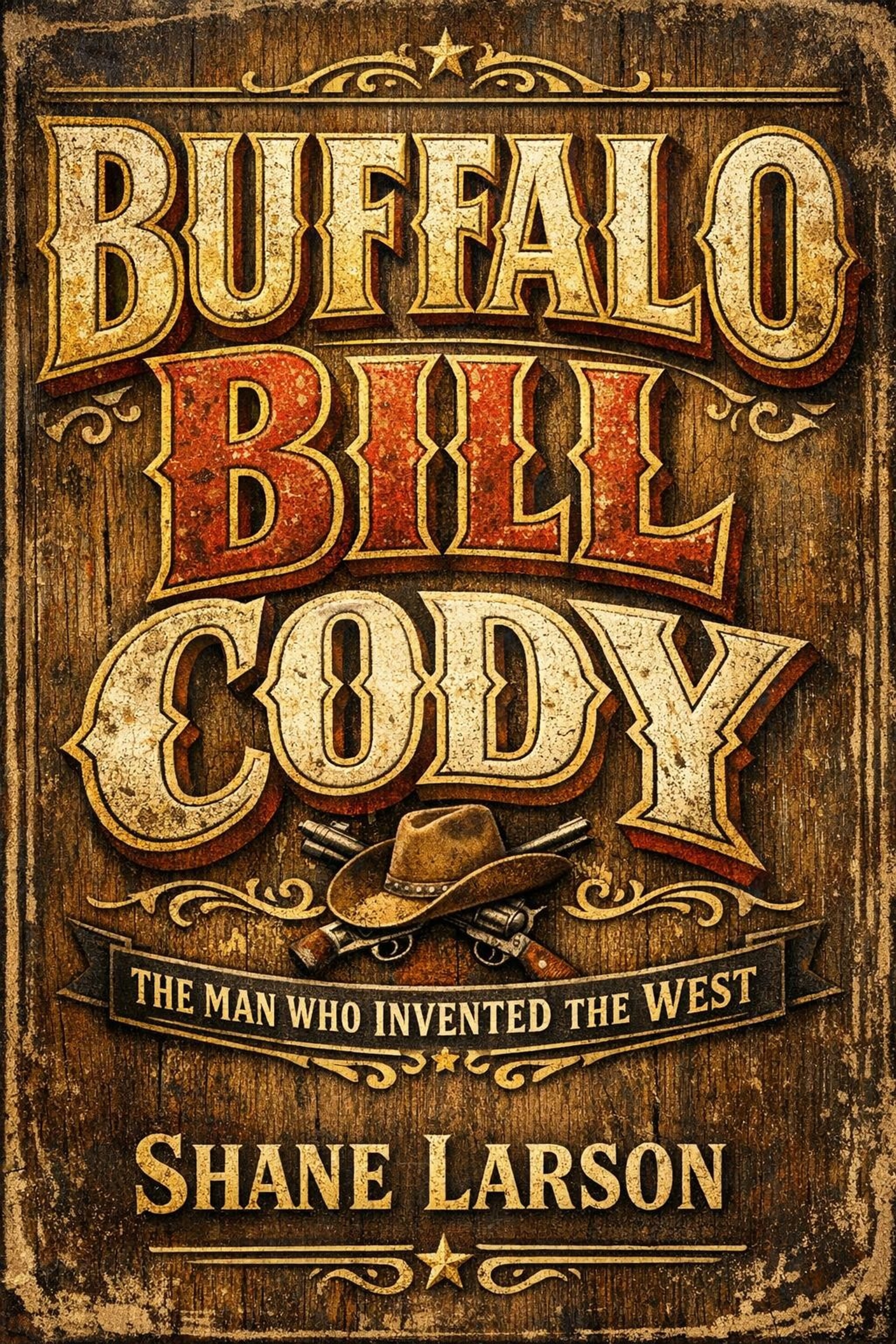
Read the full story in Buffalo Bill Cody: The Man Who Invented the West — Book 27 in The Wild West series.
Buffalo Bill Cody
New posts and releases, straight to your inbox. No spam, unsubscribe anytime.