Who Actually Got Rich in the Klondike Gold Rush? The Gold Was Claimed Before the Stampede Began
November 5, 2026 · 8 min read
The most famous gold rush in history has a timeline problem, and once you see it the whole story turns over.
The gold on Bonanza Creek was found in the middle of August 1896. Within a week every man within reach of the news had come up from the camp at Fortymile and staked the creek from end to end. Eldorado, the richer creek next door, was staked through that autumn. By the time the Yukon froze in October, the ground that would produce nearly all of the Klondike's great fortunes was held by a few hundred men who had already been in the country when the strike was made. Through the winter they burned shafts down through frozen gravel to bedrock, and in the spring of 1897 they washed out the gold and carried it to the first steamer.
That steamer, and the one behind it, reached the outside world in July 1897. The Excelsior docked at San Francisco on 14 July. The Portland tied up at Schwabacher's Wharf in Seattle on the morning of 17 July with sixty-eight miners aboard and what the Post-Intelligencer called more than a ton of solid gold. Later reckonings put it closer to two tons. Within a week the continent was packing.
Here is the problem. Eleven months had passed between the discovery and the news. The rich ground was not merely claimed; it had been worked for a full winter, and the men who held it were already hiring laborers and selling off fractions. The miners coming down the gangway said as much to the reporters, and the newspapers printed it, below the fold. The stampede that followed was a race for something that had been taken before the starting gun. About 100,000 people went anyway.
How many went, and how many found anything
The figures are disputed, and anyone who gives you a single number for the Klondike is rounding. The estimate most often repeated is that about 100,000 people set out between the summer of 1897 and the end of 1898. It rests on the ticket sales of the steamship lines, the records of the North-West Mounted Police at the mountain passes, and a good deal of guesswork. Of those, somewhere between 30,000 and 40,000 reached Dawson City, the town that grew up on a mudflat at the Klondike's mouth. The police, who counted heads at the summits and numbered every boat that came down the river in 1898, are the source for that range, and they had an interest in the numbers being large.
Of the people who reached Dawson, perhaps half ever went out to the creeks and put a pan in the water. Of those who did, a few thousand found gold in any quantity. A few hundred found enough to be called rich. Of the rich, the number who still had their money ten years later is small enough to count on your fingers. Alexander McDonald, who held so many claims he was called the King of the Klondike, died by his woodpile in 1909 with nothing. The one group that reliably prospered was the one that had been there in August 1896, and nobody on the Portland's wharf in Seattle was in it.
That is the inversion. It was not a rush to a gold field. It was a rush to a place where the gold field had been, by people who had been told so.
The ton of goods
If the gold was gone, where did the money go? Follow the stampeder's year and the answer is in the weight he carried.
The Klondike lay in Canada, about six hundred miles inland from the nearest salt water, across a coastal range and down a river that was frozen for seven months of the year. The practical way in, for anyone who could not afford the long sea voyage around by the mouth of the Yukon, was to land at Skagway or Dyea, two American beaches at the head of Lynn Canal, climb to a mountain pass, build a boat on the far side and float five hundred miles to Dawson. And the Canadian police at the summit would not let anyone cross without a year's food, something like 1,150 pounds of it per person. With tools, clothing, a tent, a stove and the hardware to build a boat, the outfit came to roughly a ton.
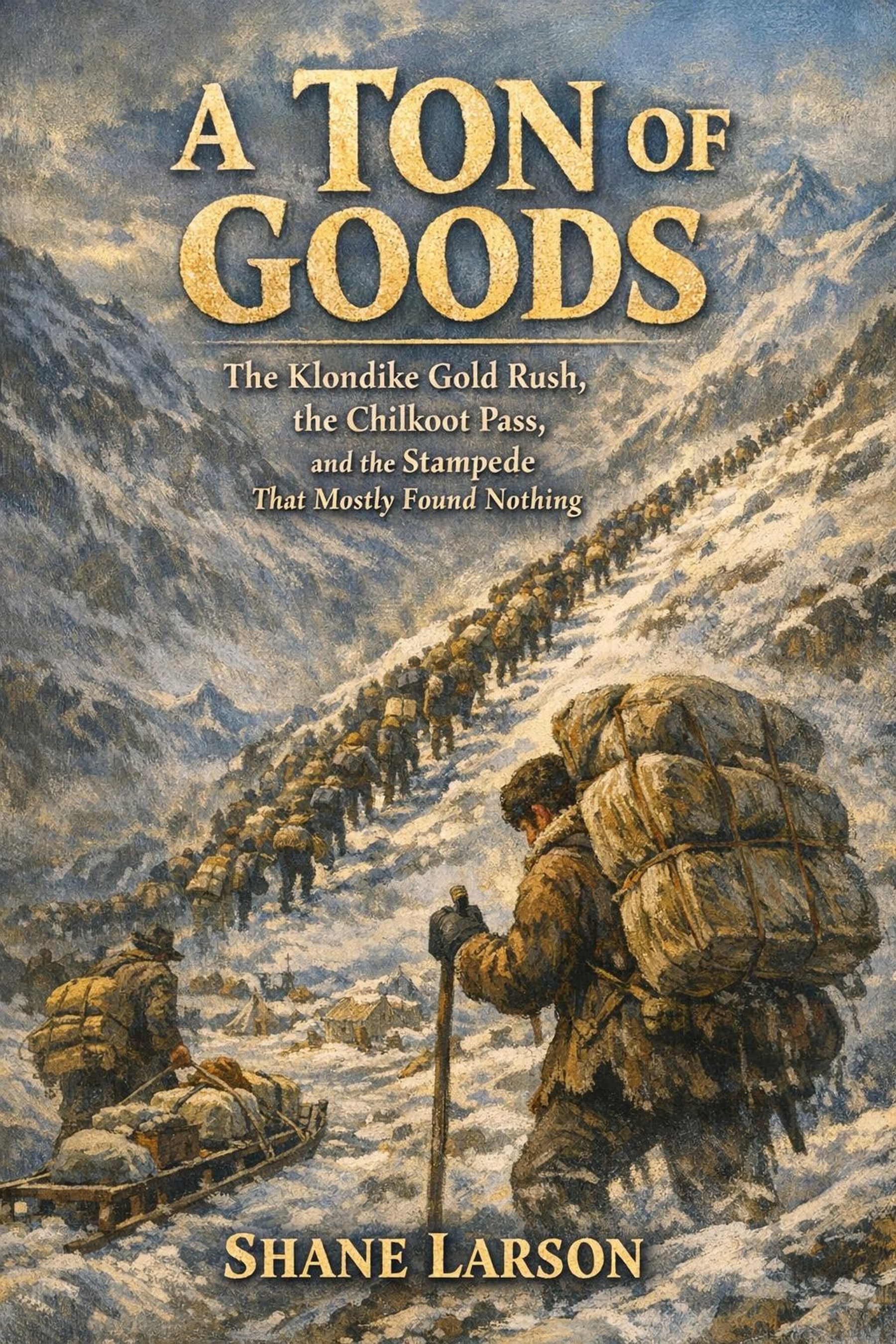
A ton is 2,000 pounds. On the Chilkoot, the last pitch to the summit was a slope of ice and boulders that no horse or mule could climb, so the ton went up on human backs. Fifty or sixty pounds a load. Thirty to forty trips. By the time a stampeder had moved his outfit from the beach at Dyea to the lakes on the far side, he had walked more than 2,000 miles and spent one to three months of his life doing it. The famous photograph of the line of men going up the Golden Stairs is not a picture of a journey. It is a picture of freight being moved by hand.
A Ton of Goods
The outfit itself cost about $500 at a Seattle outfitter's in 1897, and with passage, fees and the rest a stampeder was out something like $1,000 before he had turned a shovel. Those who could afford it paid the Tlingit packers, who had controlled the pass for generations and set their own price: fifteen to twenty cents a pound at the start of the rush, thirty to forty cents by the autumn, and more in reports from the worst of the winter. At forty cents a pound, a ton over the pass was $800, which is more than the outfit had cost. On the White Pass, the so-called easier route, stampeders bought horses at Skagway, overloaded them, and drove them up a trail of mud and rock until they died. About 3,000 did, in the autumn of 1897 alone.
Then the lakes, where the ice went out on 29 May 1898 and 7,124 homemade boats, numbered on the bow and registered by the police, set off down the Yukon. Then Dawson, where lumber sold at $140 a thousand feet, flour had reached a dollar a pound in the hungry winter before, and a man who gave up could sell his outfit back to a store at a fraction of its price and watch the store sell it to the next man off the boat.
Where the money actually went
Add it up from the other side of the counter and the Klondike looks like a different business.
The historian who first did the sums put the gold recovered from the Klondike in its three big years, 1897 through 1899, at about $30 million by the official figures, perhaps $30 to $40 million allowing for what went unreported. The money the stampeders spent getting there, outfitting, shipping, packing, paying duties, buying passage and boat lumber and meals, she put at $50 million to more than $60 million. The stampede, taken as a whole, cost more than it found. It was paid, in cash, to the people who sold things to a hundred thousand hopeful customers who had not yet found any gold and mostly never would.
Those people had names and addresses, and the addresses were mostly in Seattle. The city's Chamber of Commerce hired a publicist named Erastus Brainerd in the autumn of 1897, and his campaign made Seattle the outfitting port of the rush. The federal assay office that opened there in July 1898 made it the place the gold came out as well as the place the stampeders went in. Seattle had about 43,000 people in 1890 and over 80,000 in 1900. The city never saw a Klondike claim. It did not need one.
Below Seattle in the chain were the steamship lines, who sold passage north to anyone with the fare; the wharf owners at Skagway; the Tlingit packers, for two good seasons until a railway over the White Pass took the trade; the tramway companies on the Chilkoot; the pilots at the canyon; and in Dawson the sawmills, the saloons, the dance halls, the stores and the men who bought and sold fractions of claims to people who could not tell a good one from a bad one. Every one of them was paid in money the stampeders had brought from home.
None of this makes the stampeders fools. The United States in 1897 was four years into the worst depression it had known, with hundreds of banks failed and unemployment somewhere between twelve and eighteen percent. Gold was the one thing in the economy whose price could not fall. A man with no job, some strength in his back and a ton of gold in the morning paper was making a rational bet with the information he had. What he did not have was the timeline. The strike was eleven months old, the ground was gone, and the only certain money in the Klondike was the money he was about to spend.
A Ton of Goods: The Klondike Gold Rush, the Chilkoot Pass, and the Stampede That Mostly Found Nothing is a narrative history of the rush from the Yukon of the Tlingit traders to the summer of 1899, when word of gold on a beach at Nome emptied Dawson in a week. It follows the route the stampeders took, gives the weights, prices and distances the sources give, and keeps the Tagish family who found the gold and the Hän whose fishing camp became Dawson City at the center of the story rather than at its edge. Every scene names its witness, and every disputed figure is given as a range.
If you want the Skagway of 1898 as a novel, No Law Below the Pass is set there. For the American gold camps the Klondike is measured against, see Deadwood and The Montana Vigilantes.
A Ton of Goods
New posts and releases, straight to your inbox. No spam, unsubscribe anytime.