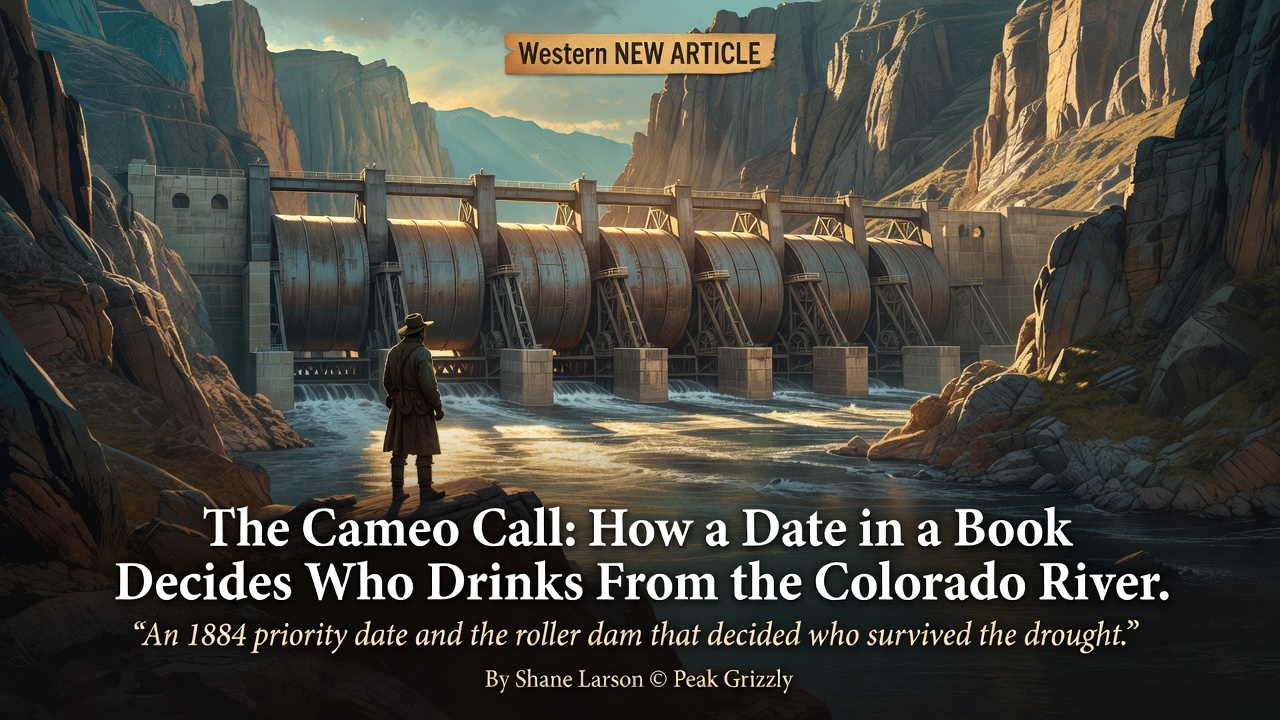
The Cameo Call: How a Date in a Book Decides Who Drinks From the Colorado River
August 20, 2026 · 7 min read
There is a place in western Colorado where the Colorado River is stopped by six steel drums lying across it, and what happens next is decided by a number written in a ledger in 1889.
The drums are roller gates — each one about seventy feet long and eleven feet through, wound up and down an inclined rack by a gear. They were the first of their kind in the United States when they went in, built in Pittsburgh to a German design and freighted out to De Beque Canyon in pieces. They form the Grand Valley Diversion Dam, which everybody in Mesa County has always called the roller dam, and which sits three miles above the town of Palisade at a place called Cameo.
Below the dam, the water that gets turned aside runs west along the foot of the Book Cliffs in the Government Highline Canal for fifty-five miles.
And which of the eleven thousand acres under that canal gets any of it, in a dry year, is not a question of need, or acreage, or crop value, or hardship, or who has children. It is a question of who filed first.
First in time, first in right
Colorado adopted the doctrine of prior appropriation in its 1876 constitution, and the state has never seriously wavered from it since. The rule is short enough to fit on a postcard:
The oldest claim takes all of what it is entitled to before the next-oldest gets a drop.
That is the whole of it. There is no proration, no sharing of shortage, no equity in it anywhere. A water right in Colorado carries a priority date — the date the water was first put to beneficial use — and in a year when the river cannot satisfy everybody, the rights are served strictly in order of that date until the water runs out. Everyone below the line gets nothing.
This is not a historical curiosity. It is the operating law of the state today.
The machinery: districts, commissioners, and the call
Colorado built the administrative apparatus early, and built it before almost anybody else. Two acts, in 1879 and 1881, created the working parts:
- The state was divided into water districts, each with a water commissioner whose job was to go out and physically make the priorities true on the ground — measuring ditches, setting headgates, and shutting off junior users.
- The district courts adjudicated the rights themselves, entering decrees that fixed each ditch's date and its amount in cubic feet per second.
- The Office of the State Engineer was established to keep the records. Colorado was the first state in the country with a dedicated water administration office, and the first anywhere to put public officials in charge of administering private water use.
The mechanism that brings it all to life is the call.
When a senior right stops receiving its full decreed amount, its owner "calls the river." The water commissioner goes out, measures, and — if the senior is genuinely short — begins shutting off junior rights, in order of date, working up the list until the senior is whole again.
A call is placed by telephone, or was, once telephones existed. It is one of the few things in American law where a private party can pick up an instrument, say a sentence, and cause a state officer to go and close a gate on a neighbor's farm that afternoon.
The Cameo call
On the Colorado River — which was still officially named the Grand River until 1921 — the most consequential call in the state is placed from this stretch of valley.
It is known as the Cameo call, after the old coal camp at the diversion dam. It is made up of the water rights of the agricultural diverters near Palisade, and when it comes on it demands roughly 2,200 cubic feet per second down through the river system, shutting off junior users far upstream in the mountains. It is the second-most senior call on the river. It typically comes on in July and stays on into October.
Its component rights include some that are very old indeed. The Grand Valley Irrigation Company's canal has been drawing water since 1884, dug by men with mules and fresno scrapers into a country that most reasonable people at the time thought was a rock pile.
The Ditch Rider
And here is the part that reorganizes everything you thought you knew about the American West.
The government canal is the junior
The Grand Valley Project — the roller dam, the tunnels, the fifty-five miles of Government Highline Canal, the whole enormous federal enterprise — was authorized under the 1902 Reclamation Act, funded in earnest in 1909, and built out between 1913 and 1917. The dam was finished in the spring of 1916. The first official delivery of water through the government canal reached farms on May 4, 1916. The full system of canals, tunnels, flumes, siphons and laterals was complete at the end of 1917.
Its water right carries a priority date of 1914.
Which makes it junior — junior to the 1884 canal on the valley floor, junior to the 1885 and 1886 ditches, junior to essentially every private ditch dug by the families who arrived in the 1880s.
So in a short year, the sequence runs like this. The old private ditches on the low ground call the river. The water commissioner measures, finds them short, and shuts off juniors in order of date. And the junior he shuts off is the United States government's canal — the one that waters the new orchards up on the benches, planted after 1916 by the newcomers whom the Reclamation Service's own promotional circulars had brought to the valley in the first place.
The federal government advertised the land, built the works, sold the water, and got in line behind a man with a scraper.
The dry year
The Colorado River basin has a well-documented run of drought in this period; tree-ring reconstructions of streamflow identify dry events in 1916, 1917 and 1918, corroborated in the written record.
1918 is the year that matters here, because it was the first full irrigation season after the project was completed — the first time the whole apparatus was under load, on land that had just been sold to people who had never heard the phrase "priority date."
And it collided with the peach harvest.
Palisade's peach industry was already national by then. The railroads had reached the valley in 1890, ice-cooled refrigerator cars made shipping possible, and the freestone Elberta was harvested in a three-week rush in August and railed to the Midwest. A grower's whole year rode on those three weeks.
Peaches take their final size in the last four to six weeks before picking, and they take it out of water. Which means a shut-off dated to mid-July does not kill the tree. It kills the crop, by leaving the fruit too small to ship — and a two-inch Elberta is a cull worth pennies, however beautifully it ripens. A shut-off that runs into August kills the trees themselves.
An order of service is therefore a dated financial instrument, and every farmer in the valley can read it.
The part nobody had looked at
There is one more feature of the system worth sitting with.
The decrees themselves — the actual court judgments fixing every ditch's date and amount — lived in a vault at the county courthouse, hundreds of pages of foolscap in a dead clerk's copperplate. Almost nobody ever opened them.
What ran the valley day to day was the commissioner's tabulation: his working abstract of the priorities, kept in his own office, compiled from the decrees by a clerk at some point nobody could quite fix, and never once compared against the original by anybody who did not work in that office.
The tabulation was almost certainly correct. That is not really the point.
The point is that the document deciding who ate in a dry year in western Colorado was a copy of a copy, held by the man who used it, and the people whose farms depended on it had never in their lives seen the thing it was a copy of — and would have been entitled to walk in and inspect it for fifteen cents a page any working day of the year.
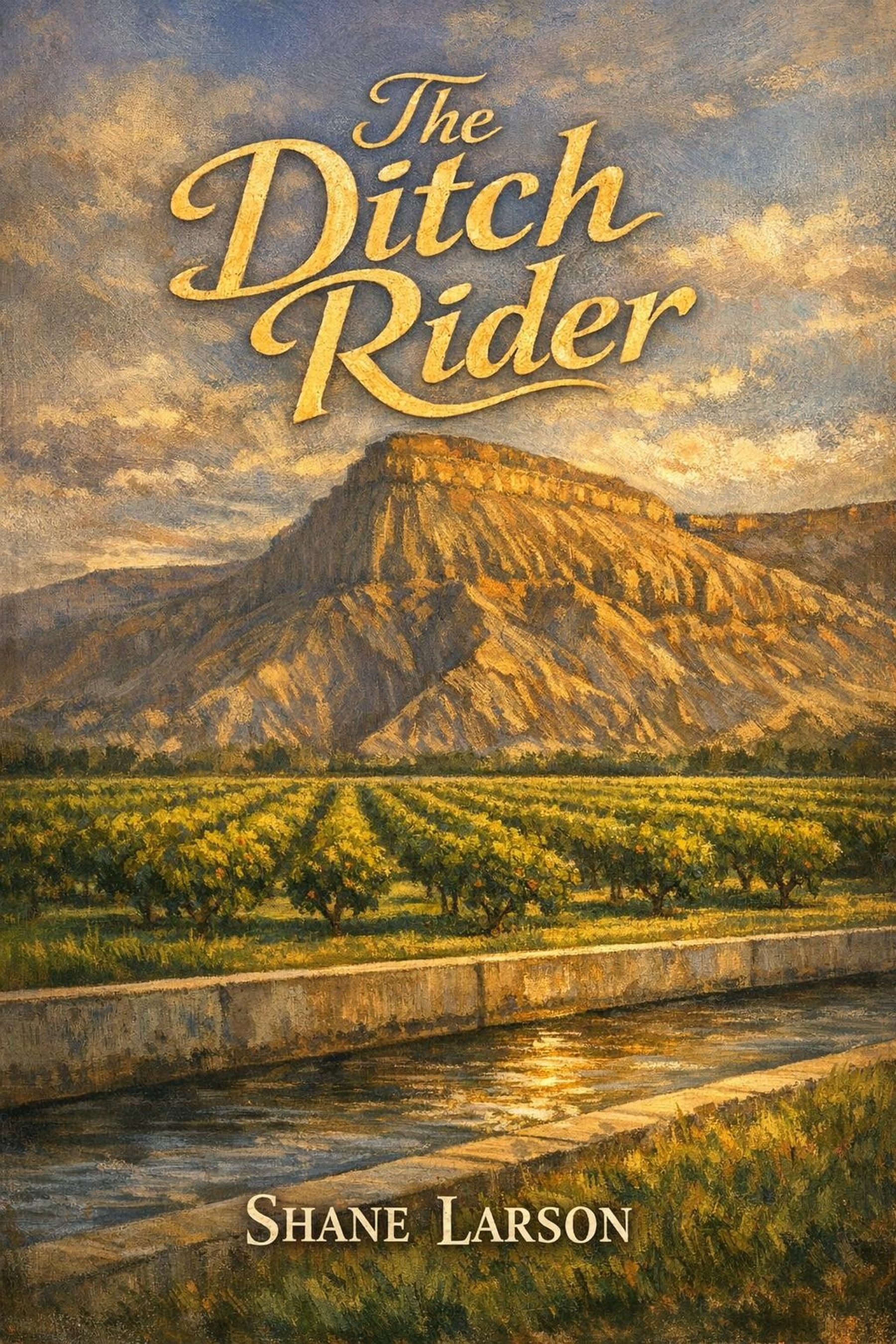
This history is the spine of my novel The Ditch Rider — set in the Grand Valley in 1918, in the first dry season after the government canal was finished, about a man who used to be the one who carried the shut-off list. The dam, the canal, the drought and the doctrine are real. The rest is invented, and the law needed no help from me.
The Ditch Rider
New posts and releases, straight to your inbox. No spam, unsubscribe anytime.