The Telegrapher's Fist: How 19th-Century Operators Knew Each Other Without Names
October 4, 2026 · 5 min read
Somewhere around 1860, without anyone deciding to build it, the American telegraph service acquired an identity system.
Nobody designed it. Nobody wrote it down as policy. It emerged because Morse code, sent by a human hand on a mechanical key, is impossible to send neutrally. Every operator put a personal signature into the rhythm — slightly long dashes, a habitual pause before numerals, dots crowded a fraction closer than regulation, a characteristic hitch when tired. Operators called it a man's fist, and within a few years of working the same circuit they could identify each other by it, instantly and without conscious effort, the way you recognize a friend's footsteps on a staircase before you see them.
It was not a party trick. It was load-bearing.
Why it mattered on a railroad
On a single-track railroad — which in the 1880s meant most of them — trains did not run on signals. They ran on train orders: written instructions issued by a dispatcher, transmitted by telegraph to station operators, copied out by hand, and handed to the crew.
Get one wrong and two trains occupy the same piece of track.
The system that grew up around this was obsessive about paper. Orders were copied in pencil onto flimsies with carbon sheets so several identical copies existed. The receiving operator repeated the entire order back over the wire, word for word, before the dispatcher would give it a completion time. A Form 19 order could be handed up to a moving train on a hooped stick, because it did not require the crew's signature. A Form 31 order — the restrictive kind — required the train to stop and the conductor and engineer to physically sign for it before it took effect. That distinction is the whole safety philosophy of the era in one detail: the more dangerous the instruction, the more human hands had to touch it.
But underneath all that paper sat an assumption nobody examined. The dispatcher knew the order reached the right office because the right office answered. The operator knew the order came from the dispatcher because it came in the dispatcher's hand.
The hole in the middle of it
Here is the thing about a nineteenth-century railroad telegraph circuit: it was usually a party line. Every office on a division hung on one wire. Every sounder in every depot clicked out every message sent by anybody, all night. There was no switching, no addressing, no way to send a message privately to one station.
What identified a sender, then, was two things: the office's short call sign — two letters, which anybody could tap — and the fist.
That is the entire authentication stack. A pair of letters that are not secret, and a rhythm.
For decades it held, because the fist was genuinely very hard to fake and there was little reason to try. Telegraphers regarded it as unforgeable in the way people once regarded handwriting: theoretically imitable, practically not worth attempting.
They were partly right. Imitating a fist convincingly is difficult. But the difficulty is not evenly distributed — and it fails in an interesting direction.
The failure mode nobody planned for
A skilled imitator's real problem is not producing another man's habits. It is producing his imperfections.
An operator's fist is largely made of things he does not know he does. The half-beat of gathering before a figure. The dash that runs long when he is cold. These are not decisions; they are the residue of thousands of hours. A man imitating that fist hears the habit as an error and smooths it out, because he is concentrating, and concentration produces clean sending.
Which means a forged fist tends to fail by being too good. Not wrong — flawless. Regular, even, habitless, without a self in it.
And here is the part with modern teeth: detecting that requires a listener who knows the specific man's specific imperfections well enough to notice an absence. Not a document. Not a recording — there were none. A particular person's memory of a particular sound, available for about a second and a half, and impossible to show anybody else.
If you have spent any time thinking about biometric authentication, deepfaked voices, or signature verification, you have met this problem already. It is the same shape: an identity system based on something unforgeable-in-practice, quietly broken by someone patient, where the only detector is a human expert whose evidence does not survive being written down.
What a man could do about it
Suppose you are that operator. You have heard the lie. What are your options?
Almost none, and this is what makes the period so much better as a setting than as a metaphor. You cannot telephone anyone — long-distance telephony did not meaningfully exist, and the wire is the only channel there is. Anything you transmit is heard by every office on the circuit, including whoever is doing this. Your own sending is as recognizable as your face, so you cannot even raise the alarm anonymously.
What you have left is the pre-telegraphic layer the railroad never abandoned, precisely because it does not depend on trusting anybody's word:
- The torpedo — a flat tin capsule of fulminate with soft lead straps, bent over the railhead. A passing wheel crushes it and it fires like a gunshot. Two of them a rail-length apart mean stop. It has no fuse and is never lit; it is a signal, not a bomb, and a great many novels get this wrong.
- The red lantern — set on the rail, or swung across the track. It means stop, absolutely, with no discussion and no appeal.
Neither can be intercepted. Neither can be countermanded from an office. Neither requires the crew to know or trust the man who left it. They are the only messages on the whole railroad that carry no signature at all — which, on a night when a signature has become the murder weapon, makes them the only honest things left.
Somebody has to walk out and put them there. That is not a metaphor either. That is just the job.
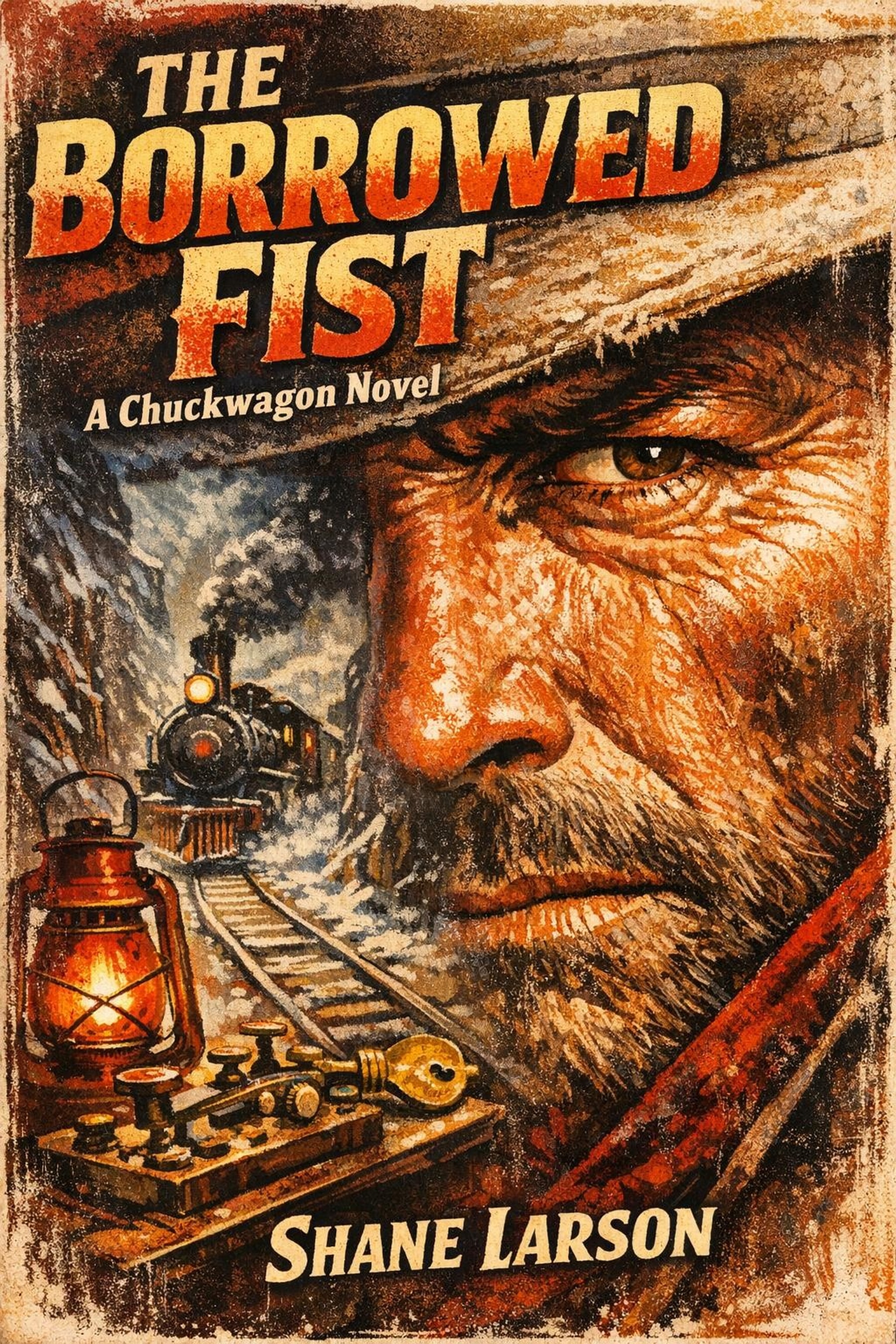
This is the world of my novel The Borrowed Fist — a night operator on the Denver & Rio Grande in January 1882 hears a train order that is correct in every particular, sent in a hand that is not the hand that signed it, and has no way on earth to prove it. It is the third Chuckwagon novel, and it is completely standalone.
New posts and releases, straight to your inbox. No spam, unsubscribe anytime.