The Man Who Never Bet: Faro, the Case Keeper, and the Honest Machine in a Crooked Room
October 7, 2026 · 6 min read
There was a man at the faro table who never wagered a cent.
He did not deal. He did not cut. He did not handle the money and he did not touch the cards. He sat at the end of the layout with a wooden frame in front of him, and as each card came out of the box he moved a bead along a wire. That was the whole of his job: to make it impossible for anybody in the room — including the house — to be confused about what had already happened.
He was the case keeper, and he is the most interesting job on the nineteenth-century frontier that almost nobody has heard of.
Faro, in about ninety seconds
Faro was the dominant banking game in the American West for most of the nineteenth century, far bigger than poker in its day. It was fast, it was easy to learn standing up, and a house could run it all night with two employees.
Here is the mechanism.
A single 52-card deck is shuffled and put into a dealing box, a spring-loaded brass or nickel case that lets cards out one at a time through a slot in the top. On the table is a layout: thirteen cards painted in two rows, ace through king. Players do not bet on a hand. They have no hand. They bet on a denomination — all four nines, say — by putting chips on the painted nine.
The first card out of the box is the soda. It is turned face up and it is dead. It pays nothing and takes nothing, and it sits on top of the box for the rest of the deal where everybody can see it.
After that the deal runs in turns, and a turn is two cards:
- The first card out is the loser. The bank takes all bets on that denomination.
- The second card out is the winner. The bank pays all bets on that denomination, even money.
Twenty-five turns to a deck. The last card is the hock — sometimes hocklebone — and like the soda it is dead.
Two refinements are worth knowing because they are where the money actually is.
Coppering. A player who thinks a denomination is going to lose puts a copper token — often just a penny — on top of his chips. That reverses the bet. Being able to bet either side of a card, on the same spot, with one coin, is an elegant piece of design and it is the sort of thing that survives a hundred and fifty years.
Splits. If both cards of a turn are the same denomination — a nine out first and a nine out second — the bank takes half of every bet on that denomination. This is the house edge. Not a rake, not a vigorish on a payout: a structural accident that happens a couple of times a deck and quietly pays for the building.
The edge was small, which is exactly why it had to be rigged
Faro's house advantage is famously thin. Worked honestly, with the split rule and even-money payouts, the edge over a full deal was small — a couple of percent at most, by most reckonings, and better for the player than roulette or almost anything on a modern casino floor.
That sounds like a story about a fair game. It is the opposite.
An honest edge that thin is a fine business if you are a corporation with a marble lobby and a thousand tables. It is a poor business if you are one man with a canvas roof, a bad winter coming, and a two-hundred-dollar bankroll that a single lucky miner can break in an hour.
So faro banks cheated, and the cheating was industrial. Gambling-supply houses in Chicago and New York sold gaffed dealing boxes out of printed catalogues, to anybody with the money, by mail. There were boxes with a hidden second slot that let the dealer take two cards as one. There were "sand-tell" boxes that worked with a deck whose cards had been roughened so the dealer could feel a pair coming and squeeze the spring. There were boxes with needles, levers and mirrors.
You could buy the reputation of an honest game and the mechanism of a dishonest one from the same page of the same catalogue. That is the real history of faro, and it is more interesting than the myth.
Which brings us back to the man with the beads
Given all that, look again at what the case keeper was for.
His frame — the casekeep — had thirteen rows, one per denomination, with four markers on each. As every card came out he moved one. At any moment, any player at that table could glance over and see exactly how many kings were left in the box, how many aces were gone, which denominations were dead.
Consider what that does.
It does not stop a gaffed box. Nothing at the table stops a gaffed box. What it does is remove every other kind of dispute. It makes it impossible for a dealer to misremember in his own favour, impossible for a drunk to insist the third nine never fell, impossible for a house to quietly re-describe a turn that went badly. It converts the one genuinely contestable thing in the room — what happened — into a public fact that forty men are looking at.
And crucially, the case keeper was usually paid by the house. This is the part I find genuinely moving. A saloon that wanted a busy table had a direct commercial interest in employing a man whose entire function was to make the house's own account of events checkable by strangers. Not out of virtue. Because players will not sit at a table where they can be told what they saw.
A case keeper was a house expense that existed to limit the house.
He is also, structurally, a very modern thing: an audit log. A public, append-only, real-time record maintained by a disinterested party, whose value is precisely that it is written down before anybody knows who it will hurt. We spend a great deal of money on that idea now. In 1882 it was a man on a stool with an abacus, and he worked for a few dollars a night.
The part that got me
Here is the thing that turned into a novel.
The case keeper's record was the most reliable account of events in the building — and it had no standing anywhere outside that room.
It was not sworn, it was not witnessed, it was kept on a frame of beads that was reset at the end of every deal, and no county clerk would ever have indexed it. Whatever a case keeper knew, he knew as a man who worked in a gambling house — and before a judge or a recorder, that was never going to count for much.
So you have this strange figure: a professional whose whole occupation is being reliable about facts, in a trade whose word is worth nothing the moment he steps outside. He can settle a two-hundred-dollar dispute in front of forty armed men with one sentence, and he cannot get a clerk to write down the date.
That gap — between a thing being true and a thing being admissible — is not a nineteenth-century problem, and it is not a card-game problem. It is most of what institutions are for, and most of what goes wrong with them.
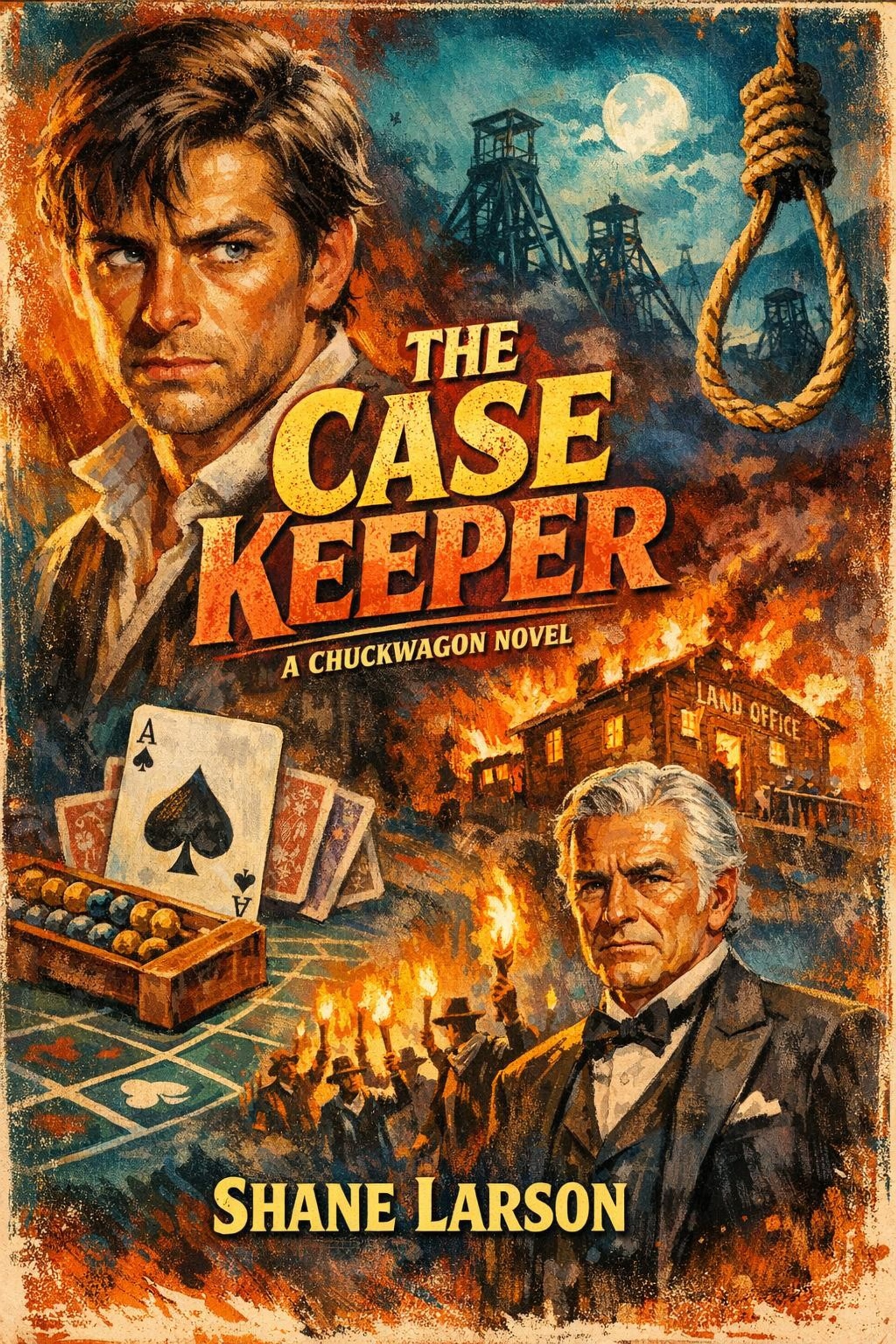
My new novel The Case Keeper is about a man in exactly that position: Ezra Tallow, eleven years at the rack in a Colorado silver camp, who hears a legally recorded deed read aloud in the street and realises it describes a card game that could not have happened. He can prove it. Nobody with any power is obliged to care. It is the hard end of the western — the camp is muddy and casually lethal and people die badly in it — and the only honest instrument in the whole book is a frame of beads on a wire.
New posts and releases, straight to your inbox. No spam, unsubscribe anytime.